Fortnite and One Piece could find themselves crossing over as early as November 2026 in a collaboration much broader than just a wave of cosmetics, but Epic Games has not confirmed anything yet. Files related to the manga were reportedly spotted in Rocket League, while several leakers mention a mini-season starting November 1st.
To separate clues from assumptions, let’s keep three reference points in mind:
- References to One Piece were reportedly discovered in a Rocket League update.
- The November 2026 window and the mini-season format remain information relayed by leakers.
- Characters, rewards, and map changes are not confirmed.
The lead is worth attention, as Fortnite has already hosted several major manga and anime licenses, whereas Luffy’s crew is still missing. Let’s examine what the leaks suggest, what they do not prove, and the elements to watch before taking the announced date as an official appointment.
Fortnite x One Piece: what the leaks really allow us to assert
As of September 24, 2026, no announcement from Epic Games confirms a collaboration between Fortnite and One Piece. The available information comes from community accounts and dataminers, i.e., people who examine files related to game updates. This method can reveal interesting clues, but an element spotted in data does not automatically mean it will be used, nor that it will arrive in the game mentioned by fans.
The rumor gained momentum after September publications. On September 13, dataminer SamLeakss reportedly announced a collaboration in November involving Fortnite and Rocket League. He also estimated it could be connected to a mini-season. On September 23, ShiinaBR in turn relayed the hypothesis of a season dedicated to One Piece and a possible launch 39 days later. This calculation leads to November 1st, but it is based on an assumed date, not on an Epic-published schedule.
To follow the story without confusing levels of information, we can classify the elements as follows:
- Reported clue: references to One Piece were reportedly found in a Rocket League update.
- Rumor relayed: several accounts associate the collaboration with November 2026.
- Plausible scenario, unconfirmed: Fortnite could offer a mini-season rather than a simple shop release.
- Free speculation: characters, items, map content, and rewards remain unknown.
This distinction helps to read the news without turning a hypothesis into an announcement. For example, if a player sees an illustration of Luffy circulating along with a date, they must check whether it comes from an official account or simply accompanies a leak message. The degree of detail in a publication does not guarantee its reliability; a very precise claim can remain unverified.
The rumor also has a favorable context: Epic’s games share an ecosystem, and cross-universe collaborations are part of Fortnite’s identity. This makes the idea of a partnership credible from a commercial and creative standpoint, without providing proof about its schedule. Previous thematic operations, such as those mentioned in the Fortnite and Pulp Fiction case, mostly demonstrate the variety of licenses likely to interest the game; they do not predict the content of the forthcoming operation.
The strongest reference therefore remains limited: One Piece is linked to presumed Rocket League files, then leak accounts suggested a November release. To understand why this first clue attracts so much attention, we must look at where it was reportedly discovered.
One Piece files spotted in Rocket League: a clue to interpret
The first recent element would not come directly from Fortnite, but from Rocket League, another game in Epic Games’ ecosystem. In September 2026, files associated with One Piece were reportedly spotted in an update. Among the mentioned references were Gol D. Roger and the Great Pirate Era, two elements closely tied to the pirates’ storyline in the manga. This origin explains both the interest in the discovery and its limits.
A name or phrase found in files can correspond to content in development, a test element, technical data, or an abandoned lead. Files do not always reveal how the content will be presented to the public. A reference to Gol D. Roger could suggest a shared theme around the golden age of piracy, without guaranteeing the appearance of the character, a decorated vehicle, or a particular game mode.
Why does this discovery in Rocket League fuel a rumor regarding Fortnite? Both games belong to the same group and have already formed spaces for collaborations related to popular licenses. A multi-game partnership is thus an understandable hypothesis: the same franchise could be highlighted in several titles, with items adapted to each game’s mechanics. In Rocket League, this could take the form of car elements; in Fortnite, skins or activities. At this stage, these are only examples of possible formats.
Caution remains necessary, as no communicated element shows that the presumed Rocket League files will transfer to the battle royale. Even if the content did concern One Piece, the schedule and participating games could evolve. Teams might also prepare elements that never launch, or organize a small-scale collaboration without a joint event. A technical clue is therefore not equivalent to a partnership announcement.
For players, a good habit is to ask three questions when a leak circulates: which game holds the files, which source identified them, and which part of the claim is directly supported by these data? In this case, the first point refers to Rocket League; the references to Gol D. Roger and the Great Pirate Era are the cited elements; the Fortnite mini-season relates to an interpretation relayed by leakers. This reading allows appreciating the clue without overstating it.
The mention of the Great Pirate Era gives a particular color to the rumor, since this period is central in One Piece’s imagination and could provide an immediately recognizable theme. It does not yet indicate whether Epic would aim for a simple skin pack or a broader shared universe. The schedule advanced by the leak accounts is thus the next point to examine, as it gives a concrete form to the scenario.
To place this hypothesis in the context of the game’s evolution, you can also check the information devoted to Fortnite Chapter 7: Override. This context helps to understand why players link the supposed end of one season to the possible arrival of a thematic event, without validating the rumor.
A One Piece mini-season on November 1st: schedule and uncertainties
The date appearing most often in discussions is November 1, 2026. It stems from the relay published by ShiinaBR on September 23, who mentioned a potential One Piece season in 39 days. The calculation indeed leads to early November. However, it is necessary to distinguish this deadline advanced by a leaker from a confirmed launch date in Fortnite’s official announcements.
The window seems consistent with the schedule mentioned by leaks around the game. Chapter 7 Season 4, entitled Override, should end on October 31, then a mini-season could occupy the period from November 1 to December 5, before the awaited arrival of Chapter 8 Season 1. This sequence outlines a plausible scenario: a short thematic period between two major game milestones. Its logic is not enough to establish that the program will actually be applied.
For a player planning their playtime, this difference is concrete. If the announced period was confirmed, they might want to reserve some evenings to discover challenges and progress in rewards. But it would be premature to spend V-Bucks anticipating a specific character or to modify their calendar according to November 1. Season dates can depend on production decisions and updates, and the rumor schedule can be adjusted.
The mini-season format is the most striking aspect of the information, as it would suggest a more sustained presence than a simple addition of outfits to the shop. A collaboration of this magnitude could, in theory, include a series of quests, a thematic space, or temporary rewards. These examples describe what the format might allow; no detailed leak currently confirms the presence of these features for One Piece.
A table clearly distinguishes the advanced dates and their status:
| Reference | What is mentioned | Status as of September 24, 2026 |
|---|---|---|
| September 13 | SamLeakss mentions a November crossover between the concerned games. | Leaker information, unconfirmed. |
| September 23 | ShiinaBR relays a potential season and a 39-day delay. | Calendar hypothesis. |
| November 1 | Possible launch date of the mini-season. | Speculative window, not a guaranteed date. |
| December 5 | Possible end of the special period before the next chapter. | Projection linked to the assumed schedule. |
This timeline also invites checking announcements near the season change, rather than treating a rumor published weeks in advance as a certainty. Official pages, patch notes, and in-game communications are the sources that can confirm a date and specify the content. Previous Fortnite events, like the Zero Hour event, show how official programming provides details different from a mere community projection.
If the mini-season exists, its presumed duration — about five weeks from November 1 to December 5 — would leave a limited time to explore its novelties. For now, players can mainly watch for announcements and keep in mind that these reference points are built from concordant leaks, not a validated calendar.
Luffy, Zoro, and possible mechanics: what fans imagine
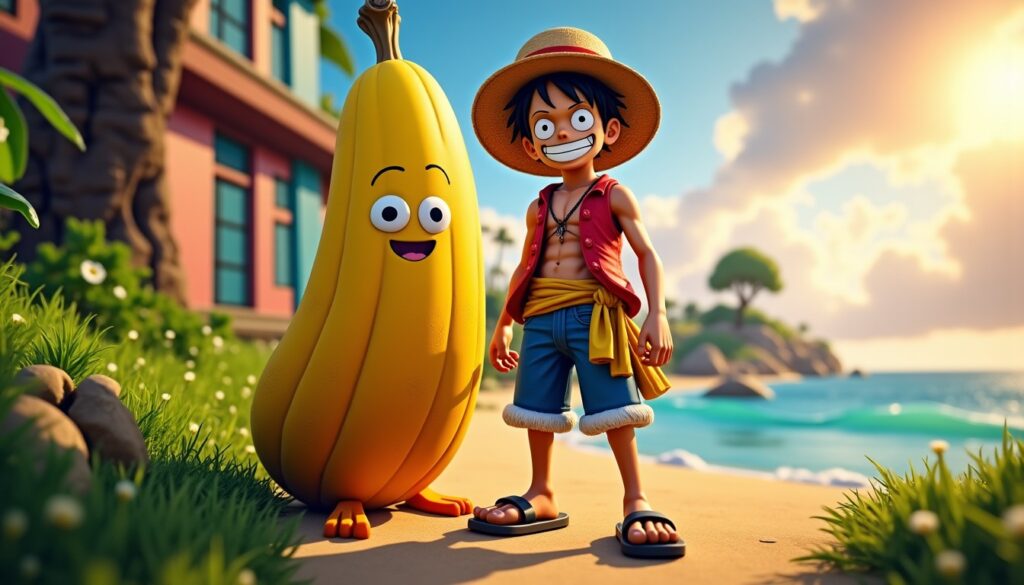
Luffy, Zoro, Sanji, and Nami are the characters many players spontaneously cite when imagining One Piece in Fortnite. Their notoriety makes them obvious choices for a collaboration, but this does not constitute a leak. No playable character, outfit, or emote has been confirmed by Epic as of September 24, 2026. It is therefore necessary to distinguish community expectations from actually announced content.
Ideas are not lacking. An emote inspired by Luffy’s elasticity, a combat pose from Zoro, or an animation linked to Sanji’s style would be easy for fans to imagine. The difficulty lies in translating very specific powers into a game where characters must remain readable and compatible with combat. A spectacular animation should not blur aiming, hide an opponent, or create an unfair advantage; fidelity to the anime must align with battle royale rules.
The same balance would apply to weapons. Zoro’s swords could inspire a harvesting tool rather than a combat-usable weapon, while powers associated with devil fruits could, in a hypothetical scenario, take the form of limited-duration items. These are not disclosed information: they are examples of possible design choices. Fortnite frequently adapts licenses to its systems, and the final result would depend on gameplay constraints as much as on the original work.
A mini-season could also offer narrative activities or challenges related to the maritime adventure. One could imagine progression stages, areas to explore, or crew objectives; none of these leads is confirmed. To illustrate how players might approach such a release, let’s take the fictional case of Léa, who plays a few hours a week and also follows the anime. She would first look for a Luffy outfit, then test quests to see if the map tells something from the pirate universe. Without content announcements, her course remains an example of what the community could expect, not the description of an official program.
Cosplay could also accompany the release outside the game. Fans might recreate the crew’s outfits for events or share versions adapted to Fortnite’s visual codes. Again, the link between these practices and a potential collaboration is speculative: the popularity of the characters makes this kind of reaction conceivable, but does not prove that Epic is preparing a specific operation around cosplay.
The presumed mention of Gol D. Roger finally reminds us that the crossover could, if it materializes, draw on a broader part of One Piece’s mythology than just the crew’s heroes. This could nourish a piracy atmosphere without each major character necessarily being sold or playable. Fans can enjoy these scenarios while keeping a simple rule: as long as visuals and details come from unofficial sources, no skin list deserves to be presented as definitive.
Why a Fortnite and One Piece collaboration attracts so much attention
One Piece is among the major Japanese animation franchises still absent from Fortnite, whereas the game has already welcomed characters from Dragon Ball, Naruto, My Hero Academia, and Attack on Titan. This presence of other licenses makes the question natural for players: why hasn’t the Straw Hat crew landed on the island yet? The comparison fuels expectation but does not constitute proof that a deal is signed.
For Epic, a collaboration of this type could bring together overlapping but not identical audiences: battle royale players, manga readers, and anime watchers. The potential interest would therefore not be limited to skins. A special event could, if the teams decided, tell a short story, offer challenges accessible to newcomers, and provide long-time fans some references to the work. These are commercial and creative possibilities, not announced elements.
The challenge is to respect One Piece’s identity while staying within Fortnite’s often eclectic tone. Eiichiro Oda’s series shifts from comedy to adventure, then to dramatic stakes; the game gathers characters from very different franchises in the same space. A successful adaptation should preserve recognizable signs — silhouettes, accessories, gestures — while producing objects understandable during a match. It is this meeting between fidelity and playability that could give the crossover its personality.
Players’ reactions would also depend on how the content is distributed. Outfits offered only in the shop would provide direct access, while a pass or temporary quests would organize progression differently. Without official information, we cannot determine the chosen model, nor the eventual price of cosmetics. Previous game operations show that formats vary by license and period, as recalled by the coverage of Fortnite’s winter event.
The community also plays a role in rumor circulation. File captures, leaker messages, and fan montages can be picked up chainwise, sometimes without the initial context. A formulation like “probably linked to a mini-season” can become, over the retakes, “mini-season confirmed.” To avoid this drift, we can go back to the original publication and note precisely what is asserted, what is interpreted, and what has been added by relays.
As November approaches, the most useful signals will be an announcement from Epic, an in-game communication, or official notes mentioning the franchise. The presumed references in Rocket League and the advanced dates give a lead to follow, but they reveal neither the chosen characters nor the definitive format. For now, the One Piece ship remains a widely discussed possibility on Fortnite’s horizon, and upcoming information will need to specify whether this rumor turns into a real event.