
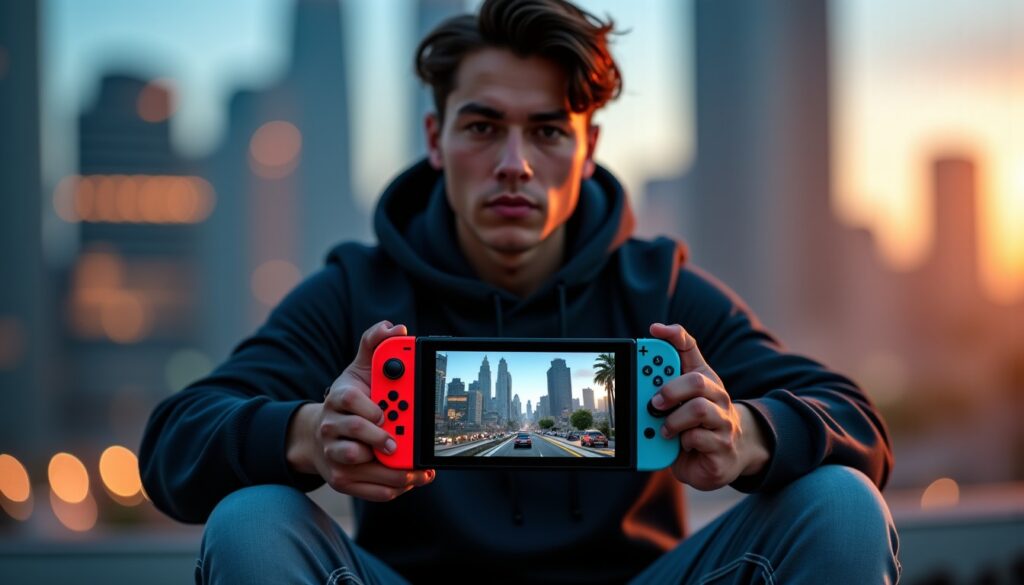
Yes, a port of GTA 6 on Nintendo Switch 2 remains technically feasible, but it is neither announced nor guaranteed. As of September 25, 2026, Rockstar Games and Take-Two confirm the game only on PlayStation 5 and Xbox Series X|S, with a release scheduled for November 19. The analysis by Jérémy Hartvick, former Rockstar developer, mainly highlights the difficulty of a native adaptation and the profitability questions it would raise.
His intervention, given on September 24 during an interview with Kiwi Talkz, does not reveal an internal project. It rather helps distinguish technical possibilities from business decisions. To follow the case without confusing rumor and announcement, we can keep three markers in mind:
- Native version: theoretically possible, but likely to require deep optimization and compromises on graphical performance.
- Streaming: a technological option mentioned, without a confirmed cloud edition for the Nintendo console.
- Official status: no release on Switch 2 has been announced by Rockstar Games or Take-Two.
The question is therefore not only whether the game can run on the machine. It is also necessary to determine at what technical cost, with what quality of experience and for which audience. This is where the real feasibility of a port lies.
GTA 6 on Switch 2: what is officially confirmed
To respond accurately, we must separate verified announcements from information circulating online. As of September 25, 2026, Rockstar Games and Take-Two announced GTA 6 on PlayStation 5 and Xbox Series X|S, with a release set for November 19, 2026. The Nintendo Switch 2 is not on this list, and no launch date has been communicated for it.
This official scope does not allow us to assert that the game will never be released elsewhere. It only indicates that the platforms announced for the planned release are those of Sony and Microsoft. Conversely, presenting a Switch 2 version as acquired would go beyond the available information. For players, this distinction is concrete: buying a console in anticipation of an unconfirmed edition amounts to making a decision based on a rumor.
A statement from a former developer, not a studio announcement
On September 24, Jérémy Hartvick, who worked on GTA 6 until 2020, discussed the question in an interview with YouTuber Kiwi Talkz. His opinion is cautious: he believes that a native version would require significant adjustments and questions the economic interest of mobilizing resources for an edition that could be technically inferior to the announced versions.
His experience provides context to his analysis but does not make him a spokesperson for Rockstar. He confirms neither ongoing work, nor schedule, nor decision made by the company. We must therefore read his statements as an assessment of possible obstacles, not as a leak from an official roadmap.
This marker also helps avoid a frequent confusion: a person who has worked on a game can provide useful insight without knowing the studio’s current choices. Teams, priorities, and production plans evolve. Hartvick’s intervention feeds the debate on technical compatibility but does not change the game’s status.
Take-Two’s precedent must also be put in context. In February 2025, Strauss Zelnick indicated that his company wanted to support Switch 2. This statement concerned the publisher and the console in general; it did not designate GTA 6. Editorial support can take the form of other games, adapted productions, or partnerships, without automatically involving Rockstar’s flagship license.
To understand the news about the announced release date, we can consult this article devoted to the delay of GTA 6 to 2026. It replaces the game’s schedule in its public evolution, without providing confirmation on an additional platform. At this stage, the only announced schedule for GTA 6 concerns the PlayStation and Xbox consoles.
A native port of GTA 6 would require a deep adaptation
A native adaptation means that the Nintendo Switch 2 would run the game directly, without a remote server producing the images. This is the scenario that gives the player the most freedom: the session can run without a constant connection, and controls respond according to the machine’s local capabilities. In return, the hardware must handle calculations, visual effects, AI of characters, and display of the vast urban environment.
Jérémy Hartvick does not describe this work as absolutely impossible. His analysis rather highlights the extent of the necessary adjustments. For an open-world game, reducing some graphical options is not necessarily enough: it is necessary to verify that systems work together, that loading times remain acceptable, and that the city retains coherent activity when the player quickly moves from one district to another.
Why technical compatibility is not just about reducing resolution
A first approach is to adjust the resolution or the density of certain effects. This type of setting can lighten the rendering, but it does not meet all constraints. If a scene contains many vehicles, characters, and light sources, the computing load can remain high even with a less detailed image. Difficulty also depends on stability: a temporary drop in fluidity in a quiet scene does not have the same effect as repeated drops during a chase.
Graphic performance is therefore only one part of a larger whole. Teams should also examine available memory, world data management, transitions between zones, and power consumption in portable mode. These are general evaluation areas for an ambitious adaptation; they do not reveal the exact characteristics of a Switch 2 version, since no version has been officialized.
Let’s imagine Léa, who often plays on the go and switches from mission to free exploration. She not only judges the image on a screenshot: she also notices loading times, scene readability, and control stability. A visually convincing version but irregular during action moments might seem less enjoyable to her than a more modest but stable adaptation. Optimization must therefore aim for a complete experience, not just a showcase result.
Compromises may also affect draw distance, scenery details, or the amount of elements visible simultaneously. Each of these decisions carries an artistic cost: a less dense city seems less lively, while a reduction of effects can change the intended atmosphere. The work consists of preserving the game’s identity by balancing rendering, fluidity, and autonomy, especially if portable use is considered.
This adaptation would finally require phases of testing and correction over a wide variety of situations. A port that works in a quiet street must still be tested in fast driving, busy scenes, and when switching between indoors and outdoors. Native feasibility would therefore depend on a balance between stability, visual quality, and fidelity to the experience of the announced consoles.
Graphical performance and optimization: possible compromises
In a production of this scale, optimization does not mean randomly removing elements. It requires identifying the systems consuming the most resources, then reducing their cost without degrading gameplay sensations. For GTA 6, the information provided does not detail the internal operation of the engine nor the settings planned for Switch 2. However, we can explain the types of decisions a studio should examine before launching a port.
The first decision concerns resolution and frame rate. A lower resolution can lighten graphical work, while a stable frame rate generally makes movements and driving easier to read. A team can choose to prioritize regularity over a finer image, but this choice must be tested in the most demanding scenes, not only in controlled sequences.
Preserving a credible city without promising an identical image
The second axis concerns visual density. An open city seems credible thanks to the combination of many details: traffic, pedestrians, lighting, signs, buildings, and environment animation. Reducing all these elements uniformly risks making the streets look artificial. More selective optimization can preserve details close to the player while simplifying those far away, provided transitions remain discreet.
Light effects and shadows can also be adjusted. In a night scene, they strongly contribute to atmosphere, but their processing can tax the hardware. The challenge is to keep contrasts that help read the scene, especially while driving, while limiting costly calculations. For players, the difference between a well-integrated reduction and a visible degradation often shows in motion, when the scenery changes quickly.
We can take the example of a dense traffic sequence. If the number of vehicles is reduced, the console can gain fluidity, but the city risks seeming less lively. If vehicles remain numerous, the team could simplify some details or adjust the distance at which they are simulated. These are design choices as much as technical settings: they change how the world reacts to the player.
Portable mode adds another dimension. A session played on an integrated screen is not identical to a session on a TV: display size, text readability, and play time between charges affect comfort. An adaptation designed for the console could adjust the interface or contrasts while ensuring controls do not become more complex. These changes are not announcements concerning GTA 6, but usual considerations for a game designed or adapted for a hybrid machine.
Compromises should be judged on the whole experience: fluidity, loading, sound quality, control comfort, and city coherence. A drop in detail may be acceptable if the game retains its rhythm and identity; persistent instability would directly affect driving and combat. The best optimization would not seek to copy every effect but to preserve what makes situations readable and lively.
GTA 6 streaming on Switch 2: a possibility, not an announcement
Streaming changes the distribution of work. Instead of the console calculating the whole scene, remote servers run the game and transmit a video to the screen. The Switch 2 then receives player commands and sends back the displayed stream. This approach could circumvent some hardware limits of a native adaptation, but it does not constitute an announced version of GTA 6.
Hartvick was less categorical about this possibility. His statement indicates that remote streaming can be considered technically; it does not mean Rockstar has started developing a cloud edition. No streaming offer dedicated to Switch 2 has been confirmed by Rockstar Games, Take-Two, or Nintendo.
Connection, latency, and server availability
To play under good conditions, streaming must rely on a sufficiently stable connection. The perceived quality depends on transmission speed, network consistency, and distance between the player and the server. In a game where driving and quick reactions are important, a noticeable delay between command and effect can impair comfort, even if the image looks detailed.
A simple example helps understand the issue: a person plays at home with a stable connection, then resumes the game on a train or in an area where the network varies. A cloud solution may offer a quality image in the first situation and become difficult to use in the second. Conversely, a native edition would work without permanently depending on a remote server, subject to any online services associated with the game.
Streaming also transfers part of the costs and responsibilities. Infrastructure, server capacity, and game distribution in relevant territories must be ensured. The business model must still be determined: access included in a subscription, game purchase only, or specific formula. None of these parameters have been announced for a possible Switch 2 version of GTA 6; mentioning them serves to measure necessary conditions, not to describe an existing plan.
Another distinction deserves to be clear: the ability to run a game on a phone or stream it remotely does not prove that a mobile or cloud version is in development. Hartvick indicated that the technology enabling GTA 6 to run on a phone already exists. This remark concerns technical feasibility, not the existence of a commercial product ready to launch.
For players, streaming could be attractive if it allowed access to the game without sacrificing so many visual details. It would remain dependent on conditions that the native version partially avoids: network access, latency, and service availability. This option broadens the possible scenarios but does not turn an engineering possibility into a confirmed console release.
Porting rumors and commercial interest for Rockstar Games
Discussions about a port on Nintendo Switch 2 rely on several elements not publicly verified. Some publications mentioned an adaptation in preparation or technical tests, while a listing attributed to French distributor Cdiscount allegedly mentioned a Switch 2 edition and different versions of the game. To date, none of these clues have been confirmed by Rockstar, Take-Two, or Nintendo.
A product listing can result from an error, a commercial anticipation, or information transmitted then modified. Similarly, a test on a platform would not prove that a game is in production. Studios may evaluate hardware to understand difficulties and costs, then decide not to proceed. It is therefore necessary to distinguish an online spotted document, a possible prototype, and a release announcement.
The opportunity cost of an additional edition
A port requires specialists, testing time, and resources dedicated to adapting the game after its initial development. Rockstar should compare these expenses to the possible sales numbers, player expectations, and the risk of offering an edition perceived as inferior. The question raised by Hartvick is therefore also economic: even if technology allows it, the studio must judge whether the result and potential audience justify the effort.
A later release could allow more time to study optimizations, but the delay does not guarantee profitability. The studio should also consider its teams’ schedule, maintaining already marketed versions, and demand on concerned platforms. We do not have official figures on the cost of adapting GTA 6 to the Switch 2; advancing a budget or specific sales goal would amount to inventing data.
To put the choice of a platform into perspective, we can consult this file on the video game console market. It recalls that machines differ by their uses and audiences but does not constitute proof of an agreement between Nintendo and Take-Two. Likewise, an article on blockbusters available on PS5 helps situate expectations related to home consoles, without prejudging Rockstar’s plans.
The Nintendo audience can represent an opportunity for a publisher, and Strauss Zelnick’s general statement on supporting Switch 2 legitimately keeps questions alive. But supporting a console does not imply porting every major production on it. The decision may depend on the game type, its complexity, and the necessary resources, as much as the estimated commercial interest.
Rumors may therefore persist without contradicting the absence of announcement: they describe hypotheses, while the official status remains unchanged. As of September 25, 2026, GTA 6 is announced on PS5 and Xbox Series X|S, not on Switch 2, PC, PS4, or Xbox One. A Nintendo version remains a possibility to consider, not a promise that players can take for granted.