
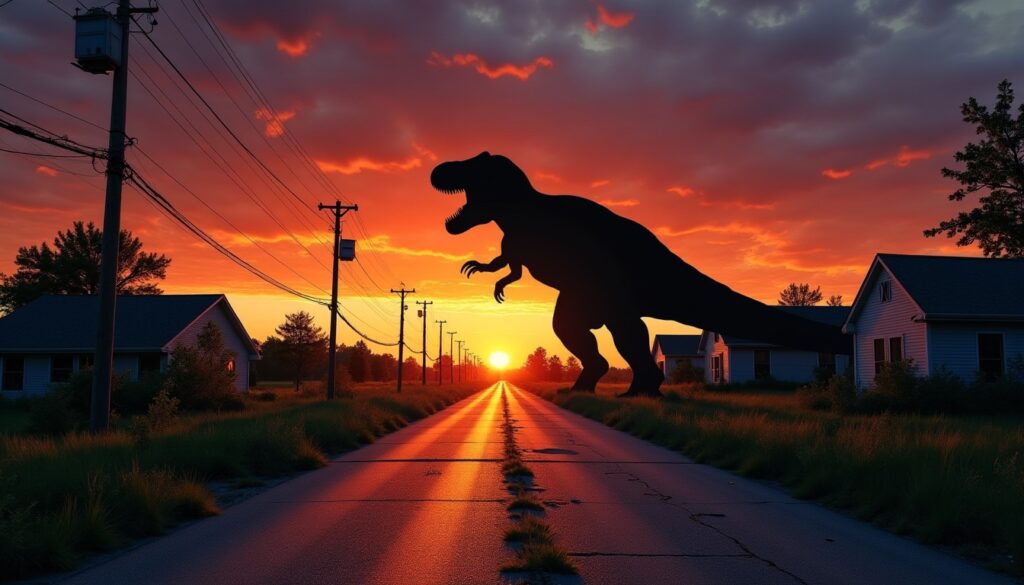
Yes, The End of Oak Street can position itself as a challenger to Jurassic Park, provided we understand this rivalry as a comparison of imagination and suspense, not as an official title. Directed by David Robert Mitchell and starring Anne Hathaway and Ewan McGregor, the film combines dinosaurs, survival, and science fiction in an American suburban setting.
Its American digital release gave it a second boost: the feature film reached the number one spot on the Apple TV Store after its arrival on video on demand on September 15, 2026. This result reflects success in digital purchases or rentals, not box office dominance in theaters. To position the film without confusing the indicators, we can note three points:
- A distinctive concept: prehistoric creatures at the heart of a residential neighborhood.
- A claimed lineage: the connection with Jurassic Park stems from a critical appreciation, not an award.
- A measurable performance: the top spot concerns precise American digital rankings.
The question is therefore less about whether the film replaces Steven Spielberg’s classic and more about understanding what it borrows, what it transforms, and why its home release sparked curiosity. Its blend of fantasy cinema, disaster film, and adventure allows the comparison to be examined from several angles.
The End of Oak Street versus Jurassic Park: a rivalry of concept rather than an official duel
Comparing The End of Oak Street to Jurassic Park means bringing together two films that place dinosaurs at the center of the spectacle but do not necessarily approach their presence in the same way. Jurassic Park has long associated the creatures with wonder, scientific discovery, and the danger of a human project gone out of control. David Robert Mitchell’s film, on the other hand, fits within a vein of survival and prehistoric horror, with a residential setting that shifts the anxiety toward the everyday.
This difference in setting changes the scale of the story. A park designed for visitors suggests monumental spaces, infrastructure, and spectacular technology. A street lined with houses, with its gardens and ordinary fixtures, promises a more intimate confrontation: the inhabitants are not visitors seeking thrills but people whose familiar environment suddenly becomes threatening.
Why the comparison with Jurassic Park comes up so often
The phrase “best dinosaur movie since Jurassic Park,” used by several publications, immediately gives the audience a reference point. It indicates an ambition and a genre kinship, but it remains a critical judgment, not a distinction awarded by any institution. It is more accurate to read it as a signal about expectations raised by the film rather than a definitive verdict on its quality.
The parallel also rests on the role of the creatures in the suspense. A dinosaur does not only produce a visual effect: its presence modifies the gestures of the characters, their relationship to space, and the choices they must make. A familiar street thus becomes an unpredictable terrain, where a fence or a car no longer guarantees safety. The audience acknowledges the pleasure of seeing these animals onscreen while discovering a setting that is not that of a park or an isolated island.
For a viewer familiar with Spielberg’s saga, the challenge is clear: the novelty cannot rest solely on the size of the jaws or the amount of digital effects. It must come from the direction, the pacing, and the way the ordinary setting is transformed. This shift to the suburbs gives the film its most easily identifiable argument.
Can a challenger avoid living in the shadow of its model?
A cinematic rivalry is not reduced to naming a winner. Works that mark a genre become almost automatic points of comparison, and this visibility can both help a new title and trap it within impossible expectations. The End of Oak Street benefits from the immediate recognition of the word “dinosaurs,” but it must also convince that its approach has its own personality.
We can therefore distinguish tribute, influence, and mere resemblance. The film is linked to the legacy of Jurassic Park, and its concept shares with it a fascination for prehistoric animals. This does not mean it necessarily reproduces the same characters, the same stakes, or the same cinematic experience. Its potential interest lies precisely in the gap between a famous reference and a new setting.
To measure its ambition, it is better to ask a concrete question: what becomes of the suspense when the threat arises in the middle of a neighborhood where one could live? The answer is not found in an imaginary ranking but in the way the film structures this closeness. This is where its starting idea most clearly distinguishes itself from the model to which it is compared.
Dinosaurs in a suburb: the strength of The End of Oak Street’s setting
The most striking principle of The End of Oak Street lies in the contrast between a quiet residential neighborhood and the arrival of prehistoric creatures. A swing, a above-ground pool, or an ice cream truck belong to a familiar landscape, generally associated with vacations and childhood. Placing them opposite animals capable of upsetting this balance transforms mundane objects into markers of danger or refuge.
This choice gives the film a promise different from that of an adventure set in a remote reserve. In a wild environment, the audience expects the characters to be vulnerable. In a suburban street, the initial impression is the opposite: houses, doors, and cars seem to provide protection. When this security becomes uncertain, the viewer can project themselves more directly into the situation.
Turning the familiar into the threatening
Fantasy cinema often relies on a shift: an ordinary detail changes meaning as soon as an unknown force manifests itself there. Here, the suburban setting provides the story with a stock of immediately readable signs. A deserted street may seem peaceful at noon, then unsettling at dusk; a fence can draw a reassuring boundary before becoming a negligible obstacle.
One can imagine the logic of a scene from these elements without presuming its exact course. A family notices movement behind a row of houses; lit windows signal neighbors but also places to hide. The danger is not only the creature: it is the necessity to choose a route, to protect others, and to decide whether to stay together or to scatter.
This kind of device works because it transforms geography into dramatic stakes. In a disaster film, the setting participates in the crisis: blocked roads, weakened buildings, or cut communications influence the possibilities for action. A neighborhood, with its alleys, gardens, and passages between houses, can offer a survival map more readable than a vast landscape. The tension then arises as much from short distances as from distant horizons.
The neighborhood as a survival engine
The setting also allows exploration of social ties. In an extreme situation, residents may know each other, distrust one another, or have to cooperate with neighbors they barely greeted. A street is a collective space: one person’s reaction can help the whole group, while an impulsive decision can expose several households.
This dimension makes the concept accessible beyond dinosaur enthusiasts. Viewers can wonder what they would do with a locked door, a phone without signal, or a family to shelter. Fiction can thus transform familiar gestures — closing shutters, searching for keys, reaching a neighboring house — into decisions heavy with consequences. The spectacle gains intensity when the stakes remain human.
The setting does not replace action; it gives it a recognizable shape. A chase in a residential street does not have the same texture as a flight through a jungle because the characters move through a world organized by human habits. If the film fully exploits this opposition, its suburb becomes more than an original backdrop: it becomes the main suspense machine.
After this setting choice, the other determining element is tone: the director and actors must coexist the threat, science fiction, and credible reactions from ordinary characters.
David Robert Mitchell, Anne Hathaway, and Ewan McGregor: a tone between horror and adventure
David Robert Mitchell’s presence gives The End of Oak Street an identity that goes beyond the simple argument of dinosaurs in the suburbs. Known for It Follows, the director is associated with an approach where threat and anticipation can count as much as direct confrontation. In this new register, the challenge is to coexist a spectacular prehistoric threat with a more diffuse tension, rooted in the characters’ reactions.
The film brings together Anne Hathaway and Ewan McGregor in the lead roles. This duo brings strong visibility to a project that mixes science fiction thriller, survival, and prehistoric horror. Their presence can also shape expectations: the audience does not come only to observe digital creatures; it expects characters capable of bearing dilemmas and emotions at the heart of chaos.
From visible danger to suspense
A dinosaur movie has an obvious asset: the creature can occupy the screen and elicit an immediate reaction. But lasting suspense does not rely solely on the appearance of an animal. It depends on what characters know, what they ignore, and how much time they have left to act. This management of information allows fear to build even before a threat is fully visible.
The direction can then play on simple elements: a noise approaching, a light going out in a neighboring house, or an abnormal silence in the middle of a street. These are familiar horror CGI techniques, but they take on a particular color when the danger is associated with extinct animals. Science fiction provides the framework of the impossible; horror transforms this impossible into immediate experience.
The tone must also consider the scale of the story. Characters faced with immense peril can provoke emotion through modest reactions: hesitating before abandoning shelter, trying to contact a loved one, or taking time to check if a neighbor managed to escape. These gestures prevent the spectacle from becoming just a succession of attacks. They give the audience anchor points, even when the represented world defies all normalcy.
Why the actor duo matters in a disaster movie
Anne Hathaway and Ewan McGregor are recognizable performers, and their association gives the project a human center. In a genre production, stars are not only a promotional argument: they can help make emotional shifts credible, from calm to panic, then from fear to decision-making. The viewer then follows the disaster’s consequences through faces, relationships, and choices.
A concrete example of this function appears in the usual structure of a survival story: one character thinks it necessary to stay in shelter, another considers it safer to move to an adjacent street. Even without knowing every detail of the plot here, we can see why a central duo matters. The confrontation of two temperaments makes the risks explicit and decisions understandable, rather than advancing the story through arbitrary reactions.
The film is also presented in France under the title La Fin d’Oak Street, with a theatrical release announced for August 12, 2026, two days before its American release on August 14. Its promotion evokes a connection between E.T. and Jurassic Park, situating the imagination between wonder and peril. This reference serves as a tone indicator but is not enough to define the work: Mitchell’s personality and the residential setting must ensure the difference.
This alliance of suspense, acting, and spectacle gives the film a unique path. It remains to be seen how interest in this proposition has translated into numbers, carefully distinguishing theaters from digital platforms.
The digital release of The End of Oak Street: what the number one spot means
After its U.S. theatrical release on August 14, 2026, The End of Oak Street arrived on digital platforms on September 15. It then took the number one spot on the Apple TV Store’s movies chart in the United States. As of September 25, it had held this rank for six days, a tangible sign of interest in its home availability.
The film was also reported at the top of the American iTunes movie ranking, where it surpassed Mutiny. Among the titles it outranked on the Apple TV Store are The Invite, Backrooms, and Tony. These positions show it found an audience in the circuits concerned, but they do not alone give the total number of viewers or its entire revenue.
Reading the charts without confusing markets
| Marker | Information available | What it measures |
|---|---|---|
| Theatrical release in the United States | August 14, 2026 | Start of American theatrical run |
| Digital arrival | September 15, 2026 | Availability for purchase or rental depending on platforms |
| American Apple TV Store | Number one spot, held for six days as of September 25 | Position in that store’s movie ranking |
| American iTunes ranking | Reported number one spot, ahead of Mutiny | Position in another reported digital ranking |
The word “number one” can give the impression of general dominance, while it here describes a digital consumption ranking limited to the mentioned services. It does not mean the film tops the theater box office, nor that it dominates all streaming offers. This nuance allows recognition of the performance without attributing a scope it does not have.
The circuits respond to different habits. A theatrical release is measured notably by admissions and box office receipts; a digital store ranks purchases or rentals; a subscription service may count viewings according to its own indicators. It is therefore not enough to gather these results under a single formula to evaluate a title’s overall popularity.
A calendar marker illustrates this distinction: Spider-Man: Brand New Day held the number one spot at the U.S. box office for the weekend ending September 6, 2026. This theatrical result and The End of Oak Street’s digital number one spot concern different periods and modes of distribution. There is no contradiction in films leading their respective fields.
What six days at the top allow us to say
Six days at the top of a ranking is concrete enough to signal a good reception of the home release. It suggests the film captured attention when it became accessible to an audience that did not necessarily have the chance to see it in theaters. It may also benefit from curiosity sparked by its comparison to Jurassic Park and its easily identifiable concept.
However, it does not prove that the film broke any historical record or that it achieved a commercial success greater than Spielberg’s saga. Figures sometimes mentioned around $53 million in North America and $118 million worldwide do not have, in the information available here, sufficient official confirmation. It is more rigorous not to treat them as established results.
What we can affirm without extrapolating is more precise: in September 2026, the film reached the number one spot of reported American digital rankings and held the top position for six days on the Apple TV Store as of September 25. This dynamic constitutes a second boost after theaters, not a comprehensive assessment on its own. The next challenge is then to understand why the title lends itself so well to discovery at home.
Can a dinosaur blockbuster find its place beyond Jurassic Park?
The comparison with Jurassic Park gives The End of Oak Street immediate visibility, but it raises a fundamental question: is the public looking for a new prehistoric adventure or a novel way to rediscover the genre’s pleasure? The film answers this expectation with a simple promise to tell — dinosaurs in a residential neighborhood — and a mix of tones that combine science fiction, horror, and survival.
The simplicity of the concept matters in a landscape where big films are often presented by their universes, franchises, or already known characters. Here, the situation alone is enough to evoke mental images: a familiar street, residents taken by surprise, and creatures whose presence upset all the rules. An immediately understandable idea can attract attention, but it must then be supported by a story and direction capable of holding the viewer.
A promise of spectacle, with its own identity
The term “blockbuster” often evokes a large production intended to gather a wide audience around spectacular effects. For The End of Oak Street, this expectation is paired with another: to offer a dinosaur movie that does not seem merely to recycle a famous model. The challenge is to use the creatures’ visual power while making the residential neighborhood an active element of the story, rather than just a backdrop behind the effects.
The setting allows the film to play on a particular closeness. A large creature in a natural landscape can impress by its size; the same silhouette near an ordinary house emphasizes the fragility of human protections. The disproportion between the animal and everyday objects already tells something, even before a character voices their fear. It is an effective visual device to make the danger felt in an instant.
The public can also discover the film at home, in a context different from the theater. Digital purchases and rentals offer another way to choose one’s program, especially for viewers hesitant before a hybrid proposition. A horror enthusiast may come for the tension, while a science fiction fan will be drawn to the prehistoric creatures. The number one digital spot signals this meeting between audiences has sparked real interest, without specifying exactly which viewers contributed to the ranking.
Nostalgia as a gateway, not as the sole argument
References to E.T. and Jurassic Park place the film within a collective memory of fantasy cinema and adventure. For a viewer who grew up with these works, they may evoke wonder before the unknown and fear facing beings more powerful than the characters. For a younger audience, they mainly provide landmarks to understand the new title’s claimed place.
Nostalgia can facilitate the encounter but does not replace originality. If every discussion brings the film back to its predecessor, the comparison risks hiding its strongest idea: the shift of the threat into a domestic space. A story can honor a tradition without reproducing its devices identically. This balance is where the possibility of making a work exist beyond the nod is played.
The concept finally opens storytelling possibilities that the park setting does not allow in the same way. A neighborhood implies dispersed households, escape routes, and decisions made under pressure in private or shared spaces. This organization can produce a disaster film experience closer to the characters and less focused on a scientific institution. It also makes every movement concrete: crossing a street or reaching a neighboring house becomes an action charged with risk.
The End of Oak Street is therefore a credible challenger by its concept and by the measurable interest in its digital release, but the comparison does not constitute either an award or an official victory over Jurassic Park. Its bet consists of reinventing the scale of danger: leaving wide-open spaces for an ordinary street, and making this proximity the source of its suspense.