
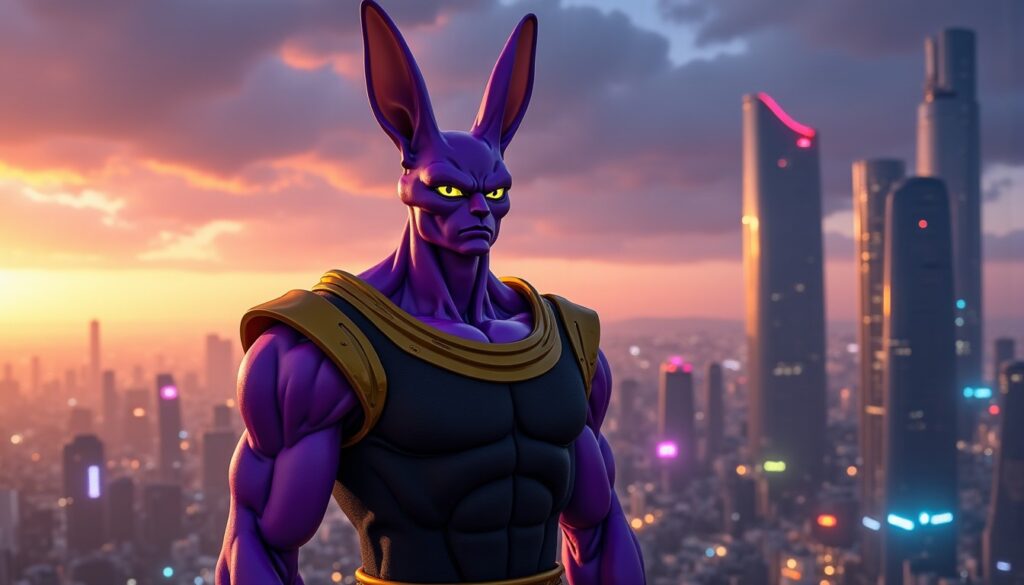
Yes, Dragon Ball Super: Beerus will tell again a story already known, but in a reworked version that promises renewed animation, re-recorded dubbing, and reconstructed narration. The series is set to launch on October 11, 2026, simultaneously on Crunchyroll in many territories, and will cover the early arcs of Dragon Ball Super rather than continuing the adventures after the original series.
The return of the God of Destruction thus revives a major turning point in the franchise, from Dragon Ball Z: Battle of Gods to the arrival of Champa. To understand what this new adaptation might change, we can distinguish three stakes: the visual and sound form, fidelity to the story imagined by Akira Toriyama, and the place of this reinterpretation in the wait for a true sequel.
- A reworked edition, not a simple rebroadcast of the 131 episodes of the original series.
- Japanese broadcast set for October 11, 2026, with an international simulcast on Crunchyroll.
- A familiar story, focused on the arcs of Beerus, Frieza, and Champa, with the extent of changes yet to be discovered.
Dragon Ball Super: Beerus, a new adaptation rather than a simple remake
Dragon Ball Super: Beerus does not present itself as an original adventure. The project reuses episodes and events already known but announces a revision work that touches on staging, images, and narrative construction. The difference with a classic rebroadcast therefore lies in the stated ambition: to offer a recomposed version, and not just to put on screen the episodes aired until March 2018.
The announcements mention newly animated sequences, redrawn shots, and modified scenes. Unseen cuts are also mentioned, which suggests the pace might change. For a viewer who knows the series, these changes can alter the feeling of a fight or the transition between two moments without necessarily upheaving the events themselves.
Reworked images for the battles
Let’s take a simple example: the arrival of Beerus and his first exchange with Goku. In a re-edited version, some additional shots might make more visible the power difference between the two fighters, while a shorter cut may speed up the scene. The value of this intervention does not depend solely on the number of new frames but on their capacity to reinforce Goku’s point of view, overwhelmed by an opponent he cannot defeat by strength alone.
The promise of renewed animation does not necessarily mean that every frame will be redone from scratch. The communicated information talks about both new sequences and work on existing images. We must therefore distinguish a completely restarted production from a hybrid edition, which combines retakes, corrections, and targeted additions. Since the number of episodes of this version has not been announced, it is too early to precisely gauge the scale of the project.
A reconstructed story, without confirmed new continuity
The communication also describes a narrative reconstruction, but this formula does not guarantee a modification of the official continuity. It may mean a reorganization of scenes, better linking between episodes, or a tighter adaptation of certain passages. As long as the exact changes are not detailed, we can speak of a new adaptation of the early arcs, not a sequel or a rewrite that would replace the established events.
This distinction matters for fans who hope to see the story progress towards the Moro or Granolah arcs, told in the manga after the anime events. For now, no date for an animated adaptation of those plots has been announced. Dragon Ball Super: Beerus chooses to return to the beginning of the series rather than immediately extend its story, and it is this editorial decision that will determine the audience’s first impression.
The project was announced on January 25, 2026, at the Dragon Ball Genkidamatsuri. It is presented as a version closer to the original idea and universe conceived by Akira Toriyama, who passed away on March 1, 2024, at the age of 68. This intention provides a framework for the work, but the exact share of documents or elements directly made by Toriyama has not been specified.
At heart, the word remake draws attention, but it is the quality of editing and staging choices that will say whether the edition truly transforms the experience. The next question concerns the concrete meeting with the series: where to watch it, and in which audio version?
Release date and broadcast of Dragon Ball Super: Beerus
The first episode of Dragon Ball Super: Beerus is scheduled in Japan on Sunday, October 11, 2026, at 11:15 p.m. local time, on Fuji TV and its affiliated channels. Amazon Prime Video and U-NEXT are then expected to offer the episodes at 12:15 a.m., thirty minutes after their TV broadcast. This schedule places the launch in the Japanese evening, with online availability shortly after airing.
Crunchyroll will ensure the international simulcast from the same date in a wide range of markets. For subscribing viewers, the interest is to follow the series at the pace of its Japanese broadcast, without waiting several months for a foreign release. The announced availability covers notably the United States, Canada, Latin America — including Brazil —, Europe, India, Southeast Asia, Australia, New Zealand, and South Africa.
| Territory or platform | Announced information |
|---|---|
| Japan, Fuji TV and affiliated channels | October 11, 2026, at 11:15 p.m. |
| Japan, Amazon Prime Video and U-NEXT | From 12:15 a.m., after TV broadcast |
| International territories concerned | Crunchyroll simulcast starting October 11, 2026 |
| United States, Netflix | Arrival announced October 17, 2026 |
| French dubbing | No official schedule communicated at this stage |
What we know about the language versions
The series is expected to be offered on Crunchyroll in Japanese with English subtitles. No schedule has been provided for an English dub, and the available information also does not confirm a date for a French dub. French-speaking viewers will therefore need to check the options available in their territory at launch time, without confusing simulcast availability with that of a dubbed version.
French dubbing counts a lot in the relationship of several generations with Dragon Ball. The localized voices give a particular color to characters and familiar lines; for some fans, hearing Goku in French is an integral part of the pleasure of rediscovering the saga. A new recording session could offer a modernized interpretation, but no public details yet allow identifying the cast or directing choices.
In the United States, Netflix is expected to host the series starting October 17, six days after its arrival on Crunchyroll. This gap illustrates the different roles of platforms: Crunchyroll bets on simultaneous broadcast for Japanese animation fans, while Netflix then broadens access to its own American audience. This announcement does not allow us to infer an identical Netflix schedule in other countries.
To follow the franchise news in parallel, we can also consult information devoted to the Galactic Patrol in Dragon Ball Super. This type of announcement reminds us that the series fits into a broader editorial universe, where expectations weigh as much on adaptations as on spin-off projects and upcoming stories.
The date and platforms give a clear reference point, but the event does not answer the most sensitive question: will this version stay faithful to the already told story, or will its re-editing change our reading of the saga’s beginnings?
From Dragon Ball Z: Battle of Gods to the Frieza and Champa arcs
The return of Beerus brings viewers back to a pivotal moment in Dragon Ball’s history. The character first appeared in theaters in Dragon Ball Z: Battle of Gods, released in 2013, before this encounter was adapted at the beginning of Dragon Ball Super in 2015. The manga also offers its own version of these events. With Dragon Ball Super: Beerus, this foundational confrontation is therefore retaken in a new presentation, nearly thirteen years after the film.
This repetition may seem unnecessary if one expects an entirely new plot. It takes another meaning if the project is seen as an attempt to make more coherent a beginning told across several media. The film, anime, and manga do not have exactly the same pace or level of detail. A reconstructed edition can bring these versions closer in the public’s mind, provided the changes truly serve the dramatic progression.
A scope that goes beyond the Beerus arc
The available information indicates that the series should cover at least the first three anime arcs: Beerus, Frieza, and Champa. The first pits Goku against a god whose power brutally redefines the hero’s limits. The second puts Frieza back at the forefront and reprises material associated with the film Dragon Ball Z: Resurrection F. The third expands the universe by introducing Champa and a new dimension of rivalry between gods and fighters.
This journey gives the series a broader function than merely retelling Battle of Gods. The Beerus arc establishes a new power scale; the Frieza arc tests the capacity of an old enemy to return to the story; the Champa arc then transforms the universe into a competition ground between several worlds. These three steps show how Dragon Ball Super moves from nostalgia for reunions to widening its mythology.
To illustrate the effect of a better articulated story, imagine a viewer discovering Dragon Ball through this edition. If the transitions clearly explain why Beerus is looking for Goku, why Frieza returns, and what Champa represents, she can follow the progression without knowing the earlier films. For a longtime fan, the same scenes become an opportunity to compare versions and spot shots or dialogues that may have been modified.
Fidelity to the story to be appreciated in the details
Fidelity to the story is not measured only by preserving the major events. It also comes into play in character portrayal, the tone of scenes, and the balance between humor and tension. Beerus can be both threatening, capricious, and comical; if new staging insists solely on his power, it risks flattening this ambivalence. Conversely, an edit that preserves his mood swings may reinforce the balance that makes him interesting.
Toriyama’s presence in the official presentation of the project deserves a measured reading. He remains associated with the original work, the story, and character design, but the proportion of content coming directly from his documents or work is not detailed. We can thus acknowledge the claimed link to his universe without attributing every decision of this new version to a personal intervention by the creator.
Another news about the character Mr. Satan shows how much fans like playing with the saga’s codes and transformations: the illustration of Mr. Satan as a Super Saiyan belongs to a playful register, opposite to the rebuilding ambition announced here. This contrast reminds that Dragon Ball also lives through parodies, debates, and shared memories.
The announced content therefore outlines a path going from the first shock facing Beerus to the opening toward other universes. It is more in the continuity between these steps, rather than in the sheer amount of new scenes, that the coherence of this reinterpretation will be decided.
Why Beerus’s return remains a turning point for Dragon Ball Super
Beerus is not just a powerful opponent added to a long gallery of rivals. His arrival changes the way Goku and his close ones view strength: for the first time in a long while, training does not guarantee an attainable victory. The hero can surpass himself, but he discovers a gap that cannot be bridged in a few exchanges. This vulnerability gives the Beerus arc a particular tension, even for an audience used to spectacular transformations.
The character also introduces a divine hierarchy that transforms the series’ universe. Before him, threats were often connected to enemies that heroes could directly face after new training. With Beerus, the question becomes broader: which forces organize the cosmos, and what place can Goku occupy there? Whis’s arrival and the existence of other gods extend this opening, which will serve as a basis for future developments.
An opponent that changes the narrative dynamic
The first encounter works because it overturns expectations. Goku returns from a period of peace eager to fight; Beerus, on the other hand, can end the conflict without seeming to exert a comparable effort. The contrast between the Saiyan’s enthusiasm and the god’s calm creates a tension both comic and serious. If the renewed animation clarifies gestures, looks, and power gaps, it can make this scene more expressive without changing its outcome.
This asymmetry also explains why Beerus can remain an endearing character. He represents a huge danger, but his interest is not only based on the threat. His appetite, impatience, and relationship with Whis establish tone breaks that prevent the story from becoming uniformly solemn. New staging will have to preserve this mix: making his attacks impressive without erasing his unpredictable, sometimes almost capricious side.
For a new fan, this step serves as an entry point into a franchise whose story spans several decades. For a viewer who already knows the films and series, it revives nostalgia while offering a comparison object. The two audiences are not looking for the same thing: the first wants to quickly understand the stakes, while the second scrutinizes differences in pace, drawing, or dubbing.
A relaunch that dialogues with the saga’s legacy
The launch of Dragon Ball Super in the mid-2010s already relied on an operation of memory and relaunch. Battle of Gods had put Goku and his companions back at the center of an original story after a long period without a new film devoted to this continuity. The TV adaptation then allowed this comeback to extend over several arcs. Revisiting these beginnings today is to revisit how the franchise found a global audience again at the cinema, on television, and in bookstores.
This return does not erase the debates caused by the first televised versions, whether about pace, uneven quality of some shots, or the place of events already told in cinemas. The new edition could partly respond to these expectations if it tightens transitions and harmonizes scenes. It will not make the historical value of previous versions disappear: for many, the first broadcast remains attached to memories of discovery, weekly appointments, or discussions among friends.
Success will therefore depend on a delicate balance. If Beerus becomes only a graphic showcase, the substance risks seeming too familiar; if the narrative reconstruction is more ambitious, it can make the conflict clearer for the current audience. The character’s strength lies precisely in this dual function: he is an opponent but also a signal that Dragon Ball’s universe has just changed scale.
By revisiting this encounter, the series takes on a scene that fans already know by heart. The challenge is to give it momentum again without taking away what made Beerus a turning point.
Renewed animation and French dubbing: what expectations for fans?
The word “renewed” can cover several realities: redrawing shots, producing new sequences, reworking effects, or harmonizing colors. The announcements of Dragon Ball Super: Beerus mention several of these operations, without yet providing a scene-by-scene inventory. To evaluate the result, it is therefore better to observe what these choices bring to the story rather than count only the retouched images.
A fight offers a good observation ground. When Goku shifts from a defensive position to an attack, the readability of movement depends on framing, cut rhythm, and continuity between poses. A reworked sequence can accentuate speed, give more weight to an impact, or more clearly show a character’s reaction. If changes serve the action and emotions, they justify a new presentation; if they remain a visual varnish, their effect will stay more superficial.
Sound can transform the perception of scenes
The production also announces a new dub recording, as well as work on the soundtrack and sound effects. A line recorded differently can change the tone of a scene: Beerus can seem more threatening, more ironic, or more detached depending on the interpretation. Effects play a comparable role in fights, where the sound of a clash or the silence before an attack contribute to tension as much as the image.
For the French-speaking public, the question of French dubbing remains particularly awaited, but no date or distribution has been announced in the available information. We can distinguish this lack of schedule from a confirmation of absence: the series is announced in Japanese with English subtitles on Crunchyroll, while the French modalities remain to be specified. French version lovers will have to wait for dedicated communication before knowing if the local launch will include dubbed voices.
A dubbing change is not reduced to replacing voices. It involves recovering the line rhythm, comedic intentions, and coherence of a group of characters. Viewers who grew up with the French version may be sensitive to the continuity of performers, while new actors may propose a different reading. In both cases, artistic direction and adaptation quality of dialogues will be decisive.
Between nostalgia and discovery, the same episode can offer two experiences
A person who has never seen Battle of Gods can discover the conflict as a new story: Beerus seeks a worthy opponent, Goku understands he has encountered a power of another nature, then the universe expands. A longtime fan, on the other hand, already knows the steps and will focus on the differences. He will be able to compare a dialogue scene, a sequence of blows, or how humor intervenes in the midst of danger.
This double reading explains the interest of nostalgia without making it the sole argument. Memories attract the audience to the series, but it is not enough to guarantee satisfaction. Additions must provide a concrete reason to rewatch the story: smoother animation, more direct editing, more consistent sound atmosphere, or better-highlighted characterization. Otherwise, viewers risk perceiving the operation as an aesthetic repetition of events already available.
We can therefore approach this edition with precise expectations rather than a vague promise of perfection. It is a new presentation of known arcs, accompanied by announced visual and sound work, whose level of transformation will be verifiable on screen. October 11, 2026 will mark the start of this comparison for the Japanese public and territories served in simulcast.
To accompany images, music, and voices, the series will have to maintain the contrast that makes the story work: Goku wants to push his limits, while Beerus reminds that there is always a power capable of surpassing them.