
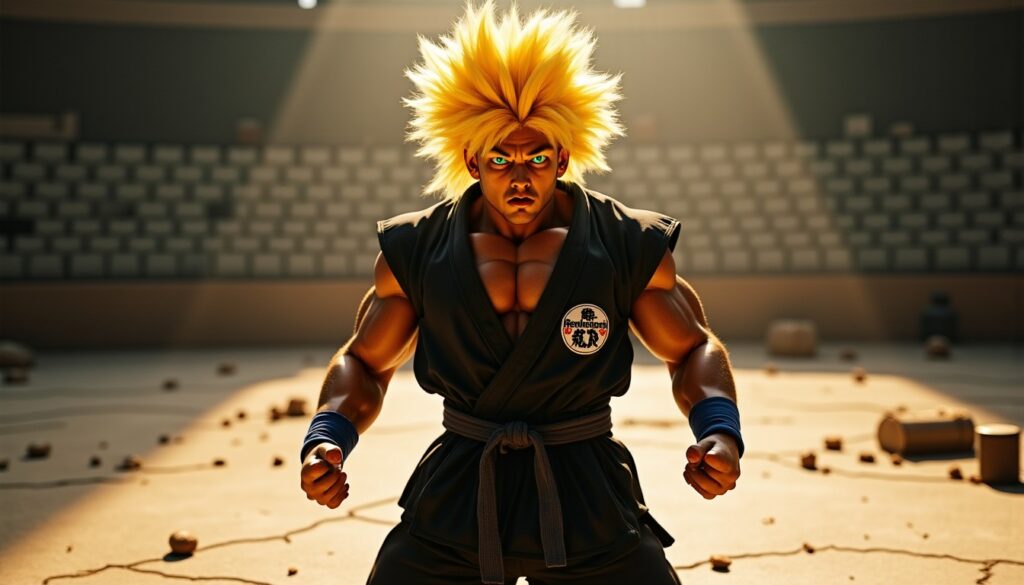
On August 27, 2026, Toyotarou surprised Dragon Ball fans by unveiling an official illustration of Mr. Satan, aka Hercule, in an unprecedented Super Saiyan transformation. This unique moment fascinates as much as it amuses, as it combines the already well-established narrative depth of the character with an iconic form of the saga usually reserved for Saiyans. This revelation comes at a busy time for the franchise, where many animated projects and mangas are enlivening the scene in 2026. We will explore together:
- The nature of this official transformation and its distinction from past parody appearances.
- The singular role of Mr. Satan in the Dragon Ball universe and his impact on fans despite his lack of Saiyan powers.
- The current context of the Dragon Ball franchise in animation and manga, especially with the return of Dragon Ball Super.
- An analysis of why Toyotarou chose Hercule for this visual revelation.
- The possible implications for the future of the series regarding reinvented secondary characters.
Let us now address each of these aspects to better understand the importance of this transformation and its resonance with fans of the saga.
The officialization of Mr. Satan’s Super Saiyan transformation by Toyotarou
We are witnessing today an unprecedented event: Mr. Satan, an emblematic character of Dragon Ball, crosses a symbolic threshold by being officially depicted as a Super Saiyan by Toyotarou. This is not just a simple drawing or parody, but an official creation from the mangaka in charge of Dragon Ball Super, who is infusing his vision into the series in 2026.
The illustration published in Toyotarou’s monthly section features Hercule with the typical golden hair of a Super Saiyan, but with an elegance and intensity reminiscent of major heroes like Goku or Vegeta. This image roots itself in a fantasy expressed in episode 15 of Dragon Ball Super aired more than ten years ago. Whereas Super Satan was a comedic act, Toyotarou’s version gives unexpected visual and symbolic weight to the transformation.
It should be emphasized that this form remains a personal creation of the author, non-canonical in the official manga storyline. No chapter has so far mentioned Mr. Satan’s mastery of Ki, let alone any ability to reach the legendary Saiyan form. The illustration relies more on the unshakable popularity of the character, a hero of the people who, despite his limits, remains a charismatic figure capable of uniting and inspiring.
- Origin of the idea: A fantasy born from the humorous perspective of the anime but elevated by an official drawing.
- Distinguishing canon: Confirmation that this transformation is not integrated into the main narrative thread.
- Toyotarou’s art: A more heroic vision, with graphic codes typical of Super Saiyans, giving Mr. Satan a new dimension.
This officialization creates a unique bridge between the traditional humor related to Hercule and the iconic power aesthetics of Dragon Ball. Toyotarou thus demonstrates the manga’s narrative flexibility, capable of inserting wild ideas without altering overall coherence. It also opens the door to interpretation and interplay between canon and more imaginative proposals.
Why Mr. Satan remains a singular character in Dragon Ball without true Saiyan power
Mr. Satan has never needed to transform his hair to establish himself as a pillar of Dragon Ball. His fame is built on a fabricated story: the supposed winner of Cell during the Cell Games. This mythical deception captivated the fictional audience of the saga, and by extension the franchise’s viewers and readers.
Unlike heroes such as Goku or Vegeta, Mr. Satan does not master Ki nor superhuman combat techniques. Yet, his strength is notable for a human not boosted by Saiyan spiritual powers. The essence of his heroism lies in:
- His great ability to manipulate public opinion and his unwavering popularity.
- His courage, which although often mixed with fear and clumsiness, fully expresses itself in critical moments.
- His survival amidst battles where even skilled warriors could succumb.
Mr. Satan’s evolution throughout the Dragon Ball arcs illustrates his transition from a simple braggart entertainer to a character capable of influencing major events. His relationship with Majin Buu, for example, reveals a human and effective side, where his social presence facilitates the mobilization of a crowd indispensable to the final victory.
This particular role explains why Akira Toriyama grants him an important place in his universe. Mr. Satan embodies a human-faced heroism, far from the warrior grandeur of the Saiyans, but just as essential. He offers comedic and narrative relief, while showing that bravery can take many forms, often more discreet but no less decisive.
| Aspect | Description | Impact in Dragon Ball |
|---|---|---|
| Popularity | Official Earth champion recognized by the public | Strengthens social credibility and other characters’ motivations |
| Physical strength | Human, without Ki energy but with remarkable athletic condition | Limited against Saiyans but sufficient for human fights |
| Courage | Despite fear and hesitation, acts in critical moments | Decisive during mobilization against Kid Buu |
| Social role | Opinion leader, motivator of earthly crowds | Indispensable to certain major saga arcs |
Let us recall that in Dragon Ball Super, Hercule’s role became more discreet, but his popularity among fans remains very strong. This Super Saiyan presentation today fuels a new wave of enthusiasm, reminding how much his charisma far exceeds his technical powers.
The return of Dragon Ball Super in animation and manga: opportunities for Mr. Satan
The current period sees the Dragon Ball franchise reactivating fully. Two major animated projects mark this momentum: Dragon Ball Super: Beerus, positioned as an enhanced remake of the Arc dedicated to the God of Destruction, and Dragon Ball Super: The Galactic Patrol, which adapts the Galactic Patrol Prisoner arc centered on Moro.
Dragon Ball Super: Beerus is expected in autumn 2026 in Japan. It spans six episodes revisiting key moments with refined staging and closer fidelity to the original manga. This initiative aims to enrich animation quality and engage fans seeking a more complete story.
The future Galactic Patrol arc in anime will continue the story, introducing new stakes and strategic positions for Goku, Vegeta, and other characters. The schedule remains somewhat unclear, with surveys around a potential 2027 release, but the excitement is palpable.
In this context, highlighting Mr. Satan as a Super Saiyan by Toyotarou can have several objectives:
- Revive interest in the character with a view to possible increased involvement in the manga or anime.
- Offer an original and refreshing break amidst intense and powerful arcs, playing on humorous and imaginary contrasts.
- Inspire other Dragon Ball content creators to revisit or enrich secondary characters.
Toyotarou’s graphic and narrative proposals have often influenced the manga’s expansion, sometimes announcing future directions. The illustration of Hercule as Super Saiyan thus fits into a strategy of diversifying reading angles, playing on nostalgia but also creative boldness.
The symbolism and cultural impact of the image of Mr. Satan as Super Saiyan
Depicting Mr. Satan as a Super Saiyan also asserts a strong idea about the very nature of heroes in Dragon Ball. While the audience usually expects to see this transformation in Saiyan warriors, offering this appearance to a human opinion leader provides a skewed and humorous reading.
This illustration acts as a mirror of the fandom, which for years has enjoyed imagining extraordinary characters in unexpected roles. So many fanarts and discussions have fed this idea that the greatest bluffer on Earth could one day unleash power worthy of the gods of the saga.
The image created by Toyotarou combines:
- The feeling of the impossible realized, giving an unprecedented visual flash.
- Artistic elegance that respects the established codes of the classic Super Saiyan.
- A loving tribute to the character of Mr. Satan, giving him a symbolic place in the pantheon of heroes.
This approach thus favors emotion and humor as much as graphic quality. It does not seek to disrupt existing lore but to celebrate the range of narrative and aesthetic possibilities in Dragon Ball.
Prospects for Mr. Satan and Dragon Ball through this unofficial transformation
Finally, this image of Mr. Satan as Super Saiyan opens several doors for the franchise. Without formally announcing a change in canon, it leaves free rein to creativity around a character often underused in major moments.
From a narrative point of view, this initiative shows that even secondary figures can wear a heroic aura, and that humor can coexist without break with dramatic stakes. It also suggests to Toyotarou and producers the possibility of further integrating Hercule in future arcs, in more involved or symbolic roles.
For fans, this officialization transforms the image of Mr. Satan, until now seen as an exaggerated champion, into a character capable of evoking power and grandeur, even if fantasized. It enriches the dialogue between creators and audience, between expectations and surprises, increasing interest in an already very dense universe.
- Open new storylines around human heroes.
- Explore new forms of transformations and powers.
- Diversify narration through secondary characters.
This innovative approach brings a fresh perspective to Dragon Ball and demonstrates a creative flexibility always at work, capable of surprising after more than thirty years of existence.