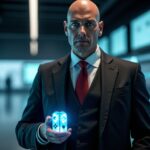

The second episode of VisionQuest, entitled “Theseus,” reveals Tommy Shepherd’s origins by connecting his powers, his past in foster families, and memories associated with Westview. This TV series turns these revelations into a rescue operation: Paladin uses the young man to lure Vision to Saint Mabyn’s, while Ultron pushes the android to act despite his doubts about his own identity.
Released on Disney+ on October 13 or 14, 2026, depending on availability schedules, this episode belongs to the two-part launch of the new Marvel Television production. We follow a dual journey: Tommy tries to understand the images and sensations inhabiting him, while Vision must decide if he can recognize as family a boy he doesn’t really know. These two trajectories intersect in a story that speaks as much about memory as about kinship.
- Tommy discovers a consciousness and memories that seem linked to Tommy Maximoff.
- Vision chooses to rescue him without claiming to have already resolved his identity crisis.
- The disappearance of J.A.R.V.I.S. exacts a terrible price on their escape from Saint Mabyn’s.
To clarify the stakes of “Theseus,” we can follow three threads: the young man’s origins, Vision’s moral choice, and the consequences of the rescue. The question that ties them together is simple to formulate but difficult to resolve: does a person remain the same when their body, memories, or history have changed?
VisionQuest, episode 2: the origins of Tommy Shepherd revealed
“Theseus” begins with a flashback set one year before the main events. Tommy Shepherd is questioned at a police station after being accused of injuring several teenagers in a swimming pool. He claims not to have controlled his actions and describes an electric shock, then the impression that another consciousness settled in his mind. This testimony immediately places the viewer at the heart of his turmoil: Tommy does not yet know if the images that emerge within him are memories, visions, or fragments of a life that is not his own.
This past is illuminated by the events of Agatha All Along. After the disappearance of the Hex, Tommy Maximoff’s soul is said to have been transferred into Tommy Shepherd’s body. The episode does not present this revelation as an explanation that settles everything. On the contrary, it opens a fracture between the young man’s birth identity, his concrete lived experience, and the emotional memory of Wanda and Vision’s child.
Tommy grew up in the foster care system, without a living mother or a father present to offer a stable reference point. This story lends particular weight to his need for belonging. He is not only trying to understand why he has unusual abilities: he also tries to know whom he can trust and what place he can claim in a family he may have known in another form.
The journey to Saint Mabyn’s makes this vulnerability tangible. In the vehicle taking him to the facility, images of the pool, Westview, and Vision pass through his mind. Tommy also meets Lisa Molinari, played by Lauren Morais, a young pickpocket who advises him to adopt the personality necessary to survive. Her advice reflects a street rule, not a psychological solution: when no one provides you with a framework, the mask can become a way to get through the day.
A first manifestation of powers, between reflex and survival instinct
The transport escape marks a decisive stage. A guard uses an electric device against a detainee, then targets Tommy. The young man absorbs or redirects the energy, neutralizes the agent, and allows Lisa to seize the keys. The scene shows the effectiveness of his power, but does not reduce it to a spectacular demonstration: Tommy acts without fully controlling what happens, at the moment he is threatened.
After their escape, the two youngsters become partners in fraudulent activities. This closeness gives Tommy an ally, while making his gift a tool for survival and resourcefulness. Here we find a familiar dynamic from superhero stories: power does not immediately bring a heroic vocation. It can first serve to flee, protect oneself, and no longer be the most vulnerable person in a group.
For fans following the links between Marvel productions, the parallel with Billy Kaplan, found in stories devoted to young heroes and their identities, reminds us how fragmented memory can turn a personal quest into a family intrigue. The comparison does not erase differences between works: it rather helps spot the same question, that of the weight of memories in the construction of a character.
Tommy’s origins therefore cannot be summed up only to a supernatural birth or the appearance of abilities. They take shape in the gap between the boy who grew up without a permanent home and the Westview child whose memories he carries. It is this gap that makes his meeting with Vision so delicate.
Saint Mabyn’s: Paladin turns Tommy into bait
Paladin, played by Todd Stashwick, gives the episode its most concrete threat. This is not his civil name, but a title passed down within a lineage of bounty hunters. These professionals track targets for remuneration and claim a code of honor. The series plays on the gap between this reputation for discipline and the mission’s brutality: Tommy is treated as a pressure tool, although he is a teenager whose mind already seems put to the test.
Paladin captures the young man and takes him to Saint Mabyn’s to force Vision to show up. He insists that Wanda transferred Tommy Maximoff’s soul into Tommy Shepherd’s body after the Hex’s disappearance. This link would make the captive Vision’s closest relative. The hunter also threatens to subject Tommy to experiments capable of causing severe brain damage. The threat works on two levels: it endangers a body and turns an intimate question into immediate urgency.
Vision initially rejects Paladin’s conclusion. In his eyes, Tommy Shepherd is not automatically his son, nor would he necessarily be the boy known by another version of himself. This reservation is consistent with his state at the series’ beginning: his own memories and mental references are fractured. Accepting kinship too quickly could mean relying on a story he does not yet recognize as his own.
Memories that bring Vision closer to Tommy
Tommy’s words shake this distance. He recalls Wanda reading stories to him, the sadness he perceived in her, and a red figure he associates with Vision. These images do not form a complete dossier on his identity. Yet they bear emotional value: the young man is not reciting learned information to convince the android; he is expressing scenes that seem to have imprinted themselves on him.
The trigger happens when Tommy utters a phrase linking mourning to love. Vision recognizes an echo of his history with Wanda there. Recognition does not erase his skepticism, and the episode avoids turning this scene into an instant reconciliation. Vision decides to save Tommy before knowing exactly what he feels for him. This very distinction gives strength to his choice: he acts because a being is in danger, without requiring prior certainty about their bond.
The series thus builds a form of kinship that does not rely solely on biology or shared memory. Tommy possesses fragments of Westview and of Vision; Vision himself must decide what he will make of these fragments. The viewer can then wonder if family is born from a common origin, transmitted memory, or an act of protection. “Theseus” does not resolve this, and this restraint avoids reducing their relationship to a single revelation.
Paladin acts on behalf of an external client, whose identity remains unknown at episode’s end. E.D.I.T.H. confirms this person’s existence but cannot locate them. This detail broadens the plot: the hunter may be only an executor, and Tommy’s capture is part of a larger operation. Saint Mabyn’s then becomes much more than a confrontation location because it reveals the methods of an adversary still hidden.
Paladin’s trap forces Vision to move from doubt to action. It remains to understand how Ultron influences this decision and why the episode borrows its title and central question from the paradox of the Ship of Theseus.
The Ship of Theseus and Vision’s identity crisis
In Vision’s mental space, Ultron, still played by James Spader, occupies a position as unsettling as it is lucid. Vision reproaches him for revealing their location to Paladin. Ultron denies direct responsibility or simply refuses to show any regret. Instead of soothing his host, he observes Vision’s hesitations and uses them to push him to examine what he has become.
The title “Theseus” refers to the paradox of the Ship of Theseus: if every piece of a ship is replaced over time, can one still say it is the same ship? The episode transposes this question to two characters. Vision has another body, fragmented memory, and several artificial intelligences in his mind. Tommy lives in a body linked to another consciousness and carries memories he cannot explain by his childhood in foster families.
The parallel does not mean the two situations are identical. Vision knows the weight of his successive transformations and tries to decide which part of his history still belongs to him. Tommy is barely discovering the existence of a memory that seemingly precedes his current identity. Both are reconstructed, but the series refuses to present them as mere copies or empty vessels. Their current choices matter as much as the events that preceded them.
Ultron turns doubt into decision
Ultron then formulates an idea that summarizes Vision’s progression: he must not remain a ship tossed by events but become the one who chooses his course. This image does not cure his crisis. It provides a way to act without waiting for every question to find its answer. Vision can ignore whether Tommy is truly his son in the way he once understood, and still decide to protect him.
This reasoning distinguishes responsibility from certainty. In many stories, the hero discovers a truth, then acts accordingly. Here, Vision chooses to intervene while the information remains incomplete. It is a credible progression for a character whose identity is precisely the episode’s subject: he does not retrieve an old version of himself but constructs a response in the present.
After his confrontation with Paladin, Vision transforms into White Vision and heads toward Saint Mabyn’s. This metamorphosis visually symbolizes his step into action, without canceling the accompanying complexity. The upcoming fight will not just be a show of power because his adversary has prepared means to disrupt his systems and physically constrain him.
To situate these questions in the Marvel universe, we can also think of stories where heroes inherit a name, power, or memory without receiving a manual. A discovery path like the one presented in another story of young characters facing the unknown reveals this structure’s appeal: identity is revealed in stages, through danger and forged relationships. The difference here lies in the central place given to artificial consciousness and the transmission of a soul.
Ultron thus pushes Vision to choose a direction, but this decision will have a material and mental cost. At Saint Mabyn’s, the rescue endangers not only his body but also the intelligences coexisting within him.
The rescue of Tommy costs J.A.R.V.I.S. his life
At Saint Mabyn’s, Vision confronts guards with the help of the artificial intelligences present in his mind. Paladin anticipated his arrival: a cage equipped with an electromagnetic device can destabilize his systems, while weapons designed to bypass his protections, including projectiles said to be made of adamantium, threaten his body. The device gives the confrontation a logic of a trap rather than an even duel.
The damage is not limited to his physical appearance. The available power is no longer sufficient to maintain all the functions of his mental architecture, threatening the entities residing there. The external action and internal crisis then converge: every blow to Vision can also weaken the consciences accompanying him. Tommy’s rescue becomes a race against the failure of an entire system.
J.A.R.V.I.S., played by James D’Arcy, makes a sacrificial decision. He diverts his own processing power to preserve Vision and the other artificial intelligences. His last message insists on family continuity and the need to continue the fight. His disappearance, described as final, follows Fiona’s death in the previous episode: the story thus accumulates losses without making sacrifice a mere spectacular effect.
An escape that begins with an act of trust
Vision finally reaches Tommy. The boy, terrified, first repeats that the android exists only in his head. This reaction echoes his experience since the interrogation: his memories are so disorienting that he does not always know what is real. Vision tries to reassure him despite his critical condition, then asks him to leave alone so as not to slow their escape.
Tommy refuses to abandon him. He considers him a family member, without being able to specify exactly what relationship they share. This hesitation is more eloquent than a perfectly formulated statement: it shows that the bond forms in urgency, before the two characters have the words needed to name it. The young man does not yet know what his past means, but he chooses to stay with Vision.
The escape takes an almost trivial turn when Tommy goes out to find a vehicle and returns behind the wheel of a heavily damaged car. Nothing in this scene resembles an elegant extraction. Yet this car is enough to take them away from Saint Mabyn’s, and the contrast between J.A.R.V.I.S.’s grave sacrifice and Tommy’s improvised solution makes their departure more human. The two survivors leave the facility wounded, accompanied by a still fragile trust.
The operation’s price is thus measured on several scales. Vision is seriously affected, an essential artificial intelligence disappears, and Tommy must now face a past that may not entirely belong to him. The immediate success — leaving the building alive — does not heal any of these losses. It only makes the rest of their journey possible.
The scene also confirms the difference between saving someone and resolving their story. Vision brought Tommy out of the trap, but he does not yet know how to live this relationship. Tommy, for his part, chose to help without having obtained a definitive answer about his memories. Their alliance begins precisely in this space of uncertainty.
What Theseus’ revelations change for the rest of VisionQuest
The second episode does not provide a complete resolution on Tommy or Vision. It rather modifies how we can understand their relationship. Tommy is no longer just a boy endowed with unknown abilities: he carries memories associated with Wanda, Westview, and Vision. This past explains part of his turmoil, without erasing his own story, notably the years spent in foster families.
For Vision, the change is equally nuanced. He agrees to face Paladin and rescue Tommy, but does not claim to have instantly regained a paternal feeling. The episode allows him to make a choice before reaching a stable definition of himself. This is an interesting evolution in a TV series devoted to a consciousness that cannot rely on a perfectly continuous memory.
Paladin’s client maintains a threat in suspense. E.D.I.T.H. knows a client is behind the hunt but cannot reveal their identity. This information leaves several questions open: why is Tommy the target, what abilities interest his enemies, and was Vision targeted from the start or lured into a larger trap? The series has planted clues, but the motives linking them remain undisclosed.
Three consequences to follow after the escape
| Revealed Element | Immediate Consequence | Open Question |
|---|---|---|
| Tommy carries memories linked to Westview | Vision agrees to rescue him | How to distinguish inherited memory from personal identity? |
| Paladin works for a client | The chase goes beyond the face-off between the two characters | Who orchestrates the operation and for what purpose? |
| J.A.R.V.I.S. sacrifices himself | Vision and the other intelligences survive, but his architecture is weakened | What consequences will this loss have on his functioning? |
This structure gives the episode a clear progression. Tommy’s memories make the threat personal; Paladin’s intervention turns this intimacy into action; J.A.R.V.I.S.’s sacrifice reminds us that every victory has a cost. We thus move from a question about origins to one about choices: even if Tommy understands where some images come from, what will he do with this memory?
The next episodes, released every Wednesday on Disney+, will have to extend these threads. The escape from Saint Mabyn’s offers respite, not lasting security. Vision must cope with damaged systems and J.A.R.V.I.S.’s absence, while Tommy remains tied to a case whose client remains invisible. Their family is thus built at the very moment threats continue to pursue it.
“Theseus” ultimately gives its title weight by refusing to confuse identity and origin. Tommy can carry a prior consciousness without ceasing to be the young man who survived foster homes and fleeing. Vision can change bodies and lose memory fragments without being reduced to a brand-new machine. Their nascent bond does not solve these enigmas: it gives them a reason to move forward together.