
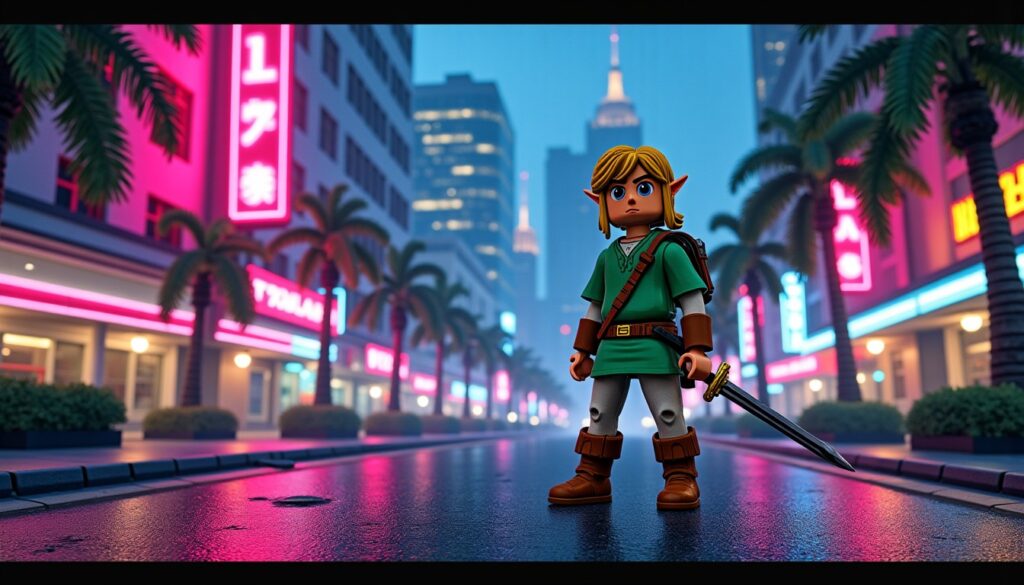
Yes: Vice: Magic City Mayhem blends on Steam the criminal and colorful atmosphere associated with GTA with a 2D adventure structured like a classic Zelda. You play as Dutch, a henchman on the hunt for Sophie, his missing partner, amid neon lights, dungeons, and velociraptors aboard yachts.
The independent video game from Jurassic Sunset Games prefers guided progression over a vast open world. Its announced program features eight dungeons, eight bosses, puzzles, and equipment that open up new paths. A free demo is available on Steam, while the game’s page lists a PC release for November 18, 2026, a date subject to change.
- For the atmosphere: a tropical criminal city, clubs, and beaches bathed in neon.
- For the progression: dungeons, items to find, and passages to revisit.
- For the tone: a retro noir where you can encounter dinosaurs on a yacht.
This mix of references is not only about its appearance: it also defines the way of exploring and fighting. To understand what the project promises, let’s first look at the meeting of its two main inspirations.
Vice: Magic City Mayhem: a GTA inspiration serving a 2D adventure
The comparison with GTA is noticeable primarily in the setting and atmosphere. Magic City evokes a fantasized 1980s Miami, with bright streets, beaches, nightclubs, and characters who seem straight out of a deliberately over-the-top crime noir. The neon palette and the gangster imagination give the game an immediately recognizable identity, without trying to reproduce the vast map or systemic freedom of a modern Rockstar episode.
This distinction matters for players who spontaneously associate “GTA inspiration” with free driving, scattered missions, and open-world activities. Here, the city serves more as an organized adventure ground. We follow a path shaped by interconnected sectors, visible obstacles, and areas that may need to be revisited after acquiring the right equipment.
The Zelda inspiration is expressed in this structure. As in the classic series episodes, an acquired item can transform an already traveled place: a passage that seemed blocked becomes accessible, a puzzle takes on a new meaning, or a detour reveals a new part of the map. The city is therefore not just a backdrop to cross between fights. It becomes a set of landmarks whose understanding sharpens as Dutch progresses.
Two references, two ways of playing
To visualize the difference, imagine a first visit along a palm-lined promenade. The atmosphere may recall the streets of Vice City, but the player does not necessarily receive the freedom to wander off in all directions. A blocked path or an inaccessible door rather indicates that an ability is still missing and invites one to keep that location in mind.
This logic provides a clear direction for exploration. Instead of multiplying side activities typical of a sandbox, the game seems to rely on curiosity, observation, and returns to familiar places. If you appreciate compact maps where every detour has a purpose, this framework may prove more satisfying than a vast territory filled with markers.
The contrast also fuels the humor. Dutch operates in a colorful criminal universe, but his adventure borrows the codes of a dungeon exploration game. We thus switch from a gangster imagination to mechanisms and secret passages that belong to another video game tradition. The encounter does not promise a miniature GTA: it offers a retro adventure whose criminal city setting gives a unique flavor.
Eight dungeons and eight bosses to structure Magic City’s exploration
The announced campaign is organized around eight dungeons and as many boss battles. This pairing suggests a stepwise rhythm, where each important place should pose a distinct challenge before leading Dutch to continue his search. We do not yet know the details of each zone or how long it will take to finish the story; the number of dungeons nonetheless gives a concrete glimpse of the planned framework.
In a 2D adventure, an effective dungeon is not limited to a sequence of rooms filled with enemies. It may require spotting a mechanism, understanding the order of activation of several elements, or using an item in a precise context. Success then depends as much on attention to the decor as on fighting skill. It is this alternation between observation and action that can give each stage its identity.
Reading the places and backtracking
Available information evokes environmental puzzles and paths that open gradually. Let’s take a plausible design example, without confusing it with a confirmed room: a corridor could present a barrier impossible to cross during the first visit. After obtaining suitable equipment, Dutch could return through a known area and discover a secondary route, with a reward or shortcut.
This kind of progression turns movement into learning. A closed door is no longer necessarily a frustrating dead-end: it can become a goal to keep in mind. To make this method enjoyable, the game must also provide sufficiently readable clues and avoid making the player roam the entire map blindly. The clarity of environments will thus be as important as the number of places announced.
The eight bosses can also serve as milestones. In a structure inspired by classic Zelda games, a major confrontation often tests what the player has just learned: recognizing an opening, avoiding an attack, then using available tools at the right moment. We have no detailed description of Vice: Magic City Mayhem’s opponents; it would therefore be premature to assign them specific mechanics. Their number simply indicates that the campaign plans several high points rather than a single final fight after a long wander.
A good example of rhythm would be a sequence alternating a few streets to explore, a locked passage, a dungeon to solve, then a return to a now more accessible neighborhood. This loop gives meaning to discoveries and helps the player gauge progress. The announced environments — clubs, beaches, night streets, and yachts — offer varied backgrounds to renew this feeling without abandoning map coherence.
Variety does not depend solely on scenery changes. A nightclub may favor observing a cluttered space, while a yacht may restrict movement and multiply dangers. If the puzzles take advantage of the differences between these places, dungeons may stand out by their reading and rhythm rather than a mere color variation. This is where exploration can become the true thread of the adventure.
At this stage, the eight dungeons and eight bosses are announced elements, not a guarantee of quality or duration for each stage. The demo is a more direct way to assess space readability, the feeling of progression, and the place given to puzzles. Once these landmarks are set, it remains to see how equipment concretely changes the way of playing.
Katana, Kevlar, and swift boots: Vice: Magic City Mayhem’s equipment
Dutch does not just cross Magic City: he must face the dangers that punctuate his search. The katana is among the mentioned weapons, along with other means of combat that have not all been detailed. The retro 8-bit presentation suggests clear action, where one must quickly understand the enemies’ positions and spatial possibilities.
The announced equipment has a function that goes beyond improving stats. A Kevlar bulletproof vest is intended to reinforce Dutch’s protection, while boots should allow him to move faster or perform dashes. Other items would open access to previously inaccessible areas. The principle thus combines combat preparation and progression through places.
Items that change routes
This articulation is a classic lever of Zelda-style adventure: equipment is not only for becoming stronger, it modifies action possibilities. A quick movement ability, for example, could help overcome a dangerous zone or reach an otherwise inaccessible passage. This is here to explain the potential role of this type of tool, without attributing to the game a particular mechanic that has not been confirmed.
Discovering an item can also give new value to previously visited spots. You may have noticed an isolated platform or a narrow opening without being able to reach it. When Dutch acquires a suitable movement tool, the player can return to that area and check if the obstacle was a clue rather than a mere decor element.
| Announced Equipment | Indicated Function | Expected Effect on Gameplay |
|---|---|---|
| Katana and other weapons | Fight enemies | Give directness to action |
| Kevlar bulletproof vest | Strengthen Dutch’s protection | Help better resist dangers |
| Movement boots | Speed up movements or perform dashes | Modify movement and access to certain areas |
| Exploration equipment | Open new zones | Encourage returns to previously visited sectors |
The table distinguishes known functions from reasonable expected consequences. It does not specify stats, item occurrence frequency, or exactly how they unlock. This information will need to be observed in the demo or communicated by the studio before release.
For the player, good progression should avoid two extremes. If each new item only serves to deal more damage, discovery risks losing interest after a few fights. Conversely, if each piece of equipment opens an excessive amount of passages, backtracking can become mechanical. The balance will depend on how the game links fights, puzzles, and the map.
One can imagine a session where an enemy blocks access, then an item obtained after the confrontation allows bypassing an obstacle in a known neighborhood. This kind of loop ties a victory to a concrete discovery and invites re-examining the setting. In this formula, equipment serves both as a key and a survival tool: it gives Dutch new options and the player new reasons to explore.
This material progression takes place in a deliberately extravagant world. To grasp the game’s tone, one must also look at how its personal quest, environments, and dinosaurs add a particular color to the action.
Dutch searches for Sophie in a criminal city with an offbeat tone
The starting point of the story is simple to understand: Dutch, presented as one of the most feared henchmen of Magic City, is looking for Sophie, his missing partner. He is therefore not set to conquer every district or build a criminal empire. This personal motivation gives a direction to movements and links the various places to a clear objective.
The project’s tone relies on the contrast between this quest and its universe. Dutch crosses illuminated streets, clubs, and beaches, then may find himself facing velociraptors on yachts. The detail is absurd, but seems consistent with Magic City’s assumed exaggeration. Here, dinosaurs are not presented as a realistic break: they participate in the promise of a game that does not take its tropical noir seriously.
Varied locations to support the narrative thread
The announced environments offer several visual registers to the campaign. Neon streets evoke city traffic, nightclubs suggest dense and lively places, while beaches provide more open breathing spaces. Dinosaur-infested yachts add an unexpected situation that can serve both to surprise and renew encounters.
The setting can also support the story without multiplying long scenes. An item left in a club, a closed passage near the port, or a character met on the beach could direct Dutch toward the next step, provided the staging makes this information understandable. We have no details confirming how Sophie intervenes in each part of the adventure; her absence remains the announced narrative driver.
This sobriety of the starting point may suit a retro game. A search quest is direct enough to guide the player while leaving room for detours and map discoveries. The contrast between a sentimental objective and a hero described as a henchman also offers a source of humor: Dutch is not a traditional adventurer, and his criminal instincts can give the journey a less heroic personality.
The visual direction already provokes mixed reactions, according to the information provided. The pixelated style and color mix give the project a strong identity, but not all players necessarily buy into its rendering. This is a point where the free demo can be useful: a still image does not always allow judging the readability of movements, the clarity of fights, or how the backgrounds stand out during action.
The demo also allows checking if the humor works within the game’s pacing. An idea like velociraptors on a yacht can bring a smile in a description, but it must find its place in a truly playable sequence. The same principle applies to gangster references: they must give character to characters and places, not just serve as a visual wink.
By giving Dutch a personal search amid a deliberately unreasonable setting, Jurassic Sunset Games connects the story to the overall tone. The next question concerns practical aspects: what Steam already offers, the displayed date, and announced platforms.
Steam demo, release date, and announced platforms for Vice Magic City Mayhem
The Steam page presents Vice: Magic City Mayhem as an upcoming game and displays November 18, 2026, as its PC release date. This date is a visible calendar indicator on the platform; it remains subject to change. Players can also add the title to their wishlist, a way to follow its availability evolution without confusing the displayed date with a definitive confirmation for all versions.
A free demo is offered on Steam. It is the most concrete element to get a first idea of the project before purchase: you can examine Dutch’s movement, the feeling of combat, and how environments guide exploration. The demo does not necessarily suffice to evaluate an entire campaign announced with eight dungeons, but it allows checking if the basics of the 2D adventure attract you.
What we know about the schedule and versions
The project was also supported by a crowdfunding campaign that raised $13,278 from 379 backers. These figures describe a modest community funding size but testify to sufficient interest to mobilize several hundred people around this atypical proposal. They do not alone allow deducing the total development budget or expected commercial scope.
Versions for PlayStation 5, Xbox Series X|S, and Nintendo Switch have also been announced. The detailed schedule for these editions is not established with the same precision as the date displayed on Steam. Divergent information has circulated about delays and possible simultaneous release; it is therefore better to clearly distinguish the PC page from console announcements.
The price has not been confirmed in the available information. To assess the game before its commercial release, one can rely on several concrete markers rather than guesses: the playable demo, studio clarifications on platforms, and details published about the campaign’s duration or content. In the absence of a price, comparing the project to other productions would not establish its real value for players.
The November 18 date also has a particular calendar story, as the developer had initially considered a launch on that day, the eve of the then-planned GTA 6 release. Subsequent schedule changes make this historical comparison interesting, without allowing to draw a certain release date for each version of Vice: Magic City Mayhem. For the public, the reference mainly serves to recall the context of announced adjustments.
Before choosing a platform, we can therefore retain confirmed information and separate those awaiting clarification. Steam offers a demo and shows a PC date; console editions are announced, with a still-to-be-clarified schedule; the price is unknown. This distinction helps to follow the project without turning an announcement into a simultaneous launch promise.
For a first experience, the Steam demo is the most direct test: it allows judging the blend of combat, exploration, and puzzles using a controller or keyboard, rather than relying solely on the concept. Players who stick to this formula can follow release information developments, while others will quickly know if the neon, dungeons, and dinosaurs form a cocktail to their taste.