On November 17, 2025, Nintendo offered fans a rare visual first by unveiling several never-before-seen images of Link and Zelda from the upcoming The Legend of Zelda movie. These photographs, appearing on the Nintendo Today app, feature the two iconic heroes in live-action shots, portrayed by Benjamin Evan Ainsworth and Bo Bragason. The anticipation around this ambitious project left little room for concrete details, but now, the revelation of the images provides clear insight into the film’s aesthetic and atmosphere. Here is what stood out to us the most in these first images as well as the prospects they open up:
- A strong visual fidelity to the cult video games, with detailed costumes and spectacular natural sets.
- An authentic physical representation of the main characters, giving Link and Zelda a credible and human look.
- A modernized narrative positioning, notably with an active Princess Zelda equipped with weapons.
- The aesthetic choice of a realistic Hyrule, embodied by the majestic landscapes of New Zealand.
- An official release of the film set for May 2027, after a meticulous production and wrapping of filming in April 2026.
These elements invite us to deeply explore the unveiled never-before-seen images, the production work, as well as the implications for the cinematic adaptation of this flagship Nintendo franchise.
A visual immersion into the world of Zelda with the film’s unseen images
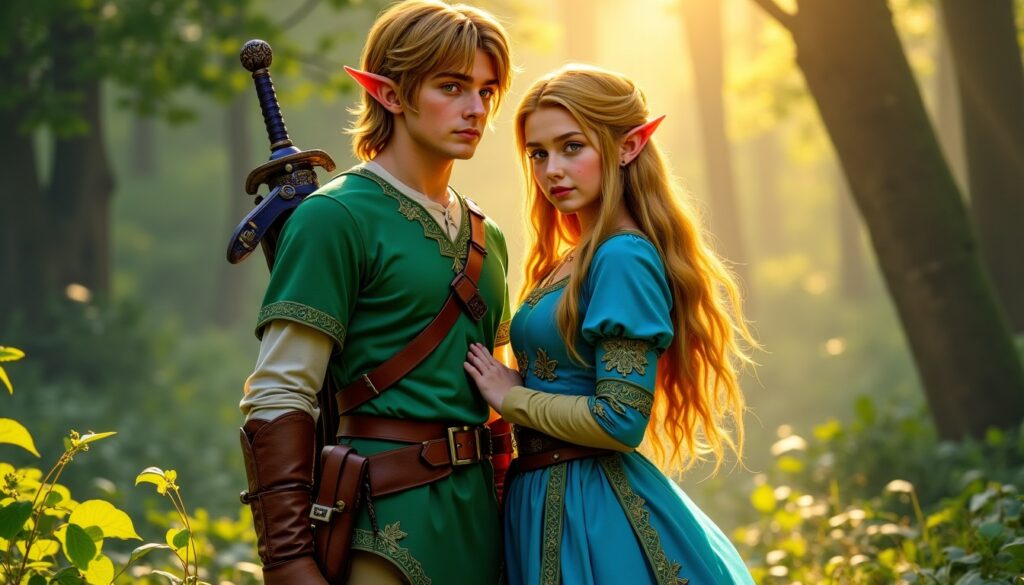
The publication of these unseen photos is a first since the official announcement of the film in November 2023. They bring welcome clarity on the visual style chosen by director Wes Ball, under the attentive supervision of the legendary Shigeru Miyamoto. Link’s costume, in particular, strongly recalls the Twilight Princess aesthetic, with a characteristic green tunic and a cream white bodysuit. This aesthetic choice is not just a simple homage: it places the production within a deep realism logic. The materials, stitching, accessories emphasize impressive meticulousness, demonstrating the investment in a true immersion.
At the heart of this visual fidelity, some elements intrigue. For example, in the shots, Link appears unarmed, which suggests an evolving narrative strategy or a desire for a refined staging for this first reveal. This absence does not diminish the iconic nature of the hero who continues to stand out by his appearance and distinctive signs. The green tunic worn remains one of the strongest symbols of the Zelda video game, anchoring the image in collective memory while establishing a sober and elegant atmosphere.
This approach sharply contrasts with other live-action adaptations of fantasy sagas, often accused of aesthetic approximations. Here, the intention is clear: to offer an organic and credible Hyrule, close to a real world but nonetheless imbued with magic. The lush natural scenery, likely captured in New Zealand in Wellington, catalyzes this impression. One perceives photographic and artistic work deeply focused on lighting, textures, and atmospheres, which promises a successful immersion for the viewer.
Additionally, the rendering of the images on social networks reflects a rather positive reception. Fans as well as professional observers highlight this respect for the original material combined with a palpable cinematic ambition. These unseen photos thus become visual markers to measure the care devoted to the long wait that the making of the Zelda film has been.
Active and armed Zelda: a modernized role through the official images
In these unseen images, Zelda is no longer just the damsel in distress many feared to see in this adaptation. Her blue costume, directly inspired by Breath of the Wild, marks a clear aesthetic choice, combining elegance and functionality. Her bow and arrows visible in one of the photos underline a more engaged initiative in confrontations, reflecting a trend in modern adaptations to no longer confine female roles to passivity.
This narrative decision goes far beyond appearance: it promises a strong dynamic between the two characters. The relationship between Link and Zelda, often imbued with mystery and balance, gains depth here thanks to Zelda’s physical expression and assertive character. Bo Bragason, the actress who portrays her, has been praised for the credibility of her role, as her silhouette and performance avoid any aesthetic overload, offering an authentic rendering that meets fans’ expectations.
The bow as an active weapon marks an interesting turning point. In the Zelda universe, the bow has always been a key instrument but rarely highlighted this way in the main narrative. This image suggests that the action will not be reserved for Link alone and that the princess will occupy an important place in the combat and adventure scenes. Within the film’s context, this is a welcome modernization matching the current trend of revisiting classic icons with more complex and nuanced angles.
It is by combining respect for the legacy and a desire for innovation that the film should find its audience. Early reactions on forums and social networks praise a balanced approach, centered on character expression and visual immersion. The equipment, textures, and posture adopted contribute to this impression of realism and reinforce the fantasy nature of the saga while grounding its story in a tangible universe.
Filming in New Zealand: a large-scale international production
The choice of New Zealand to shoot The Legend of Zelda is not surprising when considering the richness of the natural settings and the country’s film infrastructures. After about five months of shooting, completed in April 2026, production ended in a region near Wellington, whose green landscapes perfectly evoke Hyrule’s vast plains. This alliance between real nature and fantastic universe plays a major role in the film’s credibility.
Gyula Pados, director of photography, posted the final clap, marking a high point to this intensive phase. This message confirms the transition to post-production where special effects and editing will enhance the captured images. The meticulousness brought to filming is reflected in every detail of the sets, costumes, and lighting, designed to immerse the viewer in a complete and sensual atmosphere.
With a release date planned for May 7, 2027, or May 5 in France, the film benefits from a slight delay intended to refine the quality of the visual effects. This extension promises meticulous work on technical aspects, especially action scenes and magical atmospheres that characterize the Zelda saga. These adjustments will need to be closely monitored to assess the film’s ability to meet the expectations of the most demanding fans.
These details highlight Nintendo’s desire to make this adaptation an event worthy of the video game’s worldwide fame. It should also be noted that this is the first time Link will speak on screen. This structural innovation in the film should enrich the character by offering him more psychological depth and more direct interaction with Zelda. The story therefore promises a new cinematic adventure while respecting the essence that makes the saga successful.
Narrative perspectives: a Zelda film at the crossroads of tradition and modernity
The inclusion of dialogue for Link and Zelda’s active armed presence indicate a thoughtful adaptation aiming to modernize the experience without betraying the core. Facing a major antagonist such as Ganon, whose official image has not yet been revealed, the film promises a subtle dance between epic adventure and personal stakes.
Several narrative directions are possible thanks to these choices:
- Develop Link’s psychology: by giving him a voice, the film can explore his motivations, doubts, and courage more explicitly, making this mythical hero more accessible.
- Reinforce the relational dynamic with Zelda, who will no longer be merely an apparent character, but an active and fighting partner, thus changing the perception of the heroic couple.
- Extend the story to adapt it to the feature-length format, which implies secondary plots and more complex developments than the video game, to capture a varied audience.
- Modernize the franchise without distorting its universe: by marrying classical narration and stylistic innovations, the film aims to appeal both to the first-generation fans and a new generation.
Thus, the Zelda film intends to retain all the magic and power of the video game while fitting into current fantasy cinema codes. These ambitions, visible from the unseen images, are a strong promise for the release scheduled in less than a year.
The Zelda film at the heart of fans’ and the Nintendo community’s expectations
With the release of the unseen images, the Nintendo community buzzed around this highly awaited project. The discussion is fueled by precise analyses on costumes, sets, and fidelity to the original material. These exchanges contribute to making the Zelda film a major topic in the video game and animation fantasy news.
A summary table presents the film’s revealed strengths through these shots, as well as the expectations expressed by fans:
| Revealed Element | Feature | Impact on Fans |
|---|---|---|
| Link’s costume | Outfit inspired by Twilight Princess, with careful details | Approval for attention to detail and fidelity |
| Zelda’s costume and armament | Blue ensemble, bow and arrows, active posture | Excitement for a more engaged and modern role |
| Natural set | New Zealand landscapes evoking Hyrule | Increased impatience for immersive atmosphere |
| Link’s voice | First time with dialogue | Mixed opinions on the choice but high curiosity |
| Release date | May 7, 2027 (May 5 in France) | Anticipation and planning for the worldwide release |
The generated buzz has been compared to that of other major franchises, inviting close monitoring of Nintendo’s future communications. The excitement around this film fits into a dynamic context where other projects linked to the company are multiplying, as can be witnessed in the news on the exclusive Zelda film or the reactivity to leaks on popular 2026 franchises.