
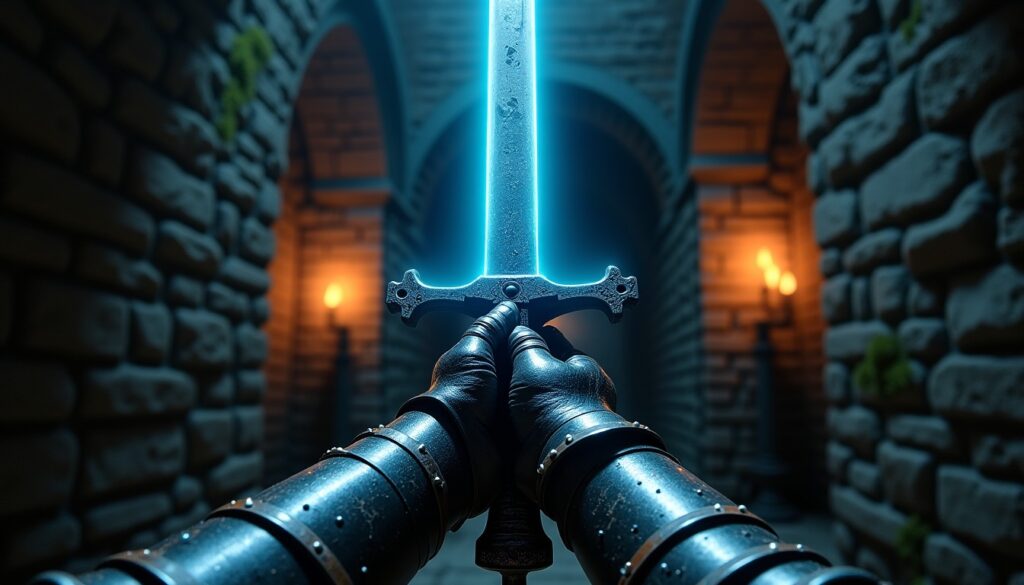
Yes, Valor Mortis makes a bold bet with its first-person view, but this perspective can also renew the reading of the soulslike genre if the fights remain clear and demanding. Developed by One More Level, the studio behind Ghostrunner, this action-RPG video game transfers endurance, timing, and progression through failure to a Napoleonic Europe ravaged by the supernatural.
- The novelty: the confrontations take place in first-person view, up close to weapons and creatures.
- The promise: swords, flintlock pistols, supernatural powers, and agile movements compose the immersive gameplay.
- The appointment: the release is scheduled for October 13, 2026 on PC, PlayStation 5, and Xbox Series X|S.
Our verdict will depend on a precise balance: bringing the action closer without blurring distances, preserving tension without making attacks difficult to anticipate. It is on this condition that innovation can meet players’ expectations rather than give them the feeling that a camera change alone is enough to reinvent the genre.
Valor Mortis and first-person view: a real evolution of the soulslike?
In many games of the genre, the camera placed behind the character allows monitoring the enemy, gauging their weapon, and observing their movements before choosing a dodge. Valor Mortis shifts this point of view inside the action. We no longer just watch a fighter face a creature: we perceive the danger from the place of the resurrected soldier, with visibility depending more on their orientation and distance to the opponent.
This proximity can make each encounter more physical. A blade crossing the field of view, a silhouette emerging from a corridor, or a shot that requires repositioning can produce a particular tension. In a soulslike, where a poorly judged attack can be costly, this change can turn a familiar sequence into a less comfortable but potentially more intense gaming experience.
The bet also involves a design difficulty. In first-person camera, the character’s body occupies less of the screen and the player can lose some spatial references. For the action to remain fair, animations must clearly signal blows, visual effects must not hide enemies, and dodges must respond precisely to controls. If these signals are clear, we can learn an opponent’s habits as in a third-person game. If they are confused, a defeat is likely to seem arbitrary rather than deserved.
Imagine a first encounter against a transformed soldier: he raises his weapon, marks a short pause, then strikes diagonally. In an external perspective, his movement can be read at the scale of his entire body. Here, the player must understand the same sequence from gestures visible in a narrower field. The quality of this reading will decide the satisfaction felt after several tries.
The camera therefore does not alone change the fundamental rules of the genre. Endurance, patience, and observation remain the declared principles, but their implementation takes another form. Valor Mortis will succeed in its innovation if the first person enriches combat mastery without depriving the player of the necessary information to progress.
First-person combat: endurance, weapons, and mobility
Gameplay information presents a system combining melee weapons, historical firearms, and supernatural abilities. The player will be able to wield swords, shoot flintlock pistols, and develop evolving powers. This combination opens several ways to approach an encounter, without the available elements reducing the game to a simple FPS. The promise remains that of a first-person combat where the timing of the moment counts as much as the equipped weapon.
Endurance should set the pace of these exchanges. In a soulslike, attacking without restraint often leaves the character unable to dodge or defend at the critical moment. A scene against a resistant enemy might thus require landing two hits, retreating, then waiting for an opening instead of immediately emptying all resources. The pistol can offer a ranged response, while a sword forces more exposure; the interest will come from how the game links these options to the cost of action.
Movement adds another dimension. One More Level is known for Ghostrunner, a series where speed and precision occupy a marked place. Valor Mortis evolves in a different register, but this experience of movement could be found in exploration and fights. A well-oriented dodge, a passage quickly crossed, or an attack coordinated with movement can prevent confrontations from being reduced to a succession of immobile parries.
Mobility must not erase caution. Although one can move quickly, the player must still read the terrain and distinguish a useful escape from a move leading into a dead end. A courtyard, stairs, or narrow corridor do not pose the same problems: open space helps to bypass an opponent, while a tight passage makes each step back riskier. These differences can give character to locations as much as to enemies.
Controls will therefore have a determining role. A clear configuration, consistent action response, and suitable settings allow distinguishing a decision error from a handling difficulty. Enthusiasts who play on keyboard can also compare formats and switches thanks to a guide dedicated to mechanical keyboards for gaming; typing comfort will never replace developers’ work, but it matters during long demanding sessions.
To judge this system, let us observe less the speed of sequences than their readability: do we know why an attack landed, how many actions endurance allows, and how a weapon changes the safety distance? The best sign would be a fight where one loses because of a poor choice, then can precisely correct their strategy.
A Napoleonic Europe transformed into a supernatural nightmare
Valor Mortis sets its story in a reinterpreted 19th century Europe. The protagonist fought in Napoleon’s army before coming back to life, in a world threatened by undead, monsters, and a conspiracy. This starting point combines a recognizable historical period with a horror fiction, without pretending to offer a documentary reconstruction of imperial campaigns.
The setting can give the game a strong visual identity. Uniforms, flintlock weapons, and references to Napoleonic army form a familiar vocabulary, while the presence of the supernatural turns it into a dark adventure. This meeting between history and fantasy reminds us that the alternative history genre does not only seek to add creatures to an old decor: it imagines how these could disrupt political, military, and personal landmarks of an era.
The resurrected hero also offers a simple thread to understand. He returns to a world that no longer quite belongs to him, and his survival forces him to discover what has changed. This situation can support progression through successive locations: each sector reveals a new facet of devastated Europe, a new danger, or a clue to the overall threat. The available information describes this premise, without by itself establishing the precise structure of all zones nor the way each revelation will be staged.
The announced presence of Vincent Cassel in the role of Napoleon Bonaparte directly places the historical character at the heart of the universe. Jennifer English is also among the actors associated with the project. These voices can help give a human presence to an adventure populated by monstrous figures, provided the dialogs serve the player’s journey rather than systematically slow exploration.
Sound and perspective will especially matter in this setting. Offscreen footsteps, a distant gunshot, or movement in an adjacent room can guide the player without immediately showing the threat. The subjective camera makes these clues more intimate, but it must balance them with sufficient visual markers. In a dark corridor, hearing a creature without understanding where it is can create suspense; repeating this situation without a readable solution can rather produce frustration.
This fantastic Europe thus allows linking atmosphere to mechanics. Historical weapons evoke the era, supernatural powers signal its rupture, and resurrection gives the hero a reason to cross this hostile world. The setting will be convincing if it does not serve only as a backdrop, but influences encounters and the way we approach them.
Release, platforms, and editions of Valor Mortis in 2026
The release of Valor Mortis is set for Tuesday October 13, 2026 on PlayStation 5, Xbox Series X|S, and PC. The launch is announced at 5 p.m. UTC. On computer, players will be able to go through Steam or Xbox on PC; the game will also be available for streaming with Xbox Cloud Gaming under a compatible subscription. PlayStation 4 and Xbox One versions are not among the announced platforms.
This date replaces September 24, dropped after an announcement made in June following the Summer Xbox Games Showcase. The delay of a few weeks was presented as a way to avoid a particularly busy September period. The schedule therefore remains defined, and the trailer published on October 9 accompanies the last step before commercialization.
| Element | Announced information |
|---|---|
| Date and time | October 13, 2026 at 5 p.m. UTC |
| Consoles | PlayStation 5 and Xbox Series X|S |
| PC | Steam and Xbox on PC |
| Streaming game | Xbox Cloud Gaming with compatible subscription |
| Standard edition | 39.99 euros |
| Deluxe edition | 59.99 euros, with cosmetics and narrative DLC planned in 2027 |
Availability in Xbox Game Pass Ultimate and PC Game Pass from day one offers another entry point. It is the full game, not a demo or limited access. For those already subscribed to one of these offers, this presence reduces the immediate cost of discovery; for others, the standard edition offers a clear reference price.
The Deluxe edition adds several cosmetic items as well as a major narrative DLC announced for 2027. Customization packs should also precede this extension. This breakdown invites evaluating the base game for what it offers at launch, without considering future content as an already available part. The campaign must first convince by its fights and progression before its universe can sustain a new story.
A duration of around 20 hours has been evoked for the campaign, but it is not presented as an official guarantee. Actual time can vary according to pace, detours, and number of tries devoted to confrontations. The PlayStation presentation mentions a solo offline experience, distinguishing the project from games that require a permanent connection. The schedule and access options are precise; the final value will depend mainly on the quality of the adventure actually delivered.
For players preparing their setup, the choice of hardware and accessories can also influence comfort for a demanding campaign. An adapted keyboard will not make enemies more predictable, but it can help find familiar controls on PC; this comparison of mechanical gear for gamers provides some guidance before setting up one’s station.
Can the bold bet of Valor Mortis disappoint players?
The project’s uniqueness gives it a chance to stand out, but also raises expectations. Soulslike enthusiasts know the genre’s landmarks: telegraphed attacks, endurance management, risks linked to exploration, and progressive enemy learning. By choosing first-person view, One More Level must preserve these principles while having players accept a different field of view. The novelty draws attention; system coherence will decide if it convinces.
The first risk concerns readability of hits. A boss can impress by size and presence, but a fight becomes hard to appreciate if its movements are hidden by effects or if one cannot distinguish when to dodge. In a subjective perspective, animations will have to signal direction and pacing of attacks with enough clarity. A high difficulty remains satisfying when one understands what caused the failure.
The second issue concerns diversity. Sword, flintlock pistol, and supernatural powers can offer different approaches, provided each tool has an identifiable use. If one weapon dominates all others, choice becomes decorative; if each imposes a particular situation, the player can adapt their plan. A creature vulnerable to ranged attacks, for example, does not require the same risk-taking as an opponent who quickly reduces distance.
Mobility represents both a potential asset and a source of contrast. One More Level’s experience in fast games can support more dynamic movement than some classic genre representatives. But Valor Mortis cannot rely solely on speed: the rhythm of a soulslike also rests on observation, restraint, and understanding spaces. A frenetic sequence only matters if the player still has the possibility to decide rather than endure a chain of effects.
The solo mode and offline play opportunity finally give the project a clear orientation. Progression seems focused on a single player campaign, not permanent multiplayer confrontations. This formula will interest those who want to advance at their own pace without having to coordinate sessions. Players seeking a cooperative adventure will need to check their expectations before starting, as no central role for multiplayer is announced in the available information.
To judge the bet, we can keep three simple questions in mind: are attacks understandable at first glance, do weapons encourage different decisions, and do environments reward exploration? The answer to these points will weigh more than the camera angle alone. Valor Mortis only reinvents the soulslike if its perspective durably transforms combat, exploration, and tension, rather than just changing their appearance.
The October 13 launch will give players the opportunity to verify this promise on PC, PS5, and Xbox Series X|S. Between its supernatural Napoleonic setting, varied combat tools, and subjective approach, the game has an immediately recognizable identity. Its true test will remain the precision of the experience: in a genre where one accepts to retry, we must always be able to understand why we fall and what we can learn for the next attempt.