
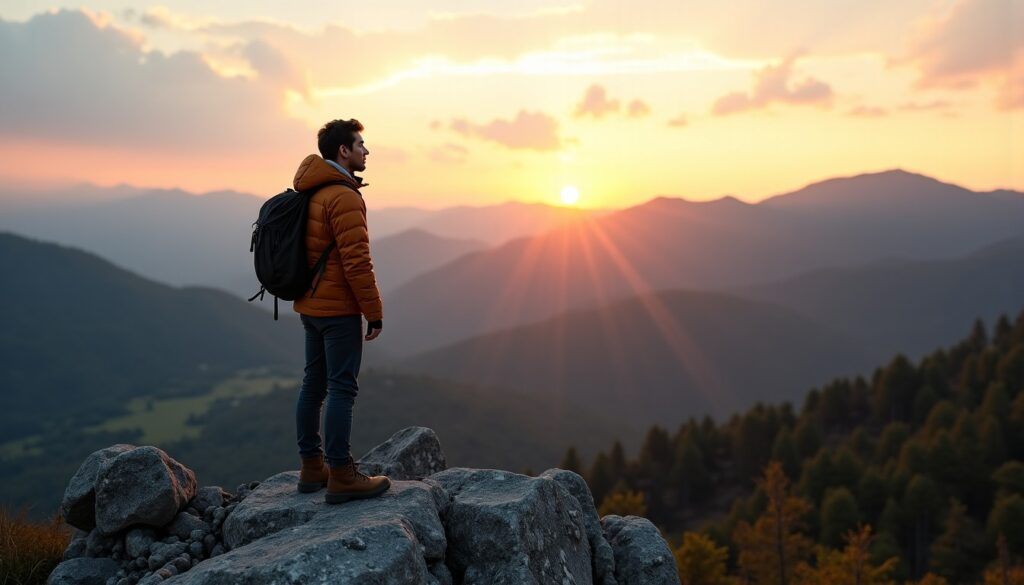
Choosing a wild life, as close as possible to nature, requires a constant exploration between the quest for independence and confrontation with the limits of reality. In this context, we address today the notion of freedom through the poignant example offered by the film Sauvage, whose story takes place in a remote valley of the Cévennes, where a young girl, Anja, chooses to distance herself from her community to live in the woods. This story raises fundamental questions:
- What challenges do we face by isolating ourselves in the wild nature?
- How does marginality become both a force of emancipation and a source of tension?
- How far can one go in the boldness of a bare life, free from social conventions?
- What role does nature play as both guarantor and limit of this quest for freedom?
- How do family ties resist or fade in the face of this human adventure?
We will thus dissect, throughout the sections, the complex interaction between untamable nature, individual boldness, and the fragility of social ties in an attempt to define how far venturing out can truly mean conquering freedom.
A profound immersion in the wild nature: freedom between conquest and constraint
Nature as presented in Sauvage is not just a backdrop; it is a powerful actor imposing its own rules. Anja’s adventure in the forests of the Cévennes illustrates both the aspiration for total independence and confrontation with an environment as magnificent as hostile.
Choosing nature means accepting a relationship to life marked by the unexpected and challenge. In the Cévennes, a preserved and wooded region, living on the margins resembles an exploration where each day reveals its perils: from extreme isolation to bad weather, including the precariousness of natural resources. One measures the immense distance between the idealized image of wild freedom and the demanding reality of a life in self-sufficiency. The film brings to the screen a rare form of authenticity, where the environment keeps its mystery and strength, making every step in the valley a genuine conquest.
This immersion invites us to reflect on the physical and emotional limits we are willing to overcome to reinvent our relation to the world. Independence cannot be decreed; it is earned in often extreme conditions where nature constantly reminds us of its law. Anja’s choice is therefore also an invitation to understand how far one is capable of defying established norms to live according to one’s own codes.
The examples of other human adventures confirm this tension between aspiration and reality. For example, some groups of neo-rurals in the Cévennes in 2026 try to recreate a closed-loop life, sharing everything among themselves and pushing this utopia to its limits. But as soon as a fault appears, solidarity wavers, revealing the fragility of this balance. These experiences show that the conquest of wild freedom is also a collective ordeal, where incessant compromises are necessary for a form of independence to endure.
Faced with these challenges, nature becomes a mirror: it reveals both the grandeur of an adventure and the complexity of human interactions. Understanding this duality is essential to grasp where the true boundary lies between boldness and vulnerability, between escapade and isolation.
In the remote valley where Anja’s story unfolds, marginality is not merely geographical distance. It takes on a political and social dimension deeply rooted in a lifestyle that advocates freedom, sharing, and self-management. The surrounding neo-rural community lives in self-sufficiency, attempting to embody a utopia from the 1970s, where nature and humans mingle in a collective quest for independence.
Anja’s choice to isolate herself intensifies tensions within this micro-society. Her departure acts like a shockwave, revealing the fragility of a fragile model. This voluntary marginality shows us that emancipation is never without impact. By fleeing the implicit rules of her community, Anja puts to the test the solidarity that is the very essence of this group.
The tacit rules of a self-sufficient life are a subtle balance between individual freedom and collective constraints. The break of one member, especially when it involves a child who represents the group’s future, constitutes a real threat. This dynamic is depicted in the film through the silences and unspoken words that surround this flight. Anja is both a symbol of boldness and the revealer of a fault. Her departure transforms a personal adventure into a collective event.
Concrete examples in other neo-rural communities in France and Europe show that these situations of marginality often confront members with painful reconstruction or the splitting of the group. The conquest of freedom through absence therefore calls for rethinking social bonds. Moreover, the presence of a psychiatrist in the film illustrates this dimension, emphasizing that the reasons for this rupture are not only physical but also psychological, requiring support.
To better understand this complexity, here is a list of the effects of chosen marginality in a community context:
- Assertion of personal autonomy: defiance against collective norms.
- Weakening of social ties: questioning of shared rules.
- Amplification of tensions: suspicion, misunderstanding, and isolation.
- Need for broad dialogue: integration of external help or mediation.
- Risk of dissolution: the community may split or withdraw.
In short, marginality as portrayed in Sauvage is never just a simple solitary escape. It questions the fragility of a human system based on trust, mutual surveillance, and sharing. The boldness to be free then clashes with a social reality often less flexible than it seems.
Anja: a complex figure of adventure and quest for freedom
Anja, at the center of Sauvage, is more than a fictional character; she embodies the intimate struggle between desire for individual emancipation and family attachments. Her journey symbolizes this delicate tension faced by those who seek to live off the beaten path, as close as possible to the elements.
Her gradual distancing and then definitive disappearance into the forest are as much acts of boldness as of distress. The film invites us to grasp this ambivalence, where freedom becomes a horizon both exhilarating and painful. The weight of social expectations, pressure of norms, but also the desire for total autonomy make her trajectory deeply human, close to the challenges faced by contemporary real marginalities.
Another key aspect is the role of the mother, Sam. This filial bond is meant to be the last bridge between Anja and the rest of the world. This relationship is a strong exploration of the affective paradoxes related to the quest for freedom: attachment protects and confines, proximity reassures and weakens. Emancipation is never a solitary path; it is inscribed within a network of ties often woven with uncertainties.
In the current context, this portrait echoes many emancipation stories, whether young adults leaving the city, neo-rurals seeking to reinvent alternative lifestyles, or simply people in search of freedom regained in the face of societal constraints.
Here is a table illustrating the central affective dynamic in the film:
| Character | Role in the story | Impact on the quest for freedom |
|---|---|---|
| Anja | Elusive young girl | Symbol of rupture and boldness |
| Sam (mother) | Main emotional bond | Last bridge between freedom and attachment |
| Neo-rural community | Collective in self-sufficiency | Structuring and limiting framework |
| Psychiatrist | External accompanist | Clinical interpretation of tensions |
This configuration strengthens the feeling of a drama on several levels, where the exploration of freedom cannot be separated from its affective and societal context. Anja is never alone; she carries on her shoulders the weight of a community and the hopes for a fragile balance.
The challenges to overcome to live in an isolated and utopian natural setting
Life in a natural environment, far from conventional society, involves a rich and complex adventure. It requires anticipating material, psychological, and social constraints that can disrupt the quest for absolute freedom.
In the case of the film Sauvage, living self-sufficiently in an isolated valley is the foundation of a utopian proposal that involves sharing, consuming differently, and reconnecting with nature. This experience translates into a daily commitment to meet essential needs without resorting to urban conveniences. For example, managing food resources, protection from the elements, health, and safety become major, sometimes dramatic, concerns.
We observe that this way of life demands a form of inner exploration accompanying the outer exploration. The boldness to move toward a wild existence calls for a high capacity for adaptation and a sharp sense of observation. In daily life in a hostile natural environment, each decision impacts survival in the broad sense and the maintenance of real independence.
Here is a detailed list of the main challenges faced by those who live this adventure of freedom regained in nature:
- Resource management: food, water, firewood—all must be planned according to the seasons.
- Natural hazards: falls, animal attacks, extreme weather conditions.
- Social isolation: need to maintain sufficient, even if limited, social ties.
- Health maintenance: limited access to medical care, monitoring of mental disorders.
- Respect for collective rules within a restricted framework to avoid conflicts.
The film also shows that this utopian way of life can quickly become a source of anxiety. When freedom plays its role of emancipation, it naturally reveals the internal and social conflicts that settle beneath the surface.
Testimonials from other isolated groups around the world converge toward the same observation: the ordeal of continuous connection with the community. Nature offers wild beauty but does not abolish relational challenges. Through this collective experience, we understand that distancing oneself to gain freedom requires a daily balance between the desire for independence and the need for belonging.
Cinema as a mirror of wild freedom: the universal significance of “Sauvage”
Camille Ponsin’s artistic choice for her first feature film shows how cinema can become a space for exploring human and social limits. By telling Anja’s true story, it offers a reflection on the very notion of freedom and what its lived experience implies in a radical natural context.
The film adopts a narrative that blends intimacy and grandeur of landscapes, where an individual’s adventure clashes with the immutable rules of the group and nature. This crossing highlights the complexity of human relationships when they take place in a wild setting, a challenge both physical and mental.
In a world where more and more people seek to reconnect with a more authentic way of life, the screening of Sauvage fits within a broader trend that questions the relationship between nature, freedom, and society. The success of this film at festivals such as Annonay in January 2026 reminds us that this subject touches a wide audience today, sharing emotions linked to exploration and the conquest of autonomy.
The cultural repercussions of such works can also influence our way of approaching universes like those of video games. One could relate this quest for freedom to the theme of survival and exploration found in very popular titles. For those interested in immersive open-world experiences, Elder Scrolls VI offers an adventure where mastery of the environment is also a victory over oneself.
Cinema therefore offers a mirror that amplifies the universal scope of questions related to wild freedom, inviting us to think of it from the perspective of sensory, social, and affective experience.