
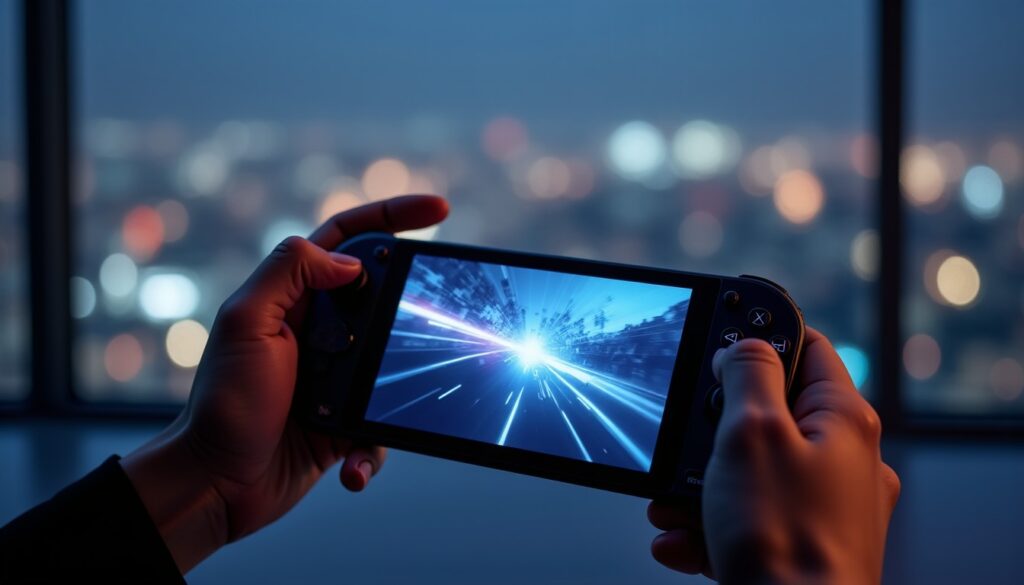
The PS6 Portable promises to be a major revolution in the landscape of handheld consoles. By combining high performance, advanced portable technology, and a design focused on mobile gaming, this new console marks an important milestone for Sony. Here is what this console, promised for the end of 2027, offers:
- Impressive graphical power both on the go and in docked mode.
- An innovative image reconstruction technology allowing to combine visual quality and autonomy.
- Generous memory to support the most demanding games.
- A smooth user experience, compatible with several generations of PlayStation games.
Let’s explore in detail how the PS6 Portable could redefine on-the-go video gaming, while perfectly integrating into the PlayStation ecosystem.
The exceptional power of the PS6 Portable: high performance for mobile gaming
From the first glimpse of technical specifications revealed by leaks, the PS6 Portable promises to be a true powerhouse for a handheld console. With a GPU based on AMD RDNA 5 architecture and a CPU configuration including six Zen 6 cores, this new console pushes the usual limits of gaming on the go.
The raw power displayed is a first in the mobile gaming domain: around 4.91 TFLOPS in portable mode and up to 6.75 TFLOPS when connected to its dock. These figures are all the more impressive as they take into account controlled energy consumption, limited between 15 and 25 W in handheld mode. This technical decision aims to best manage heat, noise, and the machine’s autonomy.
The proposed hybrid approach encourages a dual experience: playing everywhere with a compact configuration, then enjoying a power boost comparable to a home console when the console is docked. The GPU frequency boost thanks to the dock allows players to aspire to optimal smoothness even on a large TV screen.
Several specific elements make this model particularly attractive:
- The presence of 24 GB of LPDDR5X memory, a guarantee of good operation and performance optimization in demanding titles.
- A 3 nm fabricated SoC combining power and energy efficiency.
- A major innovation around native resolution management by the PSSR 3.0 system to maximize resources.
In the context of the recent release of consoles competing on portability like the Nintendo Switch 2024, the PS6 Portable clearly positions itself as a more technical and ambitious alternative. The Japanese manufacturer could thus attract a clientele eager to have a powerful machine without compromising portability.
PSSR 3.0: revolution of portable technology for optimized image quality
Visual quality is often the first compromise in classic handheld consoles due to energy and thermal constraints. Thanks to the technology PlayStation Spectral Super Resolution 3.0 (PSSR 3.0), this new handheld console rethinks this paradigm.
The concept is simple but impactful: games run at an internal resolution of 540p, then the image is reconstructed thanks to PSSR 3.0 to offer a 1080p output. This method allows significantly reduced use of graphics computing resources while guaranteeing satisfactory visual quality for the majority of games.
The process goes beyond simple upscaling. The reconstruction incorporates neural algorithms and intermediate image generation, which significantly improves perceived smoothness and sharpness, targeting a range between 30 and 60 frames per second. This innovation comes close to technologies mentioned earlier in 2026 by Mark Cerny regarding the future of video gaming on PlayStation.
Concretely, this means:
- Reduced consumption, offering better autonomy.
- Sharp images even during rapid movements, a crucial point for mobile gaming.
- Increased fluidity for immersive experiences, whether in an RPG, FPS, or racing game.
This innovative technique illustrates a real change in how power is used, relying less on raw strength and more on software intelligence to deliver a high-level user experience, far from the usual limitations of portable consoles.
The PS6 Portable in the PlayStation ecosystem: compatibility and integration with the PS6
The portable console would not be a standalone product, but a natural extension of the home PS6, also expected in the coming years under the codename Project Amethyst. This dual strategy offers a balance between portability and home power, ensuring continuity in video gaming regardless of context.
An important point to highlight is the planned compatibility with several generations of PlayStation games. Beyond support for PS6 titles, rumors specify partial backward compatibility with a selection of PS4 and PS5 games. This functionality significantly enriches the experience, although some technical limitations or specific restrictions are to be expected.
Here are some significant advantages of this integration:
- Save synchronization: possibility to continue a game started on the main console, without interruption.
- Access to the full PS Plus library thanks to portability.
- Dock mode ensuring comfortable use on a large screen and better power.
This direction shows the intelligence of Sony’s strategy, which capitalizes on a coherent and seamless ecosystem. Gaming on the go will no longer mean a reduced experience but rather the active continuation of immersion made possible by high performance and hardware portability.
For more information about the PS6 ecosystem and its future, you can consult this dedicated analysis on game backward compatibility on PS6.
Comparison with current handheld consoles: the PS6 Portable at the top of the top 5 video consoles
In the arena of handheld consoles, the PS6 Portable is announced as the leader among models available in 2026 and 2027. To better understand its place, it is useful to compare its features with other popular consoles of the same period and recent market initiatives.
The following table highlights these key differences:
| Console | GPU Power (TFLOPS) | Native Resolution | RAM Memory | Dock Mode | Estimated Battery Life |
|---|---|---|---|---|---|
| PS6 Portable (Project Canis) | 4.91 (portable) / 6.75 (dock) | 540p internal -> 1080p via PSSR 3.0 | 24 GB LPDDR5X | Yes | Estimated 4 to 6 hours |
| Switch 2024 | 1.5 | 720p | 8 GB LPDDR5 | Yes | 4 to 5 hours |
| Steam Deck | 1.6 | 800p | 16 GB LPDDR5 | Yes | 3 to 7 hours |
| Steam Deck Pro (ROG Ally) | 2.9 | 1080p | 16 GB LPDDR5 | Yes | 3 to 5 hours |
| PS Vita | 0.3 | 544p | 512 MB | No | 4 to 6 hours |
The performance of the PS6 Portable clearly stands out from competing consoles, both in raw power and technological integration. These advantages reinforce the leader position for this new handheld console.
This ranking and technical specifications testify to the speed at which portable technology is evolving, and how Sony is preparing to meet the expectations of players eager for an advanced user experience, without sacrificing portability.
Technical challenges and issues to be addressed for the PS6 Portable
Balancing high performance and portability is not without constraints. In a compact device like the PS6 Portable, several technical challenges must be mastered for the promise to be fully delivered.
The first challenge is thermal optimization. A GPU power of more than 4.9 TFLOPS, even limited to a 25 W envelope, requires an efficient, quiet, and compact cooling system. Heat management is essential to ensure gaming comfort and preserve autonomy. The 3 nm fabricated components help control this heat emission but do not completely eliminate it.
The second issue concerns the battery. To offer between 4 to 6 hours of autonomy in a context of high graphical demand with PSSR 3.0 activated, Sony will probably need to invest in a high-capacity battery while ensuring a balance between weight and thickness. Effective portability depends on this.
Third aspect, the quality of image reconstruction. Although PSSR 3.0 is promising, its efficiency will need to be proven on a wide variety of games, especially those with fast action. The final rendering must satisfy even the most demanding players, without blur effects or loss of details.
Finally, for a somewhat more experienced audience, price and software ecosystem represent key factors:
- The price will have to reflect the PS6 Portable’s place on the market, facing devices like the Steam Deck or Nintendo Switch.
- A smooth software interface, as well as seamless access to the PlayStation library, will make the difference in terms of user experience.
- Durable update support will be an indicator of the console’s longevity.
In the long run, these criteria will determine if the PS6 Portable will succeed in convincing both enthusiasts and casual players to take the new generation of video games everywhere with them.
To explore the comparison between handheld consoles in 2026, the top 5 video consoles will give you a complete view of machine evolution and trends to follow.