
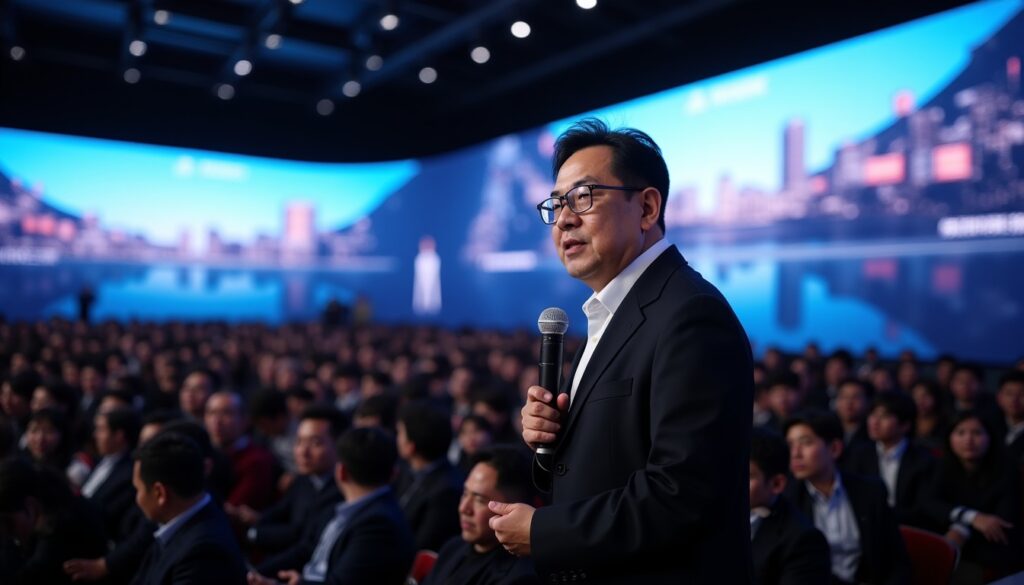
Hideaki Nishino, CEO of PlayStation, has lifted a long-held veil by finally revealing the launch window for the highly anticipated PlayStation 6. This announcement formalizes years of speculation around Sony’s next gaming console, which continues to shape the future of video gaming with a strategy combining hardware innovation and new usages. Here are the key points to remember:
- The PS6, a dedicated home console, will be launched between late 2027 and early 2028.
- Hideaki Nishino emphasizes the importance of the physical console despite the rise of cloud gaming.
- Sony is exploring an extended hardware ecosystem, with hybrid and mobile formats.
- The economic context and component tensions impact design and pricing.
- Competition with Xbox, Nintendo, and Valve stimulates innovation and diversification.
These key components fit into a strategic vision that makes the PS6 a controlled evolution, aimed at player loyalty while adapting to a rapidly changing market. Let’s explore together the details of this next generation of PlayStation console.
An official confirmation of the PS6 launch date according to Hideaki Nishino
The first notable announcement concerns the PS6 release date. After years of rumors and speculation, Hideaki Nishino confirmed that Sony’s new console will be available on the market between the end of 2027 and the beginning of 2028. This timing falls within a thoughtful interval, taking into account, in particular, the challenges related to production and the worldwide availability of electronic components. This launch window aligns with analyses made by industry experts, who anticipated a launch around this period.
Understanding this deadline allows one to appreciate Sony’s strategy, which does not rush to get ahead of the market but takes the necessary time to guarantee an optimal user experience. This approach contrasts with previous generations, some of which were launched more quickly, sometimes at the expense of insufficient stock or technical problems.
Furthermore, the 2027-2028 interval coincides with a flagship evolution in the video gaming landscape, where consoles must combine processing power, advanced connectivity, and compatibility with highly developed online services. Through this launch date, the PS6 fits into a cycle designed to maximize impact both among passionate players and the general public.
Here is a list of reasons motivating this specific delay:
- Adaptation to global semiconductor shortages, particularly RAM.
- Integration of cutting-edge technologies such as next-generation AMD Zen processors.
- Alignment with competitors for an optimal launch on the global market.
- Finalization of a hardware ecosystem that goes beyond a simple home console.
- Anticipation of players’ needs regarding content and network infrastructure.
This confirmation of the launch date is a strong signal reassuring both enthusiasts and industry observers, clarifying the contours of Sony’s inevitable future.
The central role of the home console in the PlayStation strategy unveiled by Hideaki Nishino
Facing the rise of cloud gaming and dematerialized experiences, the CEO of PlayStation clearly reaffirmed that the home console remains the heart of Sony’s activity. The PS6 will not deviate from this rule: it will above all be a dedicated physical machine, designed to offer direct, uncompromising immersion at every launch.
This position illustrates a strong strategic choice. Despite technological advances in game streaming services such as PS Plus Premium, the added value of a dedicated device connected to a television remains undeniable. Hideaki Nishino insisted that being able to turn on the console and start a game immediately is an irreplaceable experience, forming the foundation of PlayStation’s DNA.
The numbers clearly illustrate this reality. In 2023, the launch of the PlayStation Portal, a portable device focused on cloud streaming, attracted about 7% of PS5 players, a relative success compared to the massive deployment of home consoles. The choice to thus consolidate the traditional console is a return to origins that reassures the gaming community as well as developers who continue optimizing their titles for powerful hardware.
Sony adapts this hardware foundation to a demanding global context, where visual quality, game fluidity, and online connectivity become essential criteria. Maintaining a physical console model also allows the brand to control the entire user experience, from technical performance to handling with peripherals such as the DualSense.
To better understand the importance of this positioning, here is a table summarizing the key reasons for maintaining the home console model:
| Advantages of the dedicated console | Explanation |
|---|---|
| Immediate game launch | Instant access without dependence on internet connections |
| Optimized graphic quality | Powerful hardware support for 4K and advanced ray tracing |
| Controlled user experience | Full integration with controllers, accessories, and interface |
| Support for developers | Stable and uniform platform for optimizing games |
| Strategic value | Maintaining a tangible product amid the rise of cloud gaming |
This vision reassures a market where some feared a progressive disappearance of PlayStation hardware in favor of purely digital models. The CEO thus confirms that Sony bets on a balance between technological innovation and loyalty to its heritage.
Expanding the PlayStation experience: hybrid, mobility, and new formats according to Hideaki Nishino
While the home console will be the pillar, Hideaki Nishino mentions significant diversification around the PS6. Sony indeed wishes to develop a hardware ecosystem that is no longer limited to a simple black box. The future leans towards hybrid forms, combining portability, cloud gaming, and dedicated accessories.
This strategy is manifested by several initiatives already underway:
- The PlayStation Portal, a portable device launched in 2023 to experiment with streaming.
- The cloud gaming PS Plus Premium, a technology still little adopted but promising.
- InZone monitors branded PlayStation, designed to optimize rendering for demanding players.
Within this framework, the PS6 could incorporate hybrid features, such as a model capable of being used both at home and on the go, following the aspirations of modern players. One thinks of an approach close to what the Nintendo Switch 2 offers, with a balance between classic and portable consoles for greater flexibility.
This shift reflects a desire to support different lifestyles, as players now want to enjoy their universes in diverse ways without location constraints. This trend toward more mobile, modular formats could also stimulate the creation of new types of games, adapted to these multimode usages.
For industry players, this is an engineering and innovation challenge, especially to guarantee high performance while reducing energy consumption and offering user-friendly interfaces. The PS6 will likely represent this subtle balance between power and modularity, awaited by player communities.
This strategic orientation opens new horizons for Sony, which no longer just competes on raw power but develops a complete and coherent ecosystem aligned with current market trends.
Economic and technical aspects influencing the development and price of the PS6
The realization of the PS6 is also marked by strong economic constraints. Hiroki Totoki, Sony’s CEO, recalled that tensions in essential component markets, such as RAM, guide decisions related to the console’s launch and pricing. This reality affects margin and pushes for exploring alternatives to optimize costs.
In this context, Sony is considering several options, such as:
- Adoption of an all-digital model, reducing the role of physical media.
- Optional sale of a disc drive, giving players more freedom.
- Enhanced collaboration with AMD to integrate powerful Zen processors and RDNA 5 GPUs.
These choices fit into a balanced approach, aiming to preserve performance while controlling price so as not to hinder adoption. It is a delicate balancing act, facing ever more demanding requests for 4K experiences with advanced ray tracing and high refresh rates.
The following table summarizes the challenges and solutions envisaged for the PS6 design:
| Challenges | Envisioned solutions |
|---|---|
| Global component shortages | Extended planning and strategic partnerships |
| High cost of semiconductors | All-digital models and hardware flexibility |
| Competitive pressure | Continuous innovation and format diversification |
| Advanced technical requirements | Integration of AMD Zen technologies and RDNA 5 GPU |
It should be noted that caution regarding the launch date remains justified, as a shift towards 2029 is not excluded if supply chain tensions persist. The PS6 price itself will have to reflect this market reality while remaining competitive against alternatives proposed by Microsoft and its projects such as “Project Helix.”
Competition and the impact of trends on the future PlayStation 6 hardware
The video gaming market today is characterized by a strong dynamic around hybrid formats and cloud experiences. The upcoming generation faces direct competition with the new Xbox generation, notably via the “Project Helix,” which aims to merge PC and console universes. Nintendo continues its hybrid approach with the Switch 2, while Valve works on a new Steam Machine.
In this context, Sony positions itself with caution but determination. Hideaki Nishino emphasized the complementarity between hardware and content, especially live-service games, to attract and retain a global audience. This synergy forces Sony to think about hardware capable of integrating advanced connectivity and an open software environment, while maintaining solid compatibility with titles from previous generations.
Here is a concise list of expected strengths and weaknesses facing the competition:
- Strengths: solid loyal fanbase, stable platform, performant AMD technology.
- Weaknesses: risks of delays linked to the supply chain, limited adoption of mobile accessories.
- Opportunities: hardware diversification, expansion in cloud gaming and hybrid formats.
- Threats: competitors increasing modularity and mobility of their platforms.
Mastering this competition is a major strategic challenge, as the PlayStation experience must evolve to remain attractive while respecting the strong expectations of loyal players. The balance between continuity and innovation will be PS6’s key asset in this context.
To discover the history and previous models that forged Sony’s console success, you can consult this overview of the best video consoles, which illustrates the Japanese manufacturer’s trajectory in the gaming world. Additionally, to follow technical developments and rumors concerning the PS6, this detailed article on the 2025 rumors offers valuable insight.