
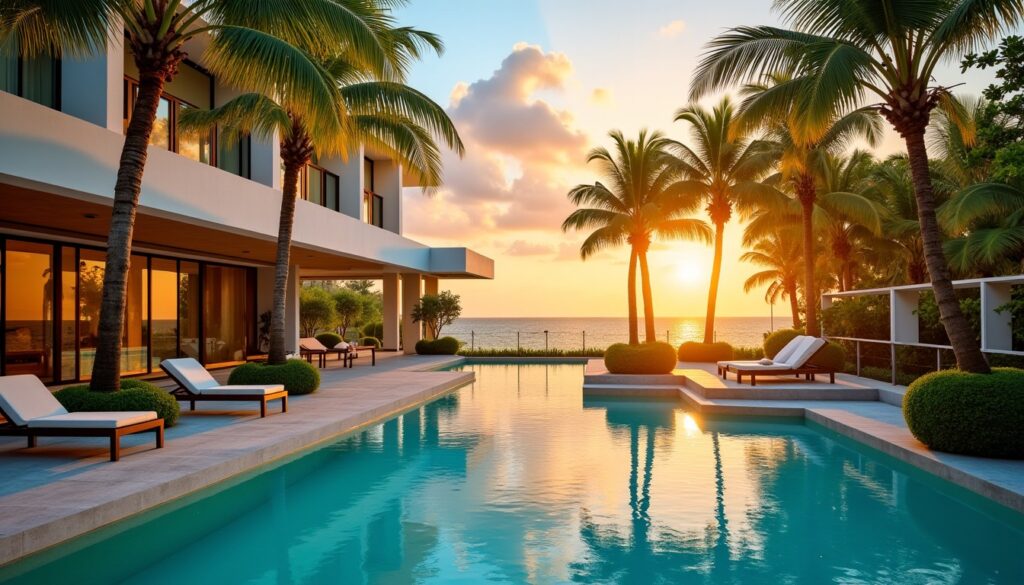
Oasis, the Spanish series broadcast on Netflix since June 19, 2026, fascinates as much for its gripping plot as for the sumptuous hotel that serves as its central setting. This eight-episode series rated 16+ captivates viewers with a mystery revolving around a disappearance in a luxury resort called Oasis Infinity. Very quickly, the question arises: does this hotel actually exist or is it merely a studio creation? We will clearly answer this question while exploring several essential dimensions:
- The link between fiction and reality in the choice of filming location
- A detailed description of the real hotel behind Oasis Infinity
- The role of the set in the narration and atmosphere of the thriller
- How Tenerife contributes to the authenticity and unique ambiance of the series
- The impact of using a real location for a fictional story on Netflix and local tourism
Each section analyzes a specific aspect to offer you a complete and meaningful discovery. So let us prepare to dive together behind the scenes and realities of this emblematic place.
Oasis on Netflix: an emblematic hotel rooted in reality
The series Oasis places the fictional hotel Oasis Infinity at the heart of its story, presented as the most exclusive place in Tenerife where wealthy families gather under the sun, by infinity pools overlooking the Atlantic. However, this idyllic image is supported by a real establishment: the Gran Meliá Palacio de Isora. Located in the municipality of Guía de Isora, on the west coast of Tenerife, this five-star complex not only provided its setting but also its logistics to the filming team.
The choice of this hotel is no coincidence. Its main pool, the longest saltwater infinity pool in Europe, becomes a powerful visual protagonist in the series. This pool symbolizes the border between luxurious appearances and hidden tensions, which the series skillfully exploits. The pools are spread across the estate, accompanied by facilities such as tennis courts, a high-end spa, and the exclusive RedLevel areas, reserved for adults only.
Here is a table illustrating some characteristics of this real hotel that help make the atmosphere so believable in Oasis:
| Feature | Description | Correspondence with Oasis |
|---|---|---|
| Infinity Pool | The longest saltwater pool in Europe | Recurring location for tense scenes |
| RedLevel Areas | Adult-only zones with premium services | Symbolizes exclusivity shown on screen |
| Geographical Location | West coast, view of the Atlantic Ocean | Magnificent panoramic view in the series |
| Rates (in 2026) | 215 to 1300 euros per night depending on season and service | Corresponds to the image of ostentatious luxury |
By booking at Gran Meliá Palacio de Isora, one enters a world very similar to the one projected by Oasis, even though the hotel’s name is changed to strengthen the fictional dimension.
The role of the real filming location in Oasis’s narrative dimension
By opting for a real hotel, the production of the Oasis series by Bambú Producciones and its team led by Ramón Campos chooses total immersion. The entire team settled in Tenerife between July and November 2025 to capture the very essence of the environment, far from superficial or virtual sets. This palpable presence is felt in the staging, which fully exploits natural volumes, sunlight, and the architecture unique to Gran Meliá Palacio de Isora.
The luxury here is not limited to mere visual appeal but becomes a dramatic driver. Interactions take place in a setting anyone could truly visit, which, for viewers used to streaming series, creates a disturbing authenticity. The subtle boundary between set and tangible location strengthens the narrative tension, with screen and reality almost blending together.
This strategy recalls series like The White Lotus where the setting plays a similar role: it is a character in its own right, both ambiance and constraint at the same time. Oasis thus stands out by fully exploiting its local setting, against superficial dressings that often try to mask their artificial nature with green screens or modular sets.
Why this choice has such an impact on the viewer’s perception
With a visible, real, and perfectly exploited location, Netflix places Oasis in a logic of sensory proximity. The viewer imagines the sea breeze, water reflections on faces, the warmth of the sun on the skin, reinforcing the tension created by the mysterious disappearance. It’s much more than just a backdrop.
By engaging a concrete location, the production also establishes a paradoxical feeling of confinement: idyllic beauty can quickly turn into a vice, a golden prison for characters trapped by their secrets and circumstances. This double effect amplifies the dramatic impact of the series.
Tenerife, a natural and narrative essential setting of Oasis on Netflix
Beyond Gran Meliá Palacio de Isora, the series highlights the idyllic and contrasting landscapes of Tenerife. The beaches, cliffs, panoramic roads, and historic landmarks become extensions of the story.
For example, in a scene from the first episode, we discover La Jaquita beach where a tense swim takes place. The majestic cliffs of Los Gigantes are the visual setting for a boat outing. These spaces contribute not only to the aesthetics but also to the symbolism of the series: the opposition between freedom and confinement.
The roads TF‑12, TF‑121, and TF‑42 lend themselves to driving scenes where escape seems possible but isolation is always felt. Towards the end of the season, the Sanatorio de Abona, a site rich in history, offers a raw and supernatural setting, heightening the dark and oppressive atmosphere.
The presence of lighthouses such as Punta Abona or Punta Rasca further anchors this unique ambiance specific to this strategic archipelago in the Atlantic Ocean, while reinforcing the feeling of being in a place that is both paradisiacal and mysterious.
List of key locations featured in the series in Tenerife:
- Gran Meliá Palacio de Isora (main hotel)
- La Jaquita Beach
- Los Gigantes Cliffs
- Panoramic Roads TF‑12, TF‑121, TF‑42
- Sanatorio de Abona
- Punta Abona Lighthouse
- Punta Rasca Lighthouse
This real-world setting provides a rich backdrop, close to nature, punctuated by stories and symbols that nourish the fiction.
Impact of the hybridization between fiction and tourism around the Oasis Infinity hotel
The decision to use a real hotel like Gran Meliá Palacio de Isora to represent Oasis Infinity triggered immense curiosity among the series’ fans and luxury travel enthusiasts. Since the release, there has been a growing tourist enthusiasm for Tenerife, its beaches, and its five-star resort.
Streaming platforms like Netflix know that the setting influences the audience, and that the quest for authenticity can create a desire for immersion that goes beyond the screen. Oasis’s example shows that the boundary between fiction and reality can stimulate the local economy, generate visits, and enhance the attractiveness of a destination.
The hotel has recorded an increase in attendance and receives unusual inquiries about the rooms and services featured in the series. The dream that fiction has sold, with its infinity pools, spas, and exclusive spaces, influences the expectations of an increasingly demanding international clientele.
Here is a summary table of the main observed effects:
| Effect | Description | Concrete Example |
|---|---|---|
| Increase in tourism | The number of visitors to Tenerife grows significantly | Increase in bookings at Gran Meliá Palacio de Isora |
| Increased popularity | Tenerife’s notoriety as a filming location spreads | The series ranked as the 2nd most-watched fiction in France |
| Attractive effect | The prospect of staying in a set seen on screen motivates | Requests for price and availability information |
This phenomenon is not isolated: productions like certain thrillers on Netflix show how the choice of setting can strongly influence the reception of the series and the desire to travel.
Why Oasis bets on a real hotel for an immersive and credible fiction
The bet to anchor fiction in an identifiable and tangible place rests on several major advantages. On the one hand, the visual credibility is indisputable: the architecture, the nuances of natural light, and the real proximity to the ocean create a setting impossible to perfectly imitate in a studio.
On the other hand, this allows the scriptwriters to create a universe where the environment acts almost like an additional character, thus limiting the banality of an anonymous setting. The series takes advantage of this authenticity to develop closed-room plots where pressure rises at the pace of secrets.
By aligning fiction with a place that exists, the creators provide a more intense visual and emotional experience. They play on the contrast between the idyllic setting, apparent luxury, and underlying character tensions. This nourishes the narrative and amplifies the share of anxiety and mystery typical of the thriller genre.
While there is no official hotel named Oasis Infinity, the combined success of the fiction and its real setting perfectly illustrates the power of a beautiful place in a high-impact production.
This strategy also recalls the sometimes unexpected effects on the leisure industry, generating both a matching between imaginary scenes and real life, but also unprecedented expectations in terms of tourism and customer experience.
To deepen the role of fictional universes in consumption and popular culture, you can find additional details in the news about future DLC and expansions in the field of video games and series.