
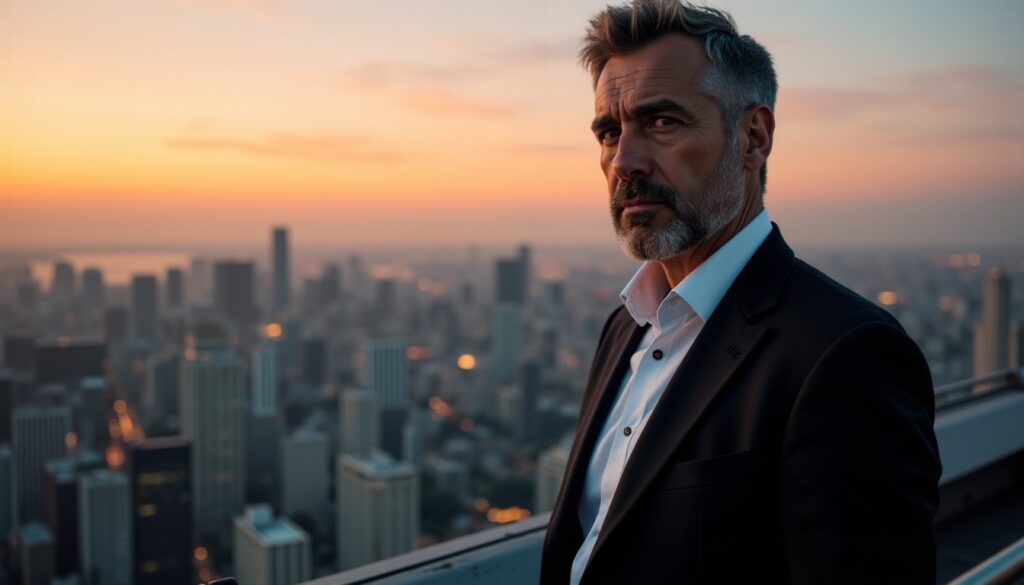
The series Man on Fire arrives on Netflix on April 30, 2026, with the heavy task of matching the legendary intensity of the cult film from 2004, starring Denzel Washington. This new adaptation of A.J. Quinnell’s novel grabs attention through several key elements:
- An ambitious cast led by Yahya Abdul-Mateen II, who portrays John Creasy, a role once immortalized by Washington.
- An extended narrative over eight episodes, offering a deeper exploration of the character and themes.
- A polished aesthetic and international filming that promise visual quality comparable to current standards.
- A screenplay that departs from the classic film to return directly to the literary sources of the first two novels.
We will explore in detail why this Netflix project raises so much hope and many questions, by examining the genesis of the film, the particularity of this series adaptation, the central role of the lead actor, as well as the narrative and aesthetic challenges the series must face to convince.
The cult film of 2004: A model of dramatic intensity and action
The film Man on Fire directed by Tony Scott remains an essential reference in modern thrillers. Its success relies on a rare combination of visceral action and human drama. Denzel Washington delivers a masterful performance in the role of John Creasy, a former assassin turned bodyguard charged with protecting a young girl in Mexico.
The film asserts its originality through its fast-paced rhythm, stylized artistic direction, and an almost constant build-up of tension. The violence is sharp, without gratuitous excess, reinforcing emotion rather than diluting it.
This alchemy between action and introspection is one of the main factors explaining the strong impact left on viewers:
- A poignant redemption story: Creasy is not an invincible hero, but a man tormented by his past and post-traumatic stress.
- An atmosphere-rich setting: Mexico in 2004 is depicted as a place both belligerent and vibrant, a fertile ground for strong narrative tension.
- The relationship between Creasy and the young ward: It brings a rare emotional dimension, infusing profound humanity into an action thriller.
The film’s impact is still noticeable in the world of cinema, inspiring generations of authors and directors. Its legacy naturally makes the task ambitious for any new adaptation, especially for the series which must face high expectations from fans.
The Netflix series: A faithful adaptation of the novels and enriched narration
The Netflix series does not position itself as a direct remake of the film but as a new interpretation based on the first two novels of the saga written by A.J. Quinnell. This approach allows offering a fresh perspective on the character of John Creasy and his evolution. Rather than simply reproducing the 2004 plot, the series seeks to deepen:
- The heavy past and traumas of the protagonist, emphasizing his internal struggle against severe post-traumatic stress.
- The social and political context of Mexico and Brazil, chosen locations to enrich the narrative and reinforce realism.
- The gradual buildup of the relationship between Creasy and the girl he protects, vital in the emotional dimension of the story.
- A deep dive into the mechanisms of vengeance and its psychological consequences.
Structured over eight episodes of about 60 minutes each, the series benefits from a format that unfolds the narration over a significant duration, allowing a depth difficult to achieve in a feature film.
The series thus introduces a dynamic mixing action and drama, with contemplative and introspective scenes that bring to life a more human and nuanced John Creasy. The official slogan, To keep her safe, he’ll burn it all down, sums up well this duality between relentless protector and man haunted by his demons.
With filming carried out between October 2024 and February 2025 in several countries, notably Mexico, Brazil, and Italy, the project also bets on a rich and realistic visual setting.
Comparative table between the series and the cult film
| Aspect | Film (2004) | Netflix Series (2026) |
|---|---|---|
| Duration | 2h26 | About 8h (8 episodes x 60 min) |
| Source | First novel only | First two novels |
| Protagonist | Denzel Washington | Yahya Abdul-Mateen II |
| Narrative approach | Condensed action and drama | In-depth exploration of character and backstory |
| Setting | Mainly Mexico | Mexico, Brazil, Italy |
Yahya Abdul-Mateen II: an heir worthy of the iconic Creasy role
Replacing Denzel Washington in a role that became cult represents a real artistic challenge. Netflix chose Yahya Abdul-Mateen II, a recognized and award-winning actor, capable of combining physical intensity and great emotional depth.
Abdul-Mateen II drew attention with his performances in works where character complexity takes precedence, such as in Watchmen. His portrayal of John Creasy seeks to reveal a more vulnerable and introspective side of this tormented bodyguard:
- Sensitivity to psychological disorders, particularly post-traumatic stress.
- Palpable tension between vengeful rage and the quest for inner peace.
- Sincere and fragile relationship with the young ward, delicately developed over the episodes.
These elements reflect a desire to differentiate the series from the cult film, proposing a more current and nuanced version of John Creasy.
This adaptation is thus not a mere copy but an evolution of the myth. The creative team, led by Kyle Killen, relies on experienced directors such as Steven Caple Jr., Vicente Amorim, Michael Cuesta, and Clare Kilner, who know how to manage tense and suspense-filled universes.
Narrative and aesthetic challenges to match the film’s intensity
Turning an intense action film into a coherent series over eight episodes requires a delicate balance between pace and depth. The series must maintain constant suspense without sacrificing dramatic quality.
The television format allows detailed exploration of the character’s traumas, social contexts, and the consequences of violence, thus offering a more thoughtful spectacle. Flashbacks notably deepen Creasy’s past, giving weight to his choices.
Visually, the series bets on a neat style, heir to Tony Scott’s work but with a modernity specific to 2026:
- Natural and authentic settings between Mexico, Brazil, and Italy, ensuring geographical diversity.
- Photography that accentuates the duality between light and darkness, symbolizing the hero’s state of mind.
- Carefully choreographed action scenes, avoiding excess to maintain strong tension.
The key is to find a middle ground where action supports the drama without falling into overkill or banality. This challenge will be decisive for the Man on Fire series to find its place in the audiovisual landscape without simply being compared to the cult film.
A series with multiple promises for a demanding audience
The series Man on Fire attracts both fans of the original film and new generations in search of intense and well-built thrillers. Several factors set it apart on this stage:
- An extended narration that allows expanding the plot and offering more complex twists.
- A deep introspection into the psychological mechanisms of the hero, ambiguous between violence and tenderness.
- A solid cast and an experienced technical team for a professional and immersive result.
- A suspense faithful to the nature of the thriller, capable of maintaining attention and surprising.
Between muscular action and intimate drama, the series does not aim to become a remake but a complementary work enriching the mythology of John Creasy. By relying on novels, this Netflix project invites audiences to reconnect with both the literary and cinematic universe.
For lovers of strong sensations and deep stories, this production promises an immersive experience where emotional intensity aligns with well-measured suspense. The comparison with the cult film is inevitable, but the series boasts undeniable assets to write its own chapter in the Man on Fire myth.