
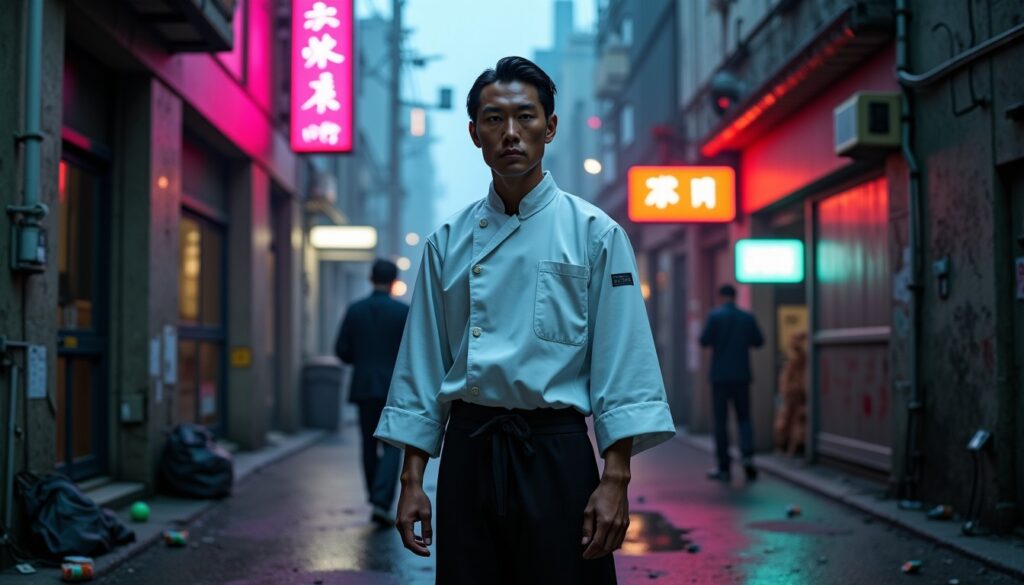
Get Jiro! turns a gang war into a gastronomic conflict: in its futuristic Los Angeles, chefs control territories, restaurants are like fortresses, and a master sushi chef pursues a quest for vengeance. Adapted from the comics created by Anthony Bourdain and Joel Rose, the Adult Swim animated series mixes crime, social satire, and excessive violence. Its gamble doesn’t rely solely on the originality of its setting: it intends to make cuisine a true language of power, without reducing the story to a succession of bloody fights.
- A universe: Los Angeles, reorganized around culinary clans and their restaurants.
- A hero: Jiro, a taciturn master sushi chef whose talent feeds both his reputation and his quest for vengeance.
- A format: ten episodes, with the American release announced for October 3, 2026, and French arrival on HBO Max on October 4.
To appreciate this adaptation, we can follow three threads at once: the satire of class relations, Jiro’s personality, and the way animation will bring this world to life. Each illuminates a different facet of this dystopia where choosing a restaurant may cost much more than just the price of the meal.
Get Jiro! turns Los Angeles into a culinary dystopia
In the world of Get Jiro!, food is not just a backdrop nor a pretext for beautiful images. It determines who commands, who dines at the best table, and who can move around without fearing retaliation. Large brigades take the place of traditional gangs: their leaders rule neighborhoods, their establishments serve as bases, and their rivalries play out through threats as well as carefully composed dishes.
This idea becomes clearer if we imagine a customer looking for a table after a day’s work. In an ordinary city, she compares prices and checks reviews; here, she also has to know which faction controls the restaurant, who recommended the place, and whether her reservation really guarantees entry. The meal becomes a sign of allegiance, almost a pass. Social hierarchy is read in the ingredients, table manners, and access to prestigious establishments.
The series draws its dark humor from the contrast between absurd stakes and their perfectly serious treatment. A chef can defend the honor of a sauce as a godfather would protect his territory. A food critic then takes on the appearance of a declaration of war, while an ingredient deemed mediocre becomes an almost unforgivable fault. It’s not just the amount of violence that makes one laugh: it’s the fact that every character seems to accept the rules of this society as if they were self-evident.
When reservations become a status symbol
A reservation in this world is worth more than just a seat at the table. It signals that one belongs to the right circle, enjoys protection, or has enough purchasing power to access rare products. Restaurants thus do not serve only to feed: they organize meetings, alliances, and the circulation of privileges.
This mechanism gives the dystopia a familiar basis. We know restaurants transformed into prestige markers, menus designed as exclusive experiences, and debates where technical mastery becomes a sign of superiority. Bourdain pushes these codes to the extreme: in Get Jiro!, obsession with quality ingredients is not trivial, as it can decide the survival of a diner or a cook.
For a French audience, the mechanism also evokes how a place can become a social boundary without any physical barrier being necessary. Price, specialized vocabulary, and reputation already filter customers; the fiction adds the direct threat of clans to these obstacles. The satire works because it starts from recognizable habits and shifts them into organized crime.
This reading distinguishes the series from a simple culinary action story. The plate reveals each person’s position, and the restaurant exposes the city’s rules better than a long explanatory speech: this is where the concept finds its first strength.
Anthony Bourdain and Joel Rose: satire sharpened by comics
The project adapts a comic book created by Anthony Bourdain and Joel Rose. This origin matters because the idea does not come from a culinary fantasy universe detached from reality: it plays with Bourdain’s reputation, as chef and observer of kitchens, sensitive to products and traditions but wary of pretentious postures. The series can rely on this tension between respect for the profession and mockery of those who turn meals into status displays.
In a professional kitchen, precision is concrete: a repeated gesture, a monitored temperature, a carefully treated fish. Teams work under pressure, roles are hierarchical, and one mistake can slow down the entire service. Get Jiro! amplifies this reality to the point of murder. The result is deliberately exaggerated, but its comic effect remains tied to behaviors the viewer can recognize: ego, competition, and the idea that a chef is always right because he masters his craft.
A political kitchen rather than a spectacular tasting
The comparison with Food Wars! helps to grasp the tonal difference. In the Japanese anime, tasting turns into ecstatic spectacle, with reactions going far beyond the meal. Get Jiro! rather uses gastronomy as a political architecture: knowing how to cut a fish grants authority, imposing a recipe asserts rank, and rejecting a sauce can be interpreted as a challenge.
This approach doesn’t prevent the series from showing appealing dishes or technical gestures. It gives them a second function: every detail of the preparation informs about the character who masters it. A chef who treats the fish patiently expresses discipline; a rival who turns every service into a performance might mainly seek to control the dining room. Thus, cuisine narrates power relations without interrupting the action.
The screen adaptation will have to maintain this acidity. Warner Bros. Animation inherits a graphic universe associated, in the comic, with Langdon Foss’s drawing. Animation will need to make the geography of restaurants, the precision of gestures, and the brutality of confrontations readable. If everything becomes a series of stained aprons and blades, the universe will lose its most interesting contrast: the beauty of a dish facing the violence of those who claim its prestige.
The animated format can also enhance the comic contrast. Impeccably run service, where every cook maintains professional calm while rivalry degenerates, can produce humor sharper than explicit jokes. This adaptation will be all the more unique by preserving the passion for the craft while attacking the codes of those who make it a social religion.
To situate this series among animated adaptations aimed at adult audiences or action fans, we can also look at the projects around Solo Leveling planned for 2026. The comparison is not about the subject but about a common challenge: making a work from another format into a visual narration capable of retaining its identity.
Jiro, master sushi and man of vengeance
Jiro arrives with an already impressive reputation. He is presented as a master sushi chef, endowed with mastery that makes him dangerous in a world where professional skill overlaps with power. His quest for vengeance places him at the heart of the conflict, but his calm sets him apart from chefs who seek to occupy space with loud speeches or displays of prestige.
This contrast can give the character real presence. When others overplay their authority, Jiro’s silence becomes a threat. He doesn’t need to proclaim control of a situation: a precise gesture, a look, or a decision made without hesitation can suffice. In a story where every exchange risks turning into confrontation, this restraint creates effective tension.
A taciturn hero must reveal his motivations
The risk is making Jiro a silhouette whose skill substitutes for personality. An impassive protagonist works as long as the story lets us understand what his silence protects: mourning, a debt, attachment to his craft, or contained anger. His vengeance must therefore have meaning beyond narrative mechanics. Who does he want to make pay for what, and what price is he ready to settle himself?
Warner Bros. Discovery’s casting announcements indicate that Brian Tee lends his voice to the main character. Known notably for Chicago Med and Fast and Furious: Tokyo Drift, he has a range capable of giving Jiro a grave authority without turning him into a constantly menacing figure. Titus Welliver, Alison Pill, and Justin Kirk are also among the announced names, while the detailed distribution of secondary roles is not fully specified in the available information.
A precedent from Adult Swim animation offers a useful clue: Primal, by Genndy Tartakovsky, makes Spear’s pain exist through gestures, silences, and pauses, without multiplying explanations. This method could suit Jiro. A scene where he prepares a meal alone after a confrontation could say as much about his relation to loss as a long monologue, if the staging lets us read his choices and hesitations.
His art also demands a particular physical presence. Preparing sushi requires precision and an attentive relationship to ingredients; making it a narrative weapon should not erase this dimension. If Jiro represents only a man armed with a knife, the story is deprived of what makes him distinctive. His culinary mastery must shape his ethics, his way of observing others, and the limits he refuses to cross.
His calm will only fully count if the series shows what it costs him. Vengeance gives Jiro his drive, but it is his relationship to the craft that can give him true depth.
Ten episodes to balance action, satire, and survival
The announced season counts ten episodes. This format gives space to factions, restaurants, and the city’s rules, while forcing the story to make choices. A longer series might multiply secondary rivalries without giving them consequences; ten chapters can instead maintain a tight progression, provided each confrontation changes the balance of power.
We can imagine an effective progression in three moves: discovering the rules through early conflicts, following Jiro’s rise or isolation at the heart of the clans, then weighing the consequences of his decisions on the city. This is not a confirmed season breakdown but a way to gauge the interest of the format. If an episode presents a restaurant or a brigade, this discovery should modify our understanding of power, not just add a colorful backdrop.
The seriousness of characters reinforces dark humor
Satire gains strength when characters take seriously rules that seem absurd to the public. Archer often exploits this kind of contrast by entrusting extravagant tasks to professionals who treat them with bureaucratic application. Get Jiro! can produce a similar effect around culinary codes: a clan negotiation could concern the origin of an ingredient, its cut, or the order in which it must be served.
Violence will not have the same impact if it remains without consequence. A confrontation should modify alliances, a chef’s reputation, or access to a place. Imagine a brigade losing its restaurant after a failed service: the sanction would not only be spectacular, it would deprive its members of their territory, income, and protection. The theme of survival would then gain a concrete dimension.
This attention to consequences also helps avoid an overdose of action. A brutal scene can mark the viewer if it contrasts with the care given to preparing a dish or the silence of a counter. Conversely, incessant fights risk making crime banal and dulling the dark humor. The pace must alternate tension, observation, and explosion, so that each register reinforces the others.
The ten episodes can thus serve the series if the world unfolds through situations rather than prolonged explanations. A menu, a refused reservation, or a room guarded by clan members can suffice to make a rule understood, provided its effects are visible. The format’s density becomes a quality when culinary details advance the plot.
The announced schedule positions the first American broadcast at midnight on October 3, 2026, Eastern and Pacific Time, on Adult Swim and Toonami. In France, the season is announced on HBO Max on October 4, 2026: the one-day gap corresponds to programming hours, not two separate launches.
| Reference | Announced information | Audience stake |
|---|---|---|
| Format | Ten episodes | Tight plot around the clans and Jiro |
| United States | October 3, 2026 on Adult Swim and Toonami | Announced first television broadcast |
| France | October 4, 2026 on HBO Max | Arrival after the American launch |
| Voice of Jiro | Brian Tee | A serious interpretation for a reserved hero |
This schedule and format provide a readable framework, but success will depend above all on the link between each episode and the satire. A battle will only be biting if it reveals something about the society that made it possible.
What Get Jiro! must succeed at to stand out
Get Jiro! has a concept easy to summarize and richer than it seems: gangs are brigades, territories are restaurants, and gastronomy serves as social currency. This starting point grabs attention, but it is not enough to carry ten episodes. To last, the series will have to develop its characters and show how the rules of this dystopia affect those who do not have the power to choose their side.
Preserving the acidity behind the spectacle
The first challenge is balancing dark humor and violence. A teaser emphasizing confrontations may announce an adult tone, but gore does not replace an idea. For satire to work, excess must reveal the ridiculousness of a system: chefs ready to kill to defend their prestige, clients accepting domination in exchange for a sought-after table, or cooks trapped in a hierarchy that values their talent while exposing them to danger.
The second challenge concerns the legibility of factions. If each clan possesses a culinary identity, it must go beyond mere costume or the name of a dish. One brigade could impose rare products to exclude modest residents; another could defend a tradition as an instrument of control. These examples would distinguish the groups while keeping the core of the story: cuisine is not neutral when those who lead it make it a boundary.
The third challenge involves representing work. A credible kitchen is built with gestures, schedules, coordination, and attention to ingredients. By showing Jiro’s skills and those of his adversaries, the series can make confrontations more specific. A duel would then not be just two characters drawing blades; it would also oppose two ways of conceiving the profession, discipline, and respect for the product.
We can relate this attention to places to the way popular culture reinvents familiar spaces. The LEGO restaurants inspired by Japan, Mexico, and Greece play, on a much lighter tone, with visual signs associated with cuisines and cultures. In Get Jiro!, these signs become markers of prestige and belonging, giving each establishment a dramatic function.
Finally, the series will have to make Jiro more than a vengeance tool. If his choices have a cost for those around him, his calm could hide a moral conflict rather than a simple stance. And if his culinary talent sometimes serves to preserve a life instead of taking one, the character will gain a tension that fights alone cannot offer him.
The strongest promise of Get Jiro! thus lies in a contrast: cuisine filmed seriously in the middle of a criminal society that has lost all measure. It is this mix, more than the number of blades or spectacular dishes, that can give the adaptation its own flavor.