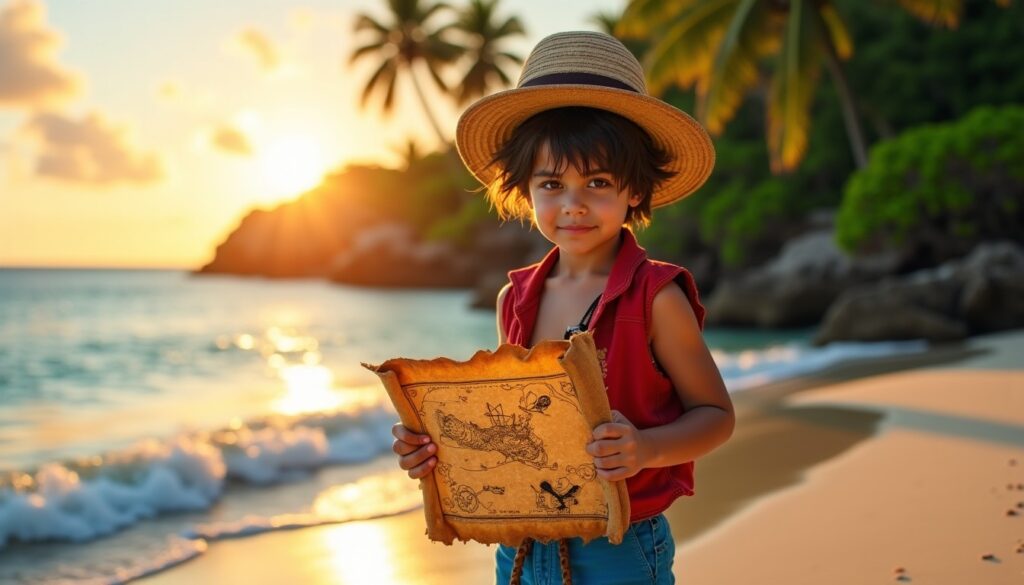
Fortnite will launch its pirate mini-season Treasure Hunters on November 1, 2026, with One Piece at the center of a collaboration revealed in a trailer published at the end of October. The Going Merry will replace the Battle Bus and will lead players to a new skull-shaped island, while Luffy, Zoro, Nami, and Usopp appear in the first images.
This new season will not be limited to the universe created around Luffy: other characters and artists are also announced. To follow the confirmed information without confusing promotional images and playable content, let’s note these initial markers:
- Announced start: November 1, 2026, after the end of the Override season.
- Main setting: a pirate island shaped like a skull, accessible aboard the Going Merry.
- Showcased elements: techniques and accessories associated with several One Piece characters.
- Information still awaited: the details of passes, skin availability, and ability rules.
The trailer therefore gives a clear direction for this event but does not yet reveal all its mechanics. We can already examine what changes in the video game, distinguish confirmed announcements from outstanding questions, and prepare our arrival on this new island.
Fortnite Treasure Hunters: release date and place in the calendar
Treasure Hunters begins on Sunday, November 1, 2026, the day after the scheduled end of Chapter 7 Season 4, called Override. The trailer published by Epic Games at the end of October confirms the launch of this mini-season and ends the speculation that arose around the collaboration with One Piece.
This date places the event at a transition moment for Fortnite. The Override season is set to end on October 31, at the same time as the Fortnitemares period mentioned in the communicated calendar. Players will therefore be able to shift from an autumnal and horror atmosphere to a pirate universe the very next day. To understand what precedes this transition, we can consult the tracking of the Chapter 7 Override season.
A mini-season in a condensed format
The announced format is that of a mini-season, designed to quickly establish a marked theme before the next major phase of the game. The period is expected to last about a month, which would place it before a planned transition to Chapter 8, Season 1, around December 1, 2026. This latter date does not have the same level of confirmation as the launch of Treasure Hunters: it is therefore better to consider it as a calendar projection.
For players, this short duration changes the way content is followed. In a season that extends over several months, it is possible to postpone certain activities; with a window of about four weeks, it becomes more useful to regularly check challenges, item rotations, and official announcements. If a player only has a few evenings per week, spotting objectives from the first days can help organize their time without turning the treasure hunt into a constant race.
What the date confirms — and what it does not promise
November 1 confirms the start of the mini-season and the collaboration within Fortnite. The date does not guarantee that all cosmetics, characters, or accessories will be available from the launch. Epic Games has not communicated any precise timing or full deployment schedule; maintenance before access to new content remains possible, as with other season changes.
The difference between launch date and availability of each item is essential to avoid unrealistic expectations. A player planning to buy a Luffy outfit on the first day should wait for the official catalog release rather than assuming all revealed characters will be in the shop. The calendar provides the general course, while following announcements will specify the content actually accessible.
The announced transition thus gives Treasure Hunters a clearly defined place: a short stopover between Override and the next phase of Chapter 7. To gauge what makes this stopover immediately recognizable, you need to look at the ship that leads the way.
The Going Merry and Fortnite’s new pirate island
The Going Merry will not be a simple decorative element placed on the map. The trailer assigns it a central function: the ship will replace the Battle Bus and transport players to the Treasure Hunters island. This change transforms a familiar symbol of match launches into a direct meeting point with the One Piece universe.
A first glimpse of the ship was broadcast in Fortnite on October 24, 2026, before being relayed on the game’s official channels. The images published afterwards clarify its role in the match. For players accustomed to observing the Battle Bus’s route, the arrival of the Going Merry immediately changes the reading of the start of the match: the journey to the map becomes itself a staging element.
A journey that sets the tone from the start of the game
In a classic game, the Battle Bus serves both as transport and a tactical reference. Everyone chooses the moment to jump, assesses landing zones, and anticipates opponents. By replacing this vehicle with an iconic ship, Epic retains this practical function while giving the start a pirate identity. The player does not just join a different map: they embark on the season’s theme even before touching the ground.
Imagine a team of four friends who divide roles before jumping. One spots a remote area, another prefers to land near a busy spot, while the other two watch opponents’ trajectories. The Going Merry provides the same common starting point as the usual bus, but its appearance can also encourage players to comment on the scenery or spot the island’s first clues. The staging does not erase strategy; it gives it a new dressing.
A skull-shaped island, without a total graphical break
The new island is described as having a silhouette inspired by a skull, a motif directly associated with piracy and crew emblems. This shape promises an identity easy to recognize on the map, even before players discover each location. It could also serve as a general reference point to discuss zones and routes once detailed information is available.
The visuals indicate that Fortnite will not switch entirely to a cel-shading rendering. Characters from the anime will coexist with the game’s usual style, rather than imposing a complete graphical transformation. This choice allows the island to maintain its coherence with Fortnite’s mechanics and environments, while leaving One Piece’s visual references sufficiently visible to be identified.
Players who have followed other themed events know that scenery counts as much for atmosphere as for in-game orientation. We can compare this expectation to that created by previous temporary island transformations, or by major events described in the file on Fortnite’s Zero Hour event. Here, the skull silhouette and the ship already form two strong visual markers, even before detailed location reveals.
The trailer thus establishes a clear visual promise: the journey to the match will now be part of the pirate experience. Once on the island, attention will naturally shift to the techniques and items associated with the crew’s characters.
One Piece in Fortnite: characters, abilities, and items shown
The trailer does not only present silhouettes meant to be recognized by series fans. It shows references to characters’ powers and equipment, hinting at a more concrete integration of One Piece in the video game. Luffy appears with his stretchable arms and the Gum Gum Pistol technique, while Zoro is associated with his three-sword attack.
Nami is depicted with her mandarins and Usopp with his slingshot. Promotional content also features Portgas D. Ace, Buggy, and Sanji. These glimpses confirm that the collaboration involves several figures of the pirate universe, without, however, establishing the definitive list of playable elements.
Faithful references, but mechanics still to be discovered
The images give clues about how certain characters might be represented in-game. Luffy’s stretchable arms suggest an unusual range ability; Zoro’s three swords immediately evoke a melee attack; Usopp’s slingshot recalls a ranged combat style. These parallels speak to fans, but they are not enough to confirm statistics, controls, or effects of these elements.
Epic Games has not specified whether these references will become pickable weapons, temporary skills, cosmetic animations, or elements of a specific activity. It also remains to be seen whether they will be accessible to all players, appear according to a particular rarity, or if their acquisition will depend on a challenge. Presenting these points as confirmed would go beyond the available information.
To prepare without speculating, we can separate the shown facts from open questions:
- Luffy: stretchable arms and Gum Gum Pistol visible in the trailer.
- Zoro: associated with his three-sword attack.
- Nami and Usopp: mandarins and slingshot highlighted.
- Ace, Buggy, and Sanji: present in promotional content, with an in-game role yet to be specified.
This distinction is useful for players following each online reveal. An image can confirm a character’s presence in the promotional campaign, without confirming if they will be a skin, a quest character, or an unlockable reward. Sanji, for example, only has a brief appearance in the trailer; screen time does not allow deducing his place in the progression.
Characters are not automatically skins
In Fortnite, a collaboration can spread its references across outfits, accessories, game items, and decor elements. The presence of Luffy or Buggy in a video does not alone define the format of their arrival. For now, no official distribution specifies who will be sold in the shop, integrated into a pass, or offered through a limited activity.
This nuance interests both collectors and players focusing on mechanics. Those wishing to obtain a specific outfit will have to wait for an announcement detailing the shop and availability dates. Strategy enthusiasts will need information about abilities, their power, and duration before knowing if they truly influence how to approach a match.
The first previews thus establish recognizable references, while the rules remain to be revealed. This separation between visual identity and playable content leads to the following practical question: how will the collaboration be distributed in passes and the shop?
Skins, passes, and shop: what remains to be confirmed
Epic Games has not yet announced how One Piece characters will be divided among the Battle Pass, Festival Pass, Fortnite Crew, and the item shop. The complete list of skins, accessories, and rewards is also unknown. The launch of Treasure Hunters on November 1 confirms the start of the mini-season but does not mean every outfit will be available on that date.
This distinction matters for players preparing purchases with a limited budget. Without an official schedule, it is better not to spend V-bucks based on a rumor or a mere appearance in a trailer. A staggered release is possible, but no precise calendar has been communicated: we must therefore wait for Epic’s published information to know the dates and prices.
Reading announcements without confusing different content
Passes do not all serve the same function in Fortnite. The Battle Pass usually accompanies season progression, while the Festival Pass fits within the Fortnite Festival musical experience. The shop can offer items for direct purchase, according to a rotation whose dates must be announced. The attachment of a character to one of these circuits changes how to obtain them and the time available to do so.
For a player who cannot follow announcements daily, a simple method is to note three items as soon as an official sheet appears: the item’s name, its method of acquisition, and its availability period. For example, an outfit shown in a promotional image only becomes a confirmed purchase when its offer, price, or pass is specified. This check prevents confusing a character reveal with an immediate sales promise.
Fans of other collaborations can also compare formats without drawing hasty conclusions. News dedicated to Pulp Fiction skins in Fortnite illustrate the importance of distinguishing character announcements from shop details. Each partnership has its own calendar: a method observed elsewhere is not enough to predict One Piece’s launch.
A pirate season that goes beyond the crossover alone
Treasure Hunters will also accompany a new Fortnite Festival season. Names announced for this period include Kasane Teto, Hatsune Miku, A$AP Rocky, and Lil Uzi Vert. Their presence shows the event gathers several offers, rather than reserving the entire program for the Straw Hat crew.
This mix may interest different audiences: anime fans will follow characters and piracy references, while Festival players will watch for musical novelties. It should not be inferred that each artist will be associated with the same pass or the same shop. The precise distribution between game modes and commercial offers remains to be published.
We can summarize the available information without extrapolating:
| Element | Announced information | To verify later |
|---|---|---|
| Mini-season | Start on November 1, 2026 | Timing and maintenance details |
| One Piece characters | Several figures appear in promotional content | Skins, rewards, and release dates |
| Passes and shop | No full distribution communicated | Prices, availability, and content of each offer |
| Fortnite Festival | Artists announced for the period | Precise organization of musical content |
For collectors, the wait is therefore less about the existence of the collaboration than about its concrete terms. The season is confirmed; the content of each offer still needs to be detailed. Beyond purchases, Treasure Hunters’ interest will also depend on how these announcements fit into a mini-season designed as a complete event.
Why Treasure Hunters is an event to follow in Fortnite
Treasure Hunters combines several components that give this season its own identity: a announced launch date, the replacement of the Battle Bus by the Going Merry, a skull-shaped island, and references to techniques of known characters. One Piece is the main attraction, but the program also includes Fortnite Festival and other names from the music world.
This composition makes the event interesting even for players who do not know Luffy’s story in detail. The ship, the pirate island, and the treasure hunt provide accessible landmarks, while the abilities and characters add nods aimed at connoisseurs. The video game can thus accommodate several levels of reading: discovering an atmosphere, recognizing a reference, or seeking to master new mechanics when they are explained.
A collaboration designed for several player profiles
A Fortnite fan who mainly plays Battle Royale will first watch the impact of the new route and island on their matches. A One Piece fan will pay attention to the characters, their equipment, and the details of the Going Merry. A player drawn to cosmetic content will monitor offers and passes, while a Festival regular will look for the musical novelties announced for the same period.
These expectations do not exclude each other. A group of friends can, for example, discover the island as a team, comment on the trailer’s references, and end a session by trying the musical mode. This diversity helps explain why a collaboration of this scope often goes beyond the simple addition of skins. Visual elements attract attention, but the event’s lifespan also depends on the activities and progression systems that will be effectively implemented.
Information to watch before launch
As November 1 approaches, the most useful announcements will be those specifying access to content. The launch timing will indicate when any maintenance will end. Patch notes may detail map changes and new mechanics. Finally, the shop calendar will show if outfits and accessories appear from day one or in later rotations.
We will also be able to check if the abilities shown in the teaser are reserved for particular items or integrated into a temporary activity. This response will have a direct effect on match pace. An attack available as a pickable item is played differently from an ability tied to a character or a quest, and players will need this precision to adapt their strategies.
The mini-season is expected to last about a month, before a planned transition to Chapter 8 around December 1. This outlook provides a limited window to enjoy the pirate stopover, without confirming the definitive calendar of the following season. The most reliable information remains that already highlighted by Epic: Treasure Hunters starts on November 1, the Going Merry replaces the Battle Bus, and One Piece holds a central place in this adventure.
As announcements specify passes, items, and how abilities work, we will move from promotional images to concrete match preparation. For now, the clearest sign of this new phase lies in the ship: the Going Merry signals the start of a pirate island where each reveal can still change how to approach the treasure hunt.