
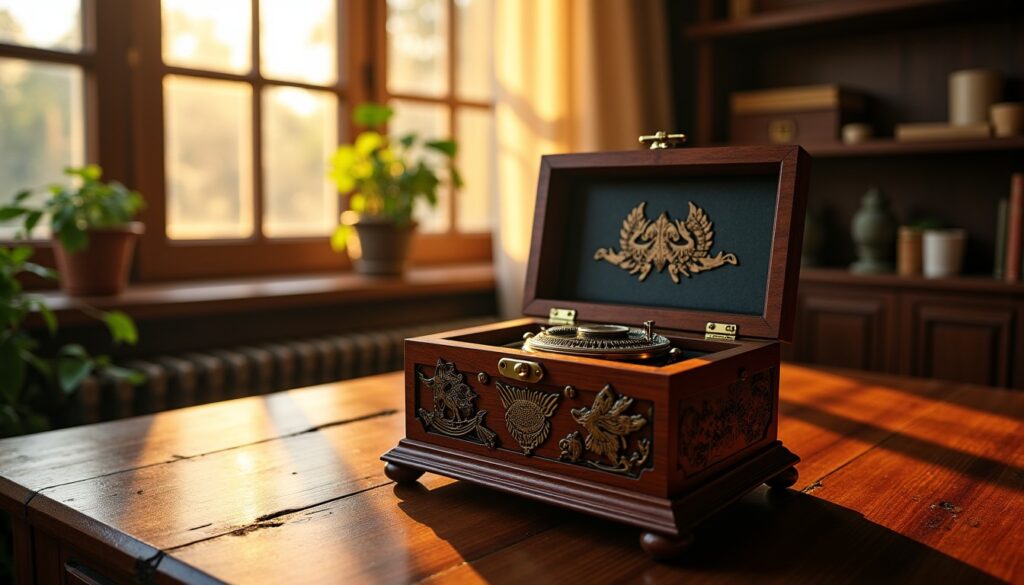
Yes, Square Enix offers a new music box dedicated to Final Fantasy IX: the North American version « Melodies Of Life Wave 2 » plays the iconic song and features the silhouettes of Zidane and Garnet. Sold for $25.99 and announced as available immediately on the official North American store, it transforms an enchanting piece of video game music into a small collectible object. A European listing also presents a box dedicated to “Melodies of Life” at €22.99, without explicitly confirming that it is the same Wave 2 version.
This announcement concerns a merchandise item, not a new game or a remake. For fans, its appeal lies more in its ability to revive, in just a few notes, the nostalgia and emotion associated with the adventure. We will examine its design, the role of the melody in the fantastic universe of the game, pricing information, and useful precautions before purchase.
The Final Fantasy IX “Melodies of Life” music box: key information
Square Enix has listed on its North American store a music box named FINAL FANTASY IX Music Box – Melodies Of Life Wave 2. The mechanism plays “Melodies of Life,” one of the songs most closely tied to the identity of the ninth episode. On the front, the silhouettes of Zidane and Garnet recall the duo at the heart of many players’ memories, without turning the object into a figurine or a reproduction of a full scene.
The designation “Wave 2” appears in the name of the North American reference. It helps distinguish this listing in the publisher’s catalog, but the available details primarily describe the product itself: its song, its illustration, its price, its dimensions, and its availability status. We have no official element linking this sale to a larger video game project. To properly understand the announcement, let’s keep our focus on the musical object rather than looking for a hidden clue about the future of the series.
Here are the main characteristics communicated for the North American version:
- Piece played: “Melodies of Life,” song from Final Fantasy IX.
- Illustration: silhouettes of Zidane and Garnet on the front.
- Approximate dimensions: 6.0 × 5.3 × 4.0 cm, about 2.36 × 2.09 × 1.57 inches.
- Price displayed in North America: $25.99.
- Indicated availability: immediate sale on the official North American store.
This information gives a fairly precise picture of the object and its use. With a height close to six centimeters, it is a small accessory that can be placed on a desk, in a display case, or near a game collection. It is not an item intended to play a complete original soundtrack: the box highlights a chosen melody, in a compact mechanical format.
The distinction between the North American offer and the European listing deserves our attention. Square Enix also offers a box titled “Final Fantasy IX – Melodies of Life” at €22.99 in its European store. The title and song match, but the available elements do not confirm that this listing carries exactly the same Wave 2 designation. For a collectible purchase, this difference in naming is worth checking on the official page.
Finally, the announcement does not present a new game episode, a special edition of the soundtrack, or an interactive experience. It offers a tangible object designed around a musical theme immediately recognizable by part of the audience. It is this modest scale, combined with a major song, that best defines the box: a musical keepsake you can keep within reach.
Melodies of Life, an enchanting melody at the heart of emotion
If Square Enix chose “Melodies of Life,” it is because the song holds a special place in the memory of Final Fantasy IX. It is not reduced to a background piece you might hear in passing: its association with the characters and themes of the game gives it a narrative strength. In a series where music often accompanies departures, reunions, and moments of doubt, this composition acts as a sensitive thread between the adventure and the memory retained by players.
The song was composed by Nobuo Uematsu, with lyrics attributed to Ciomi and a vocal performance by Emiko Shiratori. It appears on an especially generous original soundtrack, distributed over four CDs and comprising 110 tracks. The music box does not seek to condense this vast score in its mechanism: it retains just one theme, the one that can evoke the game’s atmosphere in a few familiar notes.
To grasp the intended effect, imagine a player returning to her console after several years. She does not need to reload her save or navigate menus to remember the fantastic world of Zidane, Garnet, and their companions. Sometimes a melody is enough to revive a scene, a place, or the feeling experienced when the story unfolded. The box relies on this personal memory: it offers an auditory trigger rather than a full narrative.
This evocative ability also explains the choice of a musical mechanism. A connected speaker can play an entire album, but it does not necessarily turn listening into a ritual. Here, the act of handling a small object, then hearing a short sequence, gives the song a physical presence. Listening time is limited, which encourages focusing on the melody instead of letting it fade into a playlist.
The format obviously does not replace the original recording and does not claim to reproduce all its nuances. It offers a mechanical interpretation designed for a decorative object. This difference may appeal to enthusiasts who appreciate musical gifts and compact souvenirs, while audiophiles will continue to favor the album for detailed listening. Each format fulfills a different function: one accompanies long listening, the other materializes attachment to a theme.
The place of “Melodies of Life” in this range thus helps to understand why the product can resonate beyond its price or dimensions. It establishes a direct link between a song, characters, and a gaming experience. The magic is not in the quantity of music offered but in the ability of a recognized theme to encapsulate part of the emotion associated with Final Fantasy IX.
A compact format and an illustration designed for fans
With approximately 6.0 cm in height, 5.3 cm in width, and 4.0 cm in depth, this music box stands out for its small footprint. These dimensions make it easy to integrate into a gaming space or a shelf where every centimeter counts. On a desk, it can remain visible without taking the place of a controller or a game case; in a display cabinet, its small size allows it to be shown near other items related to the series.
The choice of silhouettes is consistent with this scale. A finely detailed portrait would have been difficult to read on such a small surface, while two recognizable shapes establish a simple visual reference. Zidane and Garnet immediately evoke the romantic heart of the adventure for those familiar with the game. The object remains understated, and its illustration does not need a busy background to make clear which work it honors.
For fans, the value of a collectible often depends on the relationship between its appearance and the memory it evokes. A box bearing only the game’s name could serve as a generic trinket. Here, the association of the characters and “Melodies of Life” creates a narrative shortcut: the image catches the eye, then the mechanism plays the theme. The visual and sound work together, even if each remains very simple.
We can also consider different ways to display it. A collector gathering merchandise by game might place it next to a physical edition, an artbook, or a figurine. Someone preferring discreet decor might put it near a lamp or notebook, without organizing the entire room around Final Fantasy. In both cases, its size facilitates integration and limits the risk of it dominating the space.
Care must be taken when displaying it, as with any small mechanism. A stable surface avoids falls; a location protected from humidity and shocks helps preserve the object. If you store it in a display case, ensure its access remains practical when you want to play it. A musical item that can never be handled often ends up as merely a decorative piece, whereas its appeal also lies in listening.
Expectations should be kept proportional to the product’s nature. The information provided describes a small box and a melody, not an elaborate sculpture or a complex audio device. Its strength lies in the balance between reduced size, evocative image, and recognizable music. For a collection, it is this coherence that can make it more endearing than a larger object less directly linked to the game’s identity.
Price and availability: comparing offers by region
The North American reference is priced at $25.99, with an indication of immediate availability on Square Enix’s official store. This mention distinguishes the product from a simple pre-order announcement: in this region, the page presents it as purchasable without waiting for a later launch date. Shipping conditions, taxes, and any additional fees must naturally be checked at the time of ordering, as they vary by destination.
In Europe, a listing dedicated to the music box “Final Fantasy IX – Melodies of Life” appears at €22.99. The title clearly links this reference to the same game and song. However, the available information does not allow us to confirm that it precisely corresponds to the North American “Wave 2” item. We can therefore compare the displayed prices without presenting the two listings as a single confirmed version.
| Market | Displayed name | Quoted price | Stated condition |
| North America | FINAL FANTASY IX Music Box – Melodies Of Life Wave 2 | $25.99 | Available immediately |
| Europe | Final Fantasy IX – Melodies of Life | €22.99 | Listed in catalog |
The table highlights a practical difference: currencies and names are not identical, and the European status is not phrased the same way as the North American store’s. To avoid misleading comparisons, we should check the page corresponding to our country rather than simply converting dollars to euros. The final amount may include items not shown in the displayed price, notably shipping.
Before confirming your purchase, we recommend verifying the full product name, the description of the song, the illustration, and shipping terms. These checks are especially useful if you collect variants or seek an edition explicitly labeled Wave 2. A title difference may correspond to a naming convention based on territory; it alone does not establish a manufacturing difference.
Square Enix also offers other music boxes inspired by Final Fantasy IX, notably dedicated to “Not Alone,” “Roses of May,” and “A Place to Call Home.” These references expand the possibilities for those who wish to gather multiple themes from the game. Their presence does not mean that every product has the same price or stock status: each listing should be examined individually without automatically transferring information from “Melodies of Life” to the others.
For a gift purchase, the choice can therefore be made in two steps. First, check that the model is indeed available on your region’s store; then ensure that the total price and the title meet the recipient’s preferences. This simple approach helps distinguish an official listing from a reseller’s advertisement and make an informed purchase.
A collection of music boxes to extend the Final Fantasy IX universe
The “Melodies of Life” box is part of a larger collection of musical products inspired by Square Enix games. For Final Fantasy IX, the publisher’s store also offers models linked to “Not Alone,” “Roses of May,” and “A Place to Call Home.” These titles do not exactly fulfill the same emotional function: each refers to a particular facet of the game’s atmosphere, from the intimacy of certain characters to the feeling of departure and return that accompanies the adventure.
Gathering multiple boxes allows building a collection around themes rather than sticking to characters or game editions. An enthusiast can, for example, choose “Melodies of Life” as the centerpiece and then add another piece that reminds them of a specific sequence. This approach gives a personal coherence to the whole: the selection tells the collector’s memories, not just the extent of the official catalog.
The range also extends to other universes, with products inspired by titles like Chrono Trigger. This proximity shows that the music box serves as a transversal format for bringing the great melodies of video games to life. Each series retains its own characters and identity, while the mechanism offers a familiar way to present a song. For fans of game music, this opens a collecting avenue different from CDs, vinyls, or figurines.
It remains useful to define what you want to collect before multiplying purchases. Some prefer to gather all available references for an episode; others select only the pieces that matter most to them. Someone attached to Zidane and Garnet’s story may favor “Melodies of Life,” while another fan might choose a box associated with a moment or character that touched them more.
The diversity of formats also allows arranging a pleasant display without cluttering a room. The small dimensions of these models make it easy to place them side by side, but rotating a few displayed pieces can highlight each object. For example, we might place a box near the game it relates to and keep the others tucked away, then change the display according to the mood. This way, the object gains a living role instead of remaining forgotten at the back of a shelf.
To judge the relevance of a new release, three questions often suffice: does the song matter in your memory of the game, does the object find a place in your collection, and does its price correspond to your budget? This guideline helps avoid buying solely from nostalgia while allowing space for spontaneous pleasure when a theme really moves us. A successful music box does not need to be the rarest or the largest: above all, it must resonate with a story you want to relive.
Beyond the box itself, this collection reminds us how music can extend the relationship with a video game long after playing has ended. A song, an illustration, and a few centimeters of object can be enough to bring a whole universe back into daily life. For fans of Final Fantasy IX, the “Melodies of Life” piece offers precisely this encounter between memory, melody, and material presence.