
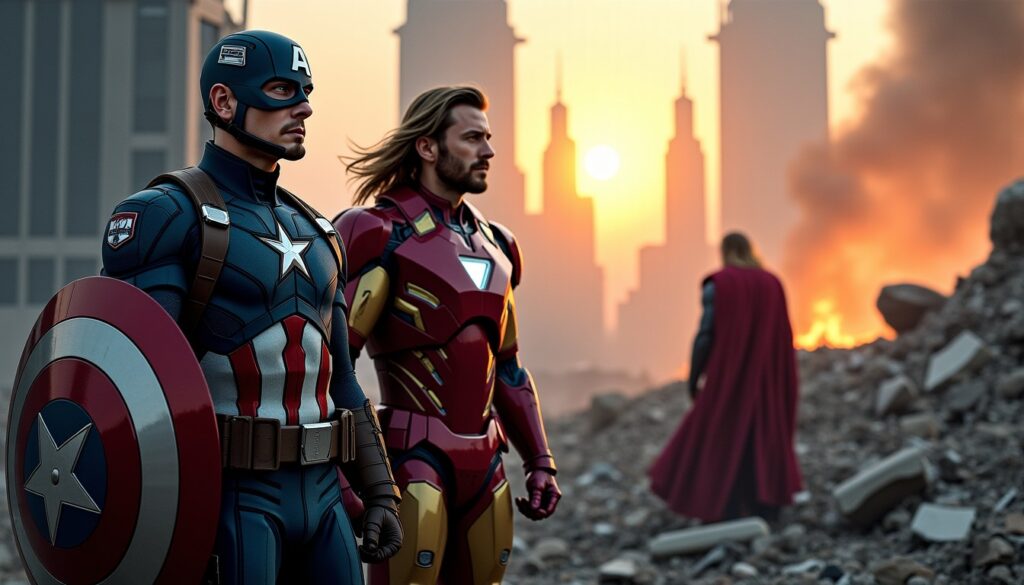
Avengers: Doomsday will be released in cinemas in France on December 16, 2026, directed by Anthony and Joe Russo and starring Robert Downey Jr. as Victor von Doom. The Marvel film is set to bring together the Avengers, Fantastic Four, and X-Men around a threat that transcends the boundaries of their universes. Its spectacular cast is already an event; its true ambition will be to turn these reunions into a comprehensible and gripping story.
To help you navigate the available information, let’s keep three points in mind:
- The French release date is set for December 16, 2026, two days before the American release announced in the communicated information.
- The cast brings together figures from the MCU, the Fantastic Four, and former X-Men films, with Robert Downey Jr. as Doctor Doom.
- The plot is based on a collision between multiple universes, but Marvel has not yet revealed all the details of the story.
Here we take stock of the release, the actors, Doom’s threat, and the narrative challenges of the Avengers’ return. The stakes go beyond simply piling up superheroes: the film must also give a new momentum to the Marvel Cinematic Universe.
Avengers: Doomsday: French release date and Marvel film schedule
The announced date for the cinema release in France is December 16, 2026. The film is scheduled two days before its arrival in the United States, according to the data released for this premiere. This difference could attract French viewers from the first week and establish the feature as one of the major events of the end of the year.
The choice of an exclusive theatrical release aligns with the scale of the project. A choral film of this size relies on shared reactions: recognizing a character, hearing an expected line, or discovering an unexpected alliance takes on a special dimension in a full theater. For an audience that has followed several branches of the MCU, the screening also becomes a moment of reunion.
The announced duration, 2 h 45, gives a concrete indication of the space allotted to this gathering. This length is sufficient to develop several groups of characters, but each sequence must serve the story. An entrance may impress for a few seconds; to remain memorable, it must then change a decision, reveal a conflict, or bring the heroes closer to a solution.
The schedule follows several years of stories dedicated to various characters and teams. The return of an Avengers film allows Marvel Studios to bring these trajectories together in a single event. For viewers less familiar with each series or film, the challenge will be to quickly grasp the essential relationships without having to revise the entire Marvel Cinematic Universe before the screening.
The Russo brothers already know the demands of this type of narrative. They directed Captain America: The Winter Soldier, Captain America: Civil War, Avengers: Infinity War, and Avengers: Endgame. These works allowed them to move from a solo hero to clashes involving many teams, while maintaining personal stakes.
In Infinity War, for example, the characters do not all share the same plan or temperament. Disagreements between Tony Stark, Doctor Strange, and Peter Quill show how rivalry or a mistake can alter the course of a battle. This method may suit Doomsday, where several groups will likely have to negotiate their priorities before fighting together.
We can summarize the main release information as follows:
| Element | Announced information |
|---|---|
| Release date in France | December 16, 2026 |
| American release | Scheduled two days after the indicated French date |
| Communicated duration | 2 h 45 |
| Direction | Anthony and Joe Russo |
| Theatrical distribution | Exclusive cinema release |
As the date approaches, the practical question will be to choose between an original version screening and a dubbed session, then to decide if a recap of previous films is useful. We can favor stories centered on the Avengers, the Fantastic Four, and the X-Men announced in the cast, without trying to rewatch everything: relationships between characters will matter more than an exhaustive inventory.
The date is known; the success of the event will now depend on how the film makes this great reunion readable for everyone.
The cast of Avengers: Doomsday: Robert Downey Jr. facing Marvel heroes
The most discussed casting choice is Robert Downey Jr. as Victor von Doom, also called Doctor Fatalis in the French comics tradition. The actor portrayed Tony Stark starting from Iron Man in 2008, then marked the conclusion of Avengers: Endgame. Seeing him in the opposing camp thus creates an immediate link to the MCU’s history.
This connection does not automatically mean that Doom would be Tony Stark in disguise or a mere evil version of the character. Victor von Doom has an identity, ambition, and journey of his own in the comics. The film will have an interest in preserving these characteristics: his intelligence, authority, and determination to control his destiny can make him an opponent far more complex than a familiar hero turned to the dark side.
Downey Jr.’s face may still provoke a particular reaction among characters who knew Stark. Imagine Sam Wilson or Thor confronted with a man who looks like him but pursues an opposite goal: the resemblance would open an emotional conflict without erasing the difference between the two individuals. This contrast can enrich the story if the heroes learn to fight Doom for who he is, rather than for the memory of Tony.
Among the returns announced by Marvel Studios are Chris Hemsworth, Anthony Mackie, Sebastian Stan, Tom Hiddleston, Letitia Wright, and Paul Rudd. Their characters belong to different generations and teams. Thor brings cosmic experience, Sam Wilson represents the current Captain America, while Loki opens paths linked to multiple realities and the TVA.
The presence of Chris Evans has been reported by several American media, but Marvel has not publicly confirmed that he would precisely reprise the role of Steve Rogers. We must therefore distinguish between a relayed piece of information and an official announcement. If Steve appears alongside Sam, the film could stage a very concrete passing of the torch; without confirmation, we cannot present this hypothesis as an established fact.
The topic of the Winter Soldier and his future has also fueled fan discussions. To follow speculations about Bucky Barnes without confusing them with studio announcements, you can consult this article on the fate of Bucky Barnes. A rumor or catchy headline does not replace an official confirmation about the character’s role in the film.
To find the names associated with the different groups and better understand who might cross paths, this presentation of the casting and heroes of Avengers: Doomsday offers a complementary guide. We can approach both actors and characters there, keeping in mind that the size of a cast alone does not guarantee an important role for each.
The real challenge is to assign each actor an identifiable dramatic function. One character may be central to the poster and have only a few scenes; another, less expected, might trigger a decisive decision. In a 165-minute story, dialogue, alliances, and disagreements must advance the plot as much as fights.
This requirement also applies to the old faces of the MCU. Nostalgia works when it awakens an emotion built by previous films, not when it is limited to an appearance meant for applause. A return should reveal what the character has learned, what they have lost, or what they now refuse to sacrifice.
The cast creates a promise of reunion; the characterization of Doom and each hero’s choices will determine if this promise becomes a real story.
Avengers: Doomsday and its plot: the collision of Avengers, X-Men, and Fantastic Four
The official synopsis mentions heroes from three distinct universes, thrown toward a deadly collision against an existential threat. The phrasing confirms the importance of the multiverse without revealing precisely the events that lead to the catastrophe. We know the involved groups include the Avengers, the Fantastic Four, and several X-Men figures; the detailed course remains to be discovered.
This encounter extends the integration of characters formerly associated with Fox adaptations. Pedro Pascal, Vanessa Kirby, and Joseph Quinn are announced among the Fantastic Four cast members. On the X-Men side, Marvel has revealed the names Ian McKellen, Patrick Stewart, James Marsden, Alan Cumming, and Rebecca Romijn, linked to previous films of the franchise.
The groups carry different legacies. The X-Men have a long cinematic memory, notably through the tensions between Charles Xavier and Magneto. The Fantastic Four arrive in this new dynamic with a more recent team history on screen. The Avengers hold a central place within the MCU, but their members do not all share the same experiences or authority.
This diversity can create a real plot if the heroes have reasons not to get along. Xavier may seek to protect mutants, Magneto might want to impose a more radical survival strategy, and Reed Richards could approach the threat as a scientific problem. Facing them, the Avengers might favor immediate action or defend populations already threatened. Cooperation would then be a conquest, not a given.
A parallel helps measure the challenge: in Captain America: Civil War, characters oppose each other over responsibility and control, rather than fighting without cause. This conflict gives direction to the action scenes. Doomsday might use the same principle on an interuniversal scale: a difference of values or method must produce visible consequences on collective strategy.
Incursions are another element likely to shed light on multiversal stakes. They designate, in Marvel stories, collisions threatening multiple realities. To deepen this track concerning Xavier and incursions, you can read this point on the X-Men, Xavier, and incursions. This reference helps understand the vocabulary without confirming that every detail cited in theories will be taken up in the film.
Loki also constitutes a natural crossing point between several realities, after the events of his TV adventures and his ties with the TVA. The analysis of Loki, the TVA and the multiverse places these notions within the Marvel universe. For a viewer, the essential thing is not to memorize every cosmic rule, but to know what is in danger and why the heroes must act together.
The film must also avoid treating the universes as mere interchangeable backgrounds. If one reality is threatened, the audience must understand what it contains and what its disappearance would cost the characters. A scene where Reed discovers an anomaly can gain tension if followed by a human consequence: a separated team, an inaccessible city, or a choice that condemns one world to save another.
Doom’s threat can give coherence to these conflicts. An opponent who has a political vision or claims order can convince certain heroes that he acts to prevent a disaster. It then becomes interesting to ask whether his methods are condemnable even when his diagnosis is correct. This dilemma would give the villain a stronger presence than a succession of physical confrontations.
The collision of universes will only make full sense if each group defends a different vision of survival and justice.
The Avengers: Doomsday trailer: clues to watch for
The first trailer was reportedly presented first at CinemaCon in Las Vegas, then posted online by Disney on July 20, 2026, according to the communicated information. This schedule places the video in a promotion phase where the studio can start to show the film’s tone without necessarily revealing the entire plot. For analysis, it is better to separate the visible images from fans’ interpretations.
A choral film trailer must present many characters in a short time. The editing can show a face, a costume, or a setting without specifying the individual’s place in the story. We will benefit from observing the directorial choices: who shares a scene, who seems to make a decision, and which characters are associated with images of threat rather than combat sequences.
Team dynamics remain a more telling clue than a simple succession of powers. If the video shows heroes contradicting each other before rallying, it indicates a story based on difficult cooperation. If it favors group shots and spectacular effects, it might rather market the scale of the event. These two dimensions do not exclude each other, but their balance will give a first idea of the narrative style.
A comparison with Infinity War is useful. Exchanges between Tony Stark, Doctor Strange, and Peter Quill brought out method differences at the heart of the action. The danger did not come only from Thanos: clumsiness, pride, and decisions made under pressure sometimes worsened the situation. For Doomsday, personalities as assertive as Magneto, Xavier, Loki, Thor, and Reed Richards could create comparable tension.
We can follow three categories of clues during viewing:
- Relationships: watch for characters who talk to each other, avoid one another, or take the upper hand. An unusual alliance may reveal a deeper disagreement.
- Consequences: an image of destruction is more meaningful if the editing shows what it threatens and who suffers its effects.
- Doom’s role: his screen presence, words, and the reactions he provokes will help determine if the film presents him as a military, political, or personal force.
The promotional format also calls for caution. An isolated shot may be moved in the final editing, and a sentence may be cut out of context. Marvel’s trailers often aim to preserve surprises: their mission is to arouse curiosity, not provide a complete map of twists.
The question of Robert Downey Jr.’s face deserves special attention. If the video emphasizes the resemblance to Tony Stark, it might prepare an emotional reaction; if it focuses on Doom’s armor, mask, or symbols of power, it may primarily build a distinct identity. Editing and music will matter as much as dialogue to establish this difference.
For fans who want to rewatch the first images, a video player dedicated to the trailer allows focusing on visual and sound details. We can notably compare the settings associated with the three groups and see if the film presents a common threat or multiple simultaneous crises.
Throughout promotion, actors’ and directors’ statements should be distinguished from production rumors. An official announcement, an image published by Marvel, and an interpretation from a clip do not hold the same weight. This approach prevents turning an attractive hypothesis into certainty before release.
The trailer will be a tool to spot tone and relationships, not a reliable summary of all the film’s secrets.
The return of the Avengers: the challenge of relaunching the Marvel Cinematic Universe
The Avengers’ return carries a particular responsibility: to offer a meeting point after a period when Marvel multiplied characters, series, and narrative tracks. This abundance may appeal to fans who love to explore every nook of the MCU, but it may also blur the hierarchy of stakes. Doomsday will have to remind why a team of heroes constitutes an effective center of gravity.
An Avengers film works when individual stories turn into a collective story. In Endgame, reunions had weight because previous films prepared the links, losses, and disagreements. A handshake or an exchanged glance could then recall several years of journey. In the new film, not all teams have accumulated the same duration of presence within the MCU.
This difference in familiarity represents a real challenge. Some viewers have known the X-Men since the first films, while others will follow mostly the Avengers and more recently introduced characters. The story will have to deliver explanations without slowing down the action. A natural dialogue between two heroes may suffice to situate a relationship; a long exposition on multiverse rules risks cutting momentum.
The Fantastic Four can serve as a bridge. Reed Richards brings scientific expertise directly useful against a reality crisis, while Sue, Johnny, and Ben give the team a family dynamic. Presenting them only as experts tasked with explaining the multiverse would reduce their scope. Their reactions, disagreements, and solidarity must also weigh on strategic choices.
The same principle applies to the X-Men. Xavier and Magneto have an immediately identifiable ideological conflict, but their presence must serve the current story’s stakes. If their rivalry sheds light on decisions made facing Doom, it enriches the meeting. If limited to an allusion meant to trigger recognition, it will remain decorative.
MCU characters can provide the thread tying these groups together. Sam Wilson is now Captain America at the center of this transition, while Bucky Barnes, Thor, and Loki bring very different experiences of loss, loyalty, and power. Rather than creating a hero dominating all scenes, the script can evolve leadership according to situations: a strategist leads negotiation, a scientist analyzes an anomaly, a fighter protects civilians.
The 2 h 45 format makes this balance possible, but does not guarantee it. An action scene costs time; a character presentation also does. The most effective sequences can serve both functions simultaneously, revealing a temperament during a fight or giving an emotional stake to a tactical decision. This is how spectacle becomes part of the story, rather than a parenthesis.
Promotion can also help newcomers find their bearings. Clear trailers, character presentations, and targeted reminders are more useful than an accumulation of obscure references. A viewer should be able to grasp essential stakes without having seen all previous productions: who threatens the universes, who tries to stop it, and what price might be paid.
For longtime fans, the pleasure will also come from echoes of the past, provided they serve the present. The return of an actor can provoke immediate emotion, but the script must then make sense of their presence. Downey Jr.’s case concentrates this expectation: the actor brings with him the memory of Tony Stark, while the character of Doom must exist independently of that memory.
Finally, rebooting the MCU will not depend solely on the scale of the final battle. A film can gather dozens of heroes and leave little trace if decisions have no lasting consequences. Conversely, a fragile alliance, a sacrifice, or a new balance among teams can make the next chapter more readable. The audience expects a spectacle, but also a reason to care about what comes next.
The success of Avengers: Doomsday will be measured by its ability to make each universe a stakeholder in the common future, rather than a mere passing guest.