
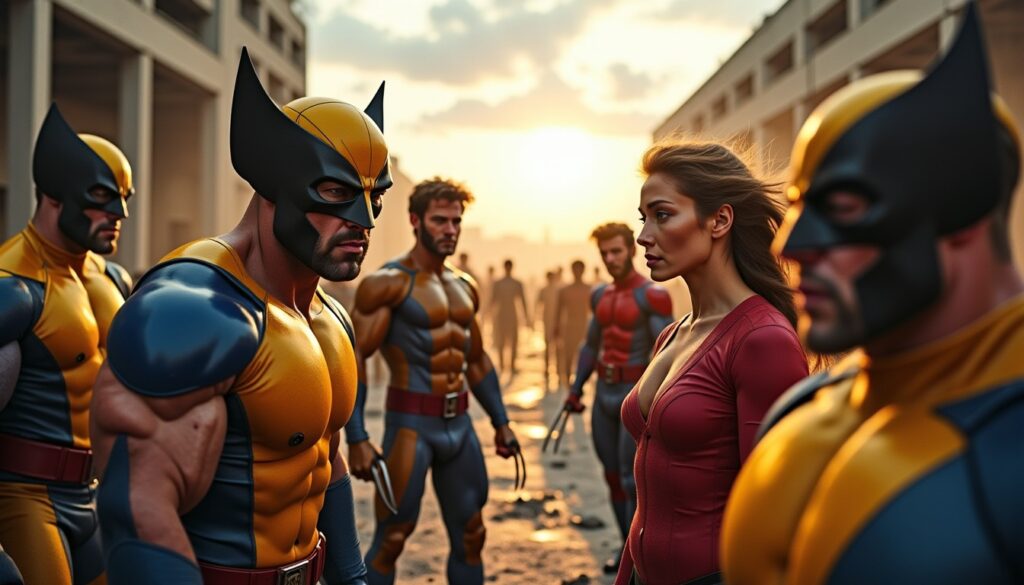
Yes: X-Men ’92: Incursions #1 will pit the heroes of the 1990s animated series against the young mutants of X-Men: Evolution, in a story where saving one Earth could condemn the other. Scheduled by Marvel for January 6, 2027, this one-shot turns an anticipated meeting into a moral dilemma around Charles Xavier’s dream.
The veterans of the 90s have behind them battles and losses that have tested their ideal of coexistence. Opposed to them, the adolescents of Evolution still defend this hope in a universe marked by high school and the first discoveries of their powers. The generational clash therefore does not only lie in two graphic styles or two televised memories: it confronts different experiences of the same dream.
To frame the stakes before the release, we can highlight three elements:
- A multiversal collision: the two realities cannot survive together without a decision being made.
- A conflict without an obvious adversary: each team has legitimate reasons to protect its world.
- A story connected to Secret Wars: the issue belongs to a series of five Incursions one-shots announced by Marvel.
The script is entrusted to Craig Kyle and Christopher Yost, while Salva Espin signs the drawings. While waiting for Marvel to unveil the outcome, we can examine what makes this meeting singular: the principle of the incursion, the opposition between two generations of mutants, and the place of the issue in a larger event.
X-Men ’92: Incursions, a collision between two Earths
In X-Men ’92: Incursions #1, the return of characters associated with X-Men: The Animated Series takes the form of a crisis on the scale of two worlds. An incursion here means the collision of distinct realities, whose coexistence becomes impossible. The concept immediately shifts the stakes: the heroes are not only trying to thwart a threat or win a battle, they must face the possibility that the survival of their Earth could lead to the disappearance of another.
The synopsis announced by Marvel places the 1990s X-Men before this alternative. Their world is in danger, but preserving it could destroy the one housing the versions from X-Men: Evolution. This other Earth is not an empty space that could be sacrificed without consequence: it hosts characters who share their names, their powers, and, to some extent, their aspirations. The peril thus takes on a personal dimension even before the teams have exchanged a word.
A choice that rejects easy solutions
We can imagine the situation through a concrete decision: if a mechanism allows only one reality to be stabilized, must the team from the 90s prioritize their loved ones and population, or give up that choice to protect another Earth? The question is not abstract for the characters. Every minute spent searching for a way out can bring the two universes closer to a breaking point, while a rushed action risks worsening the disaster.
This setup prevents the story from reducing the opposition to a confrontation between heroes and villains. The X-Men of Evolution are not portrayed as a malevolent threat, and the veterans are not described as invaders driven by a taste for power. Both groups defend a reality to which they belong. This symmetry gives the conflict a more interesting tension than a simple duel: even a victory could leave behind an irreparable loss.
Multiverse stories often rely on the surprise of seeing two versions of a character meet. Here, this surprise serves a graver purpose. When two Cyclopes, two Storms, or two teams share the same scene, the resemblance highlights what their choices and experiences differ in. The incursion forces them to see the other world not as a curiosity, but as a community whose disappearance would have a real cost.
Xavier’s dream under pressure
The coexistence project defended by Charles Xavier becomes the real battleground. If mutants fight to protect their world, they risk reproducing the logic of fear and rivalry that they seek to overcome. If, conversely, they refuse any decision in the name of their ideal, they may let both realities run to their doom. The story thus tests the professor’s principles without announcing, at this stage, which solution will be chosen.
This uncertainty is the driving dramatic force of the issue. It is not enough for the characters to recognize each other: they must decide if their shared identity can help them cooperate. The incursion makes Xavier’s dream a question of action: what does it mean to defend coexistence when lives are directly at stake?
90s veterans and young mutants: the generational clash
The strength of the crossover comes from the difference between the two teams. The characters from X-Men: The Animated Series are associated with a formation that has already gone through many crises. They approach the collision with a background of conflicts, sacrifices, and responsibilities. Their experience can make them more effective in the face of danger, but it can also fuel a caution that appears as pessimism to their younger counterparts.
The mutants from X-Men: Evolution appear as teenage versions of the heroes. Their daily lives unfold notably around school, learning, and relationships among youngsters. This approach gives another color to the story: before being seasoned figures, these characters are still understanding what their powers imply and what place they want to occupy in the world. The threat of planetary destruction thus falls on lives that have not yet followed the same path as their elders.
Two ways of believing in the same ideal
To illuminate this opposition, imagine a tactical decision made in urgency. A veteran might want to neutralize immediately the source of the collision, even if it means accepting damage he considers limited. A young mutant might insist on evacuating an area or finding a solution that first protects the inhabitants. No reflex is automatically right: the first may come from a painful experience, the second from a still-strong trust in the possibility of saving everyone.
The story can draw credible frictions from this difference without turning a generation into a model of wisdom. Habituation to fighting does not always guarantee the best judgment, and youth optimism is not enough to resolve a cosmic crisis. By confronting these ways of acting, the authors have space to show how the same principle — protecting mutants and building a common future — translates differently according to age and experience.
The school setting of Evolution accentuates this gap. In a teenage environment, ties among peers, rivalries, and the sense of belonging can take as much space as missions. The veterans, meanwhile, come with a longer collective memory. A meeting between the two groups can thus resemble an interrupted transmission: the young discover what adults had to endure, while the latter still see alive a form of hope they may have let dull.
Mirror characters rather than copies
The pleasure of recognizing familiar faces does not depend solely on fidelity to the animated series. It also comes from comparison: how does a character act before having experienced the same losses? What remains of his convictions when confronted with a version of himself who has not yet lived the same trials? These questions give a narrative function to the similarities and prevent the reunion from being limited to a gallery of winks.
Fans will find two tones associated with different eras of Marvel animation, while less familiar readers can follow a readable opposition between experience and youth. The generational clash then becomes a way to test the solidity of Xavier’s project. Both teams do not defend competing dreams: they show two possible stages of the same ideal.
This tonal difference also allows for expecting something other than a spectacular confrontation. If the characters take time to understand each other, every disagreement can reveal what they think they must preserve: their team, their population, or the promise of a future where mutants do not have to choose between surviving and living together.
Craig Kyle, Christopher Yost, and Salva Espin at the helm of the one-shot
Marvel announced a creative trio composed of Craig Kyle and Christopher Yost on script, with Salva Espin on art. The choice of this one-shot format imposes a precise task: present two universes, bring their respective teams to life, and establish a dilemma on the scale of several worlds in a single issue. The story will have to make the stakes understandable without losing the pace of a highly anticipated meeting.
A crossover of this type can quickly be absorbed by the accumulation of characters. If each hero has a scene, a distinctive exchange, and a role in the crisis, the narration risks lacking space for the central conflict. Conversely, a too limited selection could give the impression that the two groups are merely background. The challenge therefore consists in advancing the story through interactions: a decision, a disagreement, or a gesture of trust can characterize several characters at once.
Art serving two identities
The graphic part will have to make the two teams recognizable while placing them within the same story. The reader must be able to understand at a glance that the heroes come from distinct versions, without the visual difference turning the issue into a collage. Costumes, postures, and staging can evoke their respective traditions, then come closer as the characters are forced to cooperate.
Multiversal collision scenes represent another visual challenge. Overlapping fragments of scenery, geographical landmarks that no longer align, or characters catching sight of another version of their world can make the threat tangible. This type of representation also helps explain the danger to the reader without resorting to long explanations: if two landscapes merge and distort, the urgency becomes immediately perceptible.
Publication information mentions a main cover by Luciano Vecchio as well as a mirror variant. This detail echoes the very principle of the issue: two teams face each other, each able to reflect the other without being identical. The cover can play on this symmetry, even if the announced elements do not yet allow describing its exact composition.
What Marvel has confirmed, and what remains to be discovered
The announced format is indeed that of a single issue, and not a new ongoing series dedicated to these X-Men. Marvel has not communicated all the details: pagination, price, full list of characters present, and exact consequences of the incursion remain to be specified. The outcome is also unknown, which avoids presenting as certain an ending that has not been announced.
This distinction is useful to follow the news without confusing editorial promise and confirmed information. We know that the issue must pit the teams against each other and that it fits into a build-up to Secret Wars. We do not yet know if the heroes will find a way to preserve both Earths, nor which exact place this story will occupy in the following events.
For readers following other Marvel projects, the question of major X-Men reinventions also feeds discussions about adaptations and directions of the franchise. A preview of the debate around a possible Marvel X-Men reboot associated with Adam Driver allows placing this news in a landscape where mutants continue to be reinterpreted across different formats. Here, the bet relies less on a redesign than on the confrontation of two animated legacies.
In a one-shot, every scene must contribute as much to the moral duel as to the spectacle. The success of the issue will depend on its ability to make the meeting a dramatic choice, and not just a gathering of recognizable characters.
The five Incursions one-shots before Secret Wars
X-Men ’92: Incursions #1 belongs to a series of five one-shots announced by Marvel in August 2026. These stories must explore realities confronted with impossible coexistence, in the last days before a new Secret Wars event. The principle unfolds across several major character families, with alliances and oppositions specific to each.
The schedule runs from November 18, 2026, to January 20, 2027. This progression places the X-Men issue towards the end of the sequence, after several other multiversal confrontations. It allows readers to discover different variations of the incursion before the appointment dedicated to the animated versions, then to continue with the Avengers.
| Announced date | One-shot | Presented confrontation |
|---|---|---|
| November 18, 2026 | X-Men: Incursions #1 | The realities of House of M and Days of Future Past, with Kate Pryde facing the choice of which world to preserve. |
| December 9, 2026 | Spider-Man: Incursions #1 | Spider-Gwen, from Earth-65, meets Mayday Parker, from Earth-982. |
| December 23, 2026 | Fantastic Four: Incursions #1 | Fantastic Four with gamma powers cross paths with a Bruce Banner with cosmic powers. |
| January 6, 2027 | X-Men ’92: Incursions #1 | The X-Men of the 1990s animated series face off against those of X-Men: Evolution. |
| January 20, 2027 | Avengers: Incursions #1 | Thanos and his Cabal clash with a reality where the founding Avengers are still united. |
A schedule that gradually expands the multiverse
The first issue devoted to the X-Men arrives as early as November, but it should not be confused with the one in January. X-Men: Incursions #1, scheduled for November 18, involves House of M and Days of Future Past. X-Men ’92: Incursions #1, scheduled for January 6, focuses on the collision between the two animated teams. The shared Incursions name links the projects, while their oppositions remain distinct.
The sequence gives Marvel the opportunity to vary the stakes. The Spider-Man duel brings together two heroines from different realities, the Fantastic Four story assembles unexpected powers, and the Avengers story confronts a founding team against Thanos and his Cabal. The X-Men episode stands out by the identity of the opponents: it puts together related versions of heroes who share an ideal and common touchstones.
This organization can help the reader grasp the logic of the event without presuming that each issue will reveal a decisive element of the overall plot. The announced information describes a range of stories linked to Secret Wars, but does not yet detail how their consequences will unfold. It is therefore more accurate to approach them as gateways to the multiverse than as a program whose outcome would already be established.
Avengers fans can also follow the news related to the franchise thanks to this update on heroes and actors associated with Avengers: Doomsday. The comparison recalls that Marvel is simultaneously developing several stories around its major teams, across different media and continuities. For Incursions, the thread linking them remains the threat posed by incompatible realities.
The schedule finally places the January release within a concrete sequence: four other issues will surround it, from November to the end of January. The X-Men one-shot will be part of a larger whole, but its dilemma will remain focused on two teams each defending a world.
Why the return of X-Men ’92 also speaks to new readers
The return of X-Men ’92 is primarily aimed at readers who have a precise memory of the 1990s animated series. The reunion with the heroes of X-Men: Evolution evokes two televisual sensibilities and two ways of presenting mutants. Yet, the announced story does not rest solely on nostalgia: its dilemma can be understood even if one did not follow the two series at the time of their broadcast.
The starting point is simple to follow: two worlds risk mutually destroying each other, and their inhabitants have the right to want to survive. This situation provides an accessible hook for new readers, while connoisseurs can appreciate the characterization differences between versions. A reader discovering the universe can focus on the moral choice; a regular can also observe what the veterans have become faced with their younger doubles.
Nostalgia serving the story
Nostalgia works best when it advances the characters. A reference to a costume or an era can provoke immediate recognition, but it gains meaning if it recalls a value or a trial. In this issue, the contrast between the teams precisely provides this ground: the memory of the 1990s series dialogues with a story centered on adolescence, without one needing to erase the other.
We can read this crossover as a thought experiment. What would an older version of yourself say to a still confident version, convinced that a fair solution always exists? And what could the older learn in return from this confidence? The heroes here share a potential history, but their meeting forces them to consider the path travelled and the convictions they wish to preserve.
This approach also suits readers discovering Marvel through recent adaptations. Familiar names and the structure of a large-scale conflict offer landmarks, while the rivalry between realities avoids requiring exhaustive knowledge of each series. A clear presentation of the stakes would allow everyone to understand why a fight between the two groups threatens more than a simple defeat on the battlefield.
A trial for Xavier’s dream
The central question remains that of coexistence. Charles Xavier defended a future in which humans and mutants can live together, but the incursion first places mutants against their own doubles. If the two teams fail to recognize the other’s worth, how could they then defend a broader idea of peace? The conflict makes the ideal concrete by submitting it to fear, urgency, and responsibility.
The veterans can pass on useful experience without imposing their conclusions. The young can preserve hope without ignoring the danger’s severity. For cooperation to work, each will likely have to listen to what the other brings: a memory of past failures on one side, a will not to resign on the other. This dynamic offers the possibility of rich characterization, even if Marvel has not yet specified how the protagonists will evolve it.
The issue thus has several expectations to satisfy: offer the promised meeting, make the collision understandable, give a place to both generations, and maintain uncertainty around the final choice. The announced elements establish a strong framework without confirming the solution the heroes will find. For readers, this reservation maintains the essential question: can Xavier’s dream survive when two worlds simultaneously claim the right to exist?