
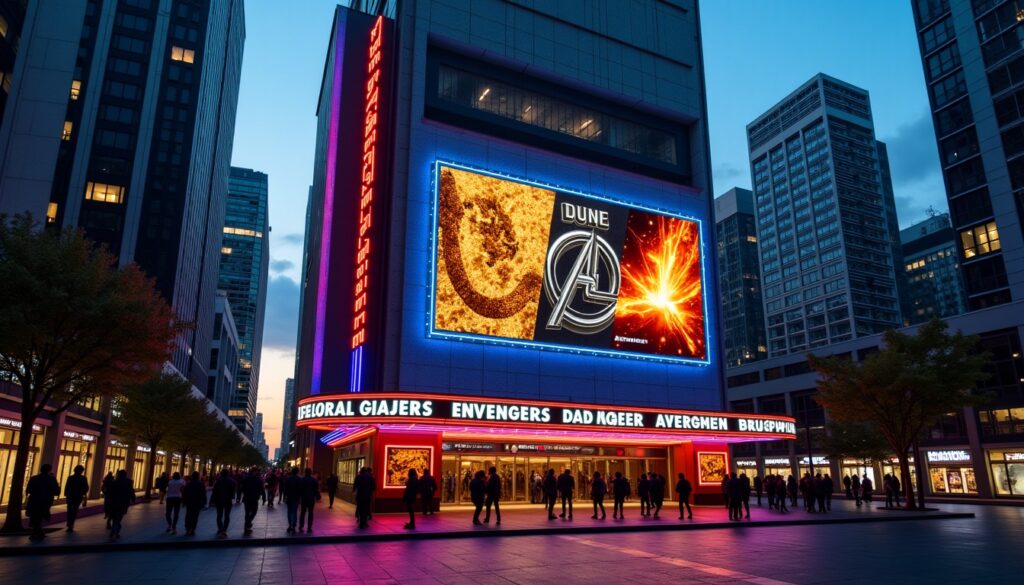
Yes: Dune: Part Three, Avengers: Doomsday, and The Hunger Games: The Ballad of Songbirds & Snakes mark the end of the year under the sign of major sagas, with a particularly tight showdown in December. In France, the first two films are announced for December 16, 2026, while the new Hunger Games is set to arrive on November 18. To prepare your cinema outings, we can already distinguish the dates, styles, and stakes of this busy period.
- The December duel: Dune 3 and Avengers: Doomsday aim for theaters on the same Wednesday in France, before their North American launch on December 18.
- The November appointment: Hunger Games returns to Panem with a story centered on a period prior to that of Katniss Everdeen.
- The session choice: IMAX, large theaters, and evening showtimes could be highly sought after during the holidays.
We will therefore be dealing with three popular cinema offerings, but not three interchangeable films. Denis Villeneuve bets on science fiction and visual scope, Marvel brings its superheroes together around a new event, while Panem extends its reflection on dystopia and political spectacle. Let’s follow the schedule, artistic ambitions, and concrete consequences for viewers: a movie night might require a bit more organization than usual.
Dune 3 and Avengers: Doomsday, a cinema release clash in December
The schedule places Dune: Part Three and Avengers: Doomsday at the heart of the same week. In North America, both films are dated December 18, 2026, while the dates circulated for France place them on Wednesday, December 16. This difference is explained by distribution habits: films often release on Wednesday in French theaters, before the North American Friday.
For Dune 3, the international launch should start from December 16, with a theatrical and IMAX release announced in North America. Avengers: Doomsday is scheduled exclusively for cinemas on December 18 across the Atlantic. Since territorial schedules may evolve, we will monitor confirmations from French distributors before considering each screening as definitively fixed.
Close dates, different programming
This proximity does not mean that every cinema will offer exactly the same combination of screenings. Exhibitors compose their schedules based on the duration of the films, reservations, commitments related to premium formats, and expected attendance. In a multiplex, teams might need to assign the largest auditoriums to two films capable of attracting a significant audience, while reserving slots for other new releases.
Take the example of Camille, who wants to see both films in their first week. If a theater has only one IMAX screen and Dune benefits from screenings in this format, she might have to choose another theater or another day for Avengers. This case illustrates a very concrete consequence of the schedule: competition also plays out on access to equipment, not just on ticket sales.
The final programming will come closer to the release dates, when cinemas have more information about the length of the works and local demand. Original version screenings, late showtimes, and premium screens can be the most sought after during the Christmas holidays. For viewers who have a specific time slot, monitoring bookings as soon as they open will be a sensible strategy.
| Film | Announced date in France | International release reference | Expected theater advantage |
|---|---|---|---|
| Dune: Part Three | December 16, 2026 | International launch from December 16 | Grand visuals and IMAX screenings |
| Avengers: Doomsday | December 16, 2026, according to the circulated schedule | December 18 in North America | Wide distribution and superhero event |
| The Hunger Games: The Ballad of Songbirds & Snakes | November 18, 2026 | From November 20 in North America | Return to the universe of Panem |
The French dates circulated for the two December films thus outline an exceptional collision, but their official confirmation remains the reference to check when booking. To understand why this duel attracts so much attention, one must also look at what each filmmaker offers on screen.
Dune 3 versus Avengers: two visions of the blockbuster
The face-off between Denis Villeneuve and brothers Joe and Anthony Russo pits two ways of constructing a grand spectacle. Dune favors expansive storytelling, monumental landscapes, and a direction that often lets the image breathe. Avengers, on the other hand, relies on the meeting of well-known characters, twists, and the pleasure of seeing several storylines converge in a single adventure.
For viewers, the difference is felt in how the screening is experienced. In Dune: Part Two, scenes designed for the big screen and IMAX reinforced the sense of scale: the desert seemed less like a set than a physical environment. Dune 3 will have to continue this ambition without simply repeating the effects of the previous film. A huge image only has lasting impact if it serves the narrative and the characters’ choices.
Arrakis: immersion before speed
The third installment is expected as the continuation of a journey already strongly marked by the consequences of power and prophecy. The available material does not justify presenting all plot details as confirmed, but the title clearly announces a return to the world of Arrakis. We can therefore expect that direction, sound, and shot composition will play a major role in the experience.
This approach invites careful choice of theater. A large screen can give greater presence to landscapes and group scenes, while a quieter screening, in a regular auditorium, may suit viewers who prioritize comfort or a specific time slot. Camille could thus book Dune in IMAX for the first evening, then rewatch a scene or discover the film with friends in a regular theater. The format then becomes a spectator’s choice, not an obligation.
Marvel: the power of gathering
Avengers: Doomsday marks the Russo brothers’ return to directing a major Marvel event after Avengers: Endgame. The title places Doctor Doom at the center of discussions, but not all plot elements are confirmed. We can talk about the anticipation generated by the gathering of superheroes without turning speculations into established information.
An Avengers film’s strength often rests on the audience’s memory. A character can evoke an old scene, an alliance can recall a previous episode, and a surprise appearance can have a different effect depending on the viewer’s journey through the franchise. This richness attracts long-time fans, while posing a practical question: should one rewatch films before the screening? A light preparation, focused on the episodes you like, can be enough to follow the thread without turning the outing into homework.
Both productions can thus complement rather than cancel each other in preferences. One invites immersion in a world built through details, the other to reunite a set of characters and a shared story. Our screening choice will depend less on the volume of effects than on the experience sought.
While waiting for trailers and detailed information, the comparison remains enlightening: Dune bets on immersion, Avengers on gathering. The third universe this year-end, Panem, will bring another form of tension, more political and more directly related to the making of spectacle.
The Hunger Games: return to Panem before the big December duel
The Hunger Games: The Ballad of Songbirds & Snakes is set to open the period of major releases with an arrival announced for November 18, 2026, in France. Lionsgate plans a North American launch from November 20. This gap gives the film two weeks to build its audience before Dune 3 and Avengers: Doomsday concentrate attention in December.
The story brings viewers back to a period before Katniss Everdeen’s story, focusing on Haymitch Abernathy. This temporal shift offers an opportunity to discover another stage of Panem, but it also changes the nature of suspense. When we already know a character’s future role, interest lies less in their ultimate fate than in the events and decisions that shaped them.
A prequel that must renew the saga
Prequels have a delicate balance to find. They must provide new elements without simply explaining every detail of an already known work. For Hunger Games, returning to Haymitch allows revisiting the mechanisms of the Games and Panem’s societal organization, while moving away from Katniss’s journey. Curiosity then lies in how the story transforms an evoked past into an autonomous dramatic experience.
Francis Lawrence knows the universe after having directed several films in the franchise. This continuity can help preserve its visual grammar: the differences between districts, the ceremony as a media spectacle, and violence framed by institutions. For the audience, these references provide a familiar entry point. The challenge will be to maintain a unique identity rather than mechanically reproducing scenes and emotions from previous episodes.
The show as a political tool
The series works particularly well when it shows how power transforms violence into entertainment and communication into a control instrument. The arenas are not only places of action: they are also designed to be watched, commented on, and exploited by leaders. This idea makes Panem’s dystopia recognizable, even when the story moves away from Katniss.
We can draw a parallel with the viewers’ own experience. The film stages citizens consuming a spectacle fabricated by power, while the real audience chooses a screening, buys a ticket, and then discusses what they saw. This mise en abyme gives the saga a scope beyond the sole adventure. It questions our fascination with images of competition and survival stories.
The November release also offers a more breathable schedule than the December clash. Viewers will be able to discover Hunger Games before the holidays, then decide if they want to book two new evenings a few weeks later. For Camille, it’s an opportunity to start the big franchise season with a story centered on political consequences of staging, before moving on to the galaxies of Dune and Marvel.
Panem thus opens the period with a fundamental question: who controls the spectacle, and who benefits from it? This dimension distinguishes the film in a season dominated by franchises, while preparing a broader issue about the concentration of screens and attention.
Why three giant franchises attract theaters so much
The gathering of Hunger Games, Dune, and Avengers in such a short period reveals the logic of current cinema releases. Studios bet on already identified universes, capable of quickly mobilizing an international audience. This does not mean every film will succeed the same way, but these brands have an advantage: viewers know what imaginary to expect and can follow announcements long before release.
Previous episodes’ figures give an indication of the scale of these properties, without guaranteeing the result of the new films. Dune: Part Two surpassed 700 million dollars in worldwide box office, Avengers: Endgame crossed 2.7 billion, and The Hunger Games: The Ballad of Songbirds & Snakes exceeded 300 million. These references show different commercial scales, but also each saga’s ability to find an audience beyond its core fan base.
Audiences and expectations that do not overlap
Comparing these amounts does not amount to establishing an artistic ranking. Avengers: Endgame was the climax of a vast set of films, while Dune: Part Two also targeted fans of demanding science fiction and immersive spectacle. The Ballad of Songbirds & Snakes continued a franchise established with an audience already familiar with Panem’s rules. Each result depends on context, promotional campaign, and narrative proposal.
Availability of premium theaters is a separate issue. Dune can attract viewers to IMAX due to its visual ambition, while Avengers may seek wide distribution with many screenings. Cinemas must also keep slots for family films and other new releases of the period. The abundance of expected titles does not automatically create more screens: it makes their allocation more complex.
We have already seen how much a format can influence purchase decisions. If a family has a limited budget, it may prioritize a single premium screening and see another film in a regular theater, or wait a few days to find a less demanded time slot. Programming becomes a factor in access to the spectacle. A film’s success also depends on how easily the public can see it at a convenient time.
Event cinema and its effects on conversation
An event release is built even before theaters open. Trailers, posters, discussions about characters, and date announcements form a conversation that can last months. Universes like Marvel or Dune fuel this anticipation, while works associated with the Zelda movie adaptation show that adaptations of popular franchises continue to hold an important place in projects intended for the big screen.
This dynamic can be beneficial when each film asserts a clear personality. A season where one can compare a desert epic, a superhero story, and a political dystopia offers more diversity than a succession of visually similar productions. It becomes less stimulating if the promotional campaign replaces any discussion of artistic choices with a simple battle of dates.
The useful measure for cinemas will therefore not be only the number of tickets sold on opening weekend. The duration of the run, attendance during weekday screenings, and ability to attract different audiences will help understand how these franchises actually coexist. A highly publicized duel can draw attention, but balanced programming allows cinema to keep several entry points open.
These three universes thus serve as a test for an industry concentrating its resources on major events. Their creative diversity and theater availability will weigh as much as their renown.
Preparing your Dune 3, Avengers, and Hunger Games screenings
To enjoy this year-end without chasing tickets, we can organize our outings according to three simple criteria: date, format, and the company we bring. Hunger Games is announced in France on November 18, while circulated schedules place Dune 3 and Avengers: Doomsday on December 16. This first reference already allows separating the November appointment from the December duo.
Choosing the format according to the film
For Dune, an IMAX screening can be particularly appropriate for viewers seeking expansive images and strong sound presence. The film has been crafted with theatrical spectacle in mind, and the experience of previous episodes showed the interest of large screens for landscapes and monumental scenes. If IMAX is sold out, a theater equipped with a large screen remains an interesting option, without needing to give up the film.
For Avengers, timing may matter more if you want to attend the screening right at launch or avoid spoilers circulating on social media. The first evening screenings are likely to attract groups of friends and fans who have followed the saga for a long time. A daytime screening, a few days after launch, might be easier to book and more comfortable for those who prefer a less lively cinema.
Hunger Games offers another possibility: discovering the film before the holiday period and taking time to discuss its story without the urgency of simultaneous release clashes. If you accompany someone less familiar with the franchise, a few reminders about Panem and the Games can ease entry into the story. It is not necessary to rewatch the entire saga to understand that it is a prequel centered on Haymitch.
Comparing prices and organizing bookings
Two premium tickets for the same day can weigh on the budget of an outing, especially if you add transport and drinks. We can therefore set a priority: reserve the large screen for the film whose image seems most decisive, then choose a regular screening for the other. Booking in advance helps secure seats, but waiting a few days can offer more schedule choices based on local programming.
Original version with subtitles can also affect the choice of theater and time slot. In some cities, the number of original version screenings is lower than that of dubbed ones. If you have a preference, check your cinema’s schedule rather than assuming it is the same in all venues. Availability varies by neighborhood, exhibitors, and demand.
An effective search for a screening can follow this list:
- Check the local date: distinguish North American announcements from confirmed French schedules by cinemas.
- Choose your priority: book IMAX for Dune if the format matters in your experience.
- Compare showtimes: look at morning, afternoon, and evening screenings, as well as the versions offered.
- Allow margin: during holidays, add time for travel, ticket purchase, and seating in the theater.
- Follow updates: exhibitors may adjust programming as bookings firm up.
For Camille, this method turns a particularly dense lineup into three readable appointments: Panem in November, then a Dune evening and an Avengers screening in December. Flexibility remains useful, as schedules and theater availability will only be known closer to release dates. The best plan will be the one that preserves the pleasure of cinema without making the entire season depend on a single highly demanded slot.
At the audience scale, the challenge is not to choose a winner before the first screening but to be able to discover these works in good conditions. Dates, formats, and everyone’s desires will shape a year-end where blockbusters can respond to each other without preventing viewers from enjoying multiple universes.