
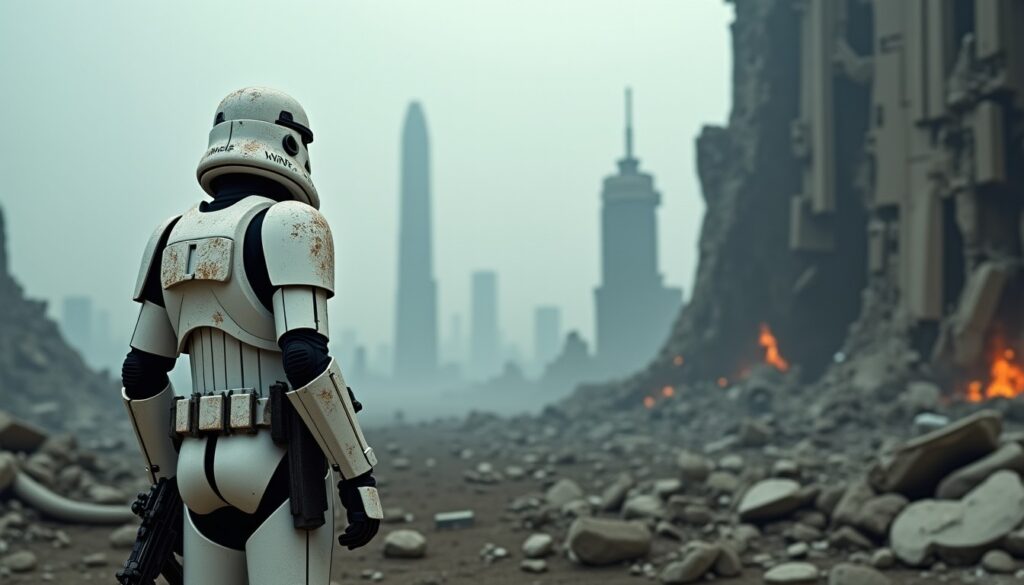
Star Wars Battlefront 3 has not yet been officially announced: Electronic Arts confirmed on October 21, 2026, that DICE and Respawn Entertainment are collaborating on a future shooter game project, but EA and Lucasfilm have not confirmed that this is the third Battlefront. Several media outlets link the project to the series, although no trailer, release date, platforms, or gameplay details are known.
To follow the matter without confusing facts and speculations, we can note three key points:
- Confirmed by EA: DICE and Respawn are working together on a project related to its shooter game strategy.
- Reported by several media outlets: the project would be Star Wars Battlefront 3.
- Still unknown: the final title, modes, represented era, business model, and schedule.
This distinction allows measuring both the hope inspired by the possible return of a beloved series and the questions that remain unanswered. To understand what is at stake, let’s examine the available information, potential creative directions, and the expectations left by previous episodes to players.
Star Wars Battlefront 3: what we really know about the DICE and Respawn project
The most solid fact concerns the collaboration between two Electronic Arts studios. On October 21, 2026, the publisher confirmed that DICE and Respawn Entertainment were working together on a new project linked to its shooter game activity. This announcement indicates that a joint development exists, but it does not give the game’s name nor explicitly mention the Battlefront series.
Several industry sources have associated this project with Star Wars Battlefront 3. This identification remains a rumor reported by the media, even if it has been picked up by various sources. The nuance is essential: EA’s confirmation of two studios working together does not equal an official announcement of the title. Lucasfilm has also not presented the game as a new episode in the franchise.
At this stage, no trailer has been published and no gameplay shown. We do not know the planned platforms, the release date, nor even which Star Wars universe eras might be explored. There is also no announcement regarding a single-player campaign, multiplayer mode, or a presentation schedule.
To keep a clear reading, we can separate public information from what remains to be verified:
| Element | Known status | What this means for players |
|---|---|---|
| DICE-Respawn collaboration | Confirmed by EA | The two teams are associated with a shooter game project. |
| Battlefront 3 name | Reported by several media | The association is credible, but the title is not official. |
| Gameplay and modes | Not revealed | No feature can be taken for granted. |
| Date and platforms | Not announced | No reliable release schedule is available. |
| Business model | Not disclosed | Progression and possible purchases remain unknown. |
Caution does not prevent interest. DICE developed the modern episodes of 2015 and 2017, while Respawn has already worked in the galaxy with Star Wars Jedi: Fallen Order and Jedi: Survivor. These experiences make the association logical, without revealing the division of labor or the form of the game.
Therefore, we must avoid turning a tempting hypothesis into a promise. As long as EA and Lucasfilm do not name Battlefront, the fairest formulation remains that of a joint project whose identification as the third episode is reported but not confirmed. It is this factual framework that allows evaluating possibilities without taking every speculation as an announcement.
DICE and Respawn: a promising but still mysterious partnership
On paper, the skills of the two studios seem complementary. DICE knows large-scale battles and designed the last two Battlefront games. Respawn brings a different experience: the studio has developed narrative action games in the Star Wars universe and also masters fast-paced online battles like Apex Legends.
This complementarity does not tell us who will do what. EA has not announced that DICE would handle multiplayer maps while Respawn would work on a campaign. The presence of a single-player mode is not even confirmed. Imagining a precise organizational chart would confuse the known specialties of the teams with an official division that has not been published.
The challenge will be to create a common identity rather than assemble two separate signatures. If each studio simply reproduces its usual methods, the result could lack unity: large battles on one side, scripted sequences on the other, without a real link between the two. Conversely, close dialogue between combat design, map readability, and storytelling could give the battles a stronger coherence.
A concrete example helps understand the issue. Imagine a battle where a squad must hold a position while a small group completes a narrative objective. If environments, rules, and roles are designed together, the mission can produce interesting tactical decisions. If modes are developed without exchange, the campaign may feel disconnected from multiplayer, and maps would only be arenas without context.
EA also indicated wanting to apply lessons from the launch and follow-up of Battlefield 6 to its shooter games, described by the publisher as a success. No specific element of this experience has been announced for the DICE-Respawn project. We therefore cannot state that any particular system, technology, or seasonal structure will be reused. The relevant point is rather how to support a game after release without letting the online service overtake its personality.
This question concerns both content and production rhythm. A multiplayer shooter requires maps, modes, and balance adjustments, whereas a campaign demands strong narrative direction and worked sequences. Finding a balance between these expectations imposes design choices early in development. The more the studios share a precise vision, the less the project risks resembling a juxtaposition of features.
For players, the good indicator will therefore not only be the number of prestigious names associated with the game. It will be necessary to observe how EA describes the collaboration: common goals, gameplay vision, and each team’s role. A successful alliance is measured by what the studios create together, not by the mere sum of their previous achievements.
The next big question concerns the chosen universe. Even a strong team will need a sufficiently marked creative direction to distinguish this project from old battlefields.
Which era of the Star Wars universe for a new Battlefront?
The film periods offer an immediately recognizable path. Players identify armies, heroes, and locations in seconds, while iconic battles promise a powerful nostalgic effect. This familiarity has an obvious commercial value, but it comes with a risk: always revisiting the same battles can give the impression of rehashing already widely explored ground.
The High Republic could open a less expected avenue. This period is approximately between 300 and 100 years before the Battle of Yavin. The Republic expands its influence and the Jedi Order holds an important place, but stories do not describe it as a time without conflict. The Nihil, a group of raiders and attackers, conduct raids, threaten civilian populations, and can seize territories under the authority of leaders like Marchion Ro.
Nothing confirms that DICE and Respawn will choose this era. It is an editorial possibility, not information about the game’s content. Respawn has already encountered some elements of the High Republic in Jedi: Survivor, notably with Dagan Gera, flashbacks, and references to this period. This familiarity may help the studio handle this part of the lore, without proving a direct link between the two games.
Such a choice could renew the dressing and conflicts while keeping the bases of a Battlefront: large battles, clear objectives, and fights between factions. It would also open clear visual differences. Equipment, vehicles, and architectures less known to the general public would give the game a unique silhouette, instead of reproducing images already associated with the cinematic trilogies.
The possible benefits of a less represented era would include notably:
- New armies, with distinctive silhouettes and equipment to better identify the camps.
- Conflicts suited to large maps, since Nihil raids can stage mobile attacks and objectives to defend.
- A different role for the Jedi, in a context where their influence is strong, but threats go beyond typical soldiers.
- A renewed visual identity, capable of distinguishing the game from its first images.
The risk is equally real: part of the public knows less about the High Republic than the film periods. It would then be necessary to introduce factions and stakes without requiring players to have read novels or followed every series. An opening mission could, for example, present a Nihil raid and explain objectives through action rather than a long exposition.
A new episode would not only benefit from reusing familiar Star Wars signs. It could also provide access to less visited conflicts by making the era understandable through the game itself. This ambition will depend on the creators’ choice, which remains entirely unknown at this stage.
An original setting would only have an impact if it also transformed the way of fighting. Opponents and rules could be the means to convey this difference rather than leaving it to artistic work alone.
Threats and mechanics capable of renewing the shooter
Changing era is not enough if matches unfold exactly the same way. A map covered with High Republic symbols but built on the same roles and objectives would risk being just a new skin. To justify a return, the setting should influence the pace of battles, team priorities, and the threats they face.
The Nameless, sometimes translated as “Sans-Nom,” illustrate a possibility in the universe without constituting an announced feature. These creatures linked to High Republic stories can affect Force users. In an action game, such an idea could disrupt Jedi characters’ habits and force teams to react differently than just relying on lightsaber power.
This is not to say these creatures will be present in Star Wars Battlefront 3. No character, enemy, location, or game system has been revealed. Their interest is conceptual: they show that a Star Wars opponent can threaten fighters through unusual rules, instead of being just another infantry unit, droid, or armored vehicle.
If such a threat were ever retained, designers would need to maintain readability. A creature that neutralizes certain powers could force a team to protect its Jedi or change its strategy. But if its effects are hard to understand, it risks feeling arbitrary. Explaining rules, the visual signal of danger, and counters would then be as important as the surprise itself.
One can imagine, for example, an objective on a map where a squad must evacuate civilians while an unpredictable threat disrupts its Force-sensitive fighters. Players would need to spread their roles: some secure passage, others control access or lure the enemy. This kind of situation would give tactical meaning to the setting, provided rules are clearly announced and balanced for each camp.
The same logic applies to multiplayer. Large-scale battles rely on easily understandable objectives, even in the middle of intense combat. Special elements can enrich a game but must not erase fundamental decisions: holding a position, supporting an advance, or preventing one. A good addition creates choices; it does not replace game understanding.
The project could thus combine spectacle and depth, but current information does not allow us to know if it will take this path. For now, we can only identify the creative challenge: exploiting the richness of the galaxy without turning every novelty into a mere visual effect. A memorable mechanic should change player decisions and remain understandable from the first matches.
Battlefront 3 and player trust after the 2017 controversy
The precedent of Battlefront II still weighs on expectations. At its launch in 2017, the game triggered a major controversy around its progression and microtransactions. Many players denounced a system that seemed to favor paid purchases. EA and DICE later modified these mechanisms after public reactions, but the episode left a lasting mark on the series’ reputation.
This history does not summarize the entire life of the game. Battlefront II received updates and maintained an active community for several years. This longevity proves that a difficult launch does not prevent a title from finding its audience, but it also does not erase the memory of the first weeks. For some players, the Battlefront name evokes as much spectacular battles as debates about progression and in-game purchases.
No business model has been announced for the new project. There is no official information about a store, progression system, passes, or post-launch content plan. Presenting these elements as already decided would therefore be unjustified. However, if the game is indeed a Battlefront, early and precise communication on these topics could help avoid old concerns dominating the conversation.
A multiplayer game may need ongoing support: new maps, balance adjustments, and updates represent work that continues after release. The question is how to finance this support without giving players the impression that competitive advantages can be bought. Cosmetic options clearly separated from in-game power, for example, would be easier to understand than a progression whose rules remain opaque.
Trust is also a component of the experience. A player who knows how to unlock equipment can calmly decide to devote time to the game. Conversely, a fuzzy system can make every reward questionable and divert attention from battles. For EA, transparency about progression would therefore not be a communication detail: it would have a direct effect on product reception.
The project arrives as Electronic Arts restructures its activities and focuses on shooter games. This pressure may push a publisher to favor a known formula, with commercial objectives easy to measure. For such a visible license, caution alone would not be enough: players will expect a convincing reason to return, whether based on an original era, polished modes, or fair progression.
Buying habits also offer insight into the context in which players evaluate leisure spending. Some wait for promotions to expand their libraries, as shown by this dossier on the summer Steam game sales 2025. That does not prejudge the price or availability of Battlefront 3, which are not announced, but reminds us that perceived value counts as much as license notoriety.
For enthusiasts following the project, the best approach is to distinguish three levels: the confirmed fact, the reported information, and the design hypothesis. EA has confirmed the joint work of DICE and Respawn Entertainment; media outlets associate this project with Star Wars Battlefront 3; everything else, from the choice of the High Republic to the functioning of the store, remains unknown. Upcoming official communications will allow judging whether this association really transforms expectation into a game vision.
Players who wish to compare consumption habits in the sector can also consult this overview of the summer video game promotions, without confusing it with an indication on the project’s release. For Battlefront, the immediate question remains simpler: when will EA and Lucasfilm finally specify the name, first images, and gameplay principles?