
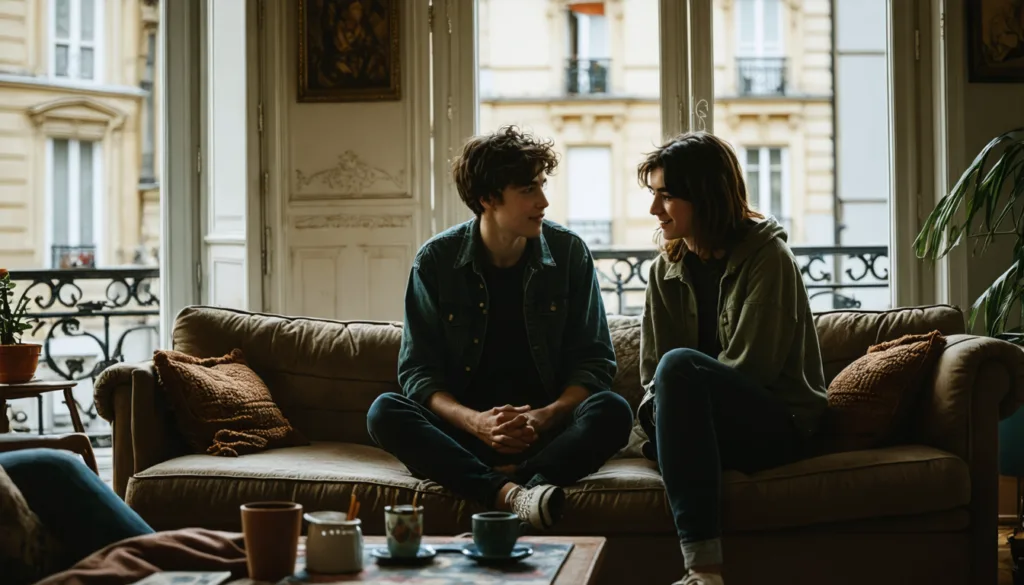
The Arte series titled Someone Should Ban Sunday Afternoons raises a genuine debate around these moments aptly named “Sunday afternoons.” Led by Isabel Coixet, this fiction dives into the lives of three young Parisian roommates, between friendships, loves, and existential uncertainties. What it offers is an exploration both melancholic and humorous of this very particular social time. Why should one consider banning Sunday afternoons? Because they crystallize complex emotions that reflect the tensions between leisure and melancholy, solitude and sharing, inactivity and reflection. The following themes will be developed to better understand this phenomenon and the scope of this Arte series shaking up Paris:
- The portrait of Parisian youth searching for meaning through the Sunday ritual
- The importance of cinema as a cultural vehicle and refuge
- The representation of Paris as a central and invigorating character of the series
- The social and cultural issues linked to the perception of Sundays in our society
- The controversy sparked by this fiction on social networks and in the media
Let’s decipher together this unique universe where the suspended time of Sunday afternoon becomes a revealing mirror of a society in transition.
The ritual of Sunday afternoons in Paris: between stagnation and quest for meaning
Sunday afternoons have always been an ambivalent moment in the weekly cycle, but with Someone Should Ban Sunday Afternoons, this time becomes a crucible of contradictory emotions. The series highlights the ritual of the trio of roommates who, faithful to the Sunday appointment, immerse themselves in watching a sad film. This sudden gesture resembles a collective refuge, a space where they share their melancholy while ritualizing it to better overcome it before Monday resumes.
This moment, which might seem trivial, takes on a particular significance in a society where leisure is often produced, consumed en masse, and without real emotional connection. Sunday afternoon represents a temporal fracture where society faces slowness, sometimes oppressive emptiness, but also a space of freedom and intimate reflection. This duality invites us to question the place given to Parisian youth in an ultra-connected world where pause time is rare.
The series beautifully illustrates this paradox with scenes shot in iconic places such as heritage cinemas or bars in the Belleville neighborhood. These settings give these shared moments a unique emotional texture often tinged with nostalgia. It is this mechanism that triggers an invitation to rethink our relationship to free time and the ways to inhabit it.
To illustrate this paradox, one can compare the number of cinema-goers on Sunday afternoons in Paris. In 2025, a study on cinema attendance revealed a 15% drop in Sunday attendance, while Friday evening and Saturday sessions remain stable. This reflects a growing disinterest for this particular moment, perhaps perceived as too contemplative, as suggested by this Arte chronicle. This observation confirms the idea that this social time tends to be avoided or experienced tensely by youth.
List of characteristics of Sunday afternoons according to the series
- Suspended time mixing boredom and shared intimacy
- Collective ritual serving to ward off melancholy
- Climax where repressed emotions can emerge
- Symbolic place for exchanges in a moving city
- Reflection of youth seeking landmarks
Cinema as a common language and refuge against melancholy
At the heart of the series broadcast on Arte, cinema is not limited to a mere leisure activity: it becomes a true emotional language, a communication tool allowing the characters to express their doubts, dreams, and frustrations. This narrative choice is particularly revealing of the cultural role cinema still holds in our society.
The Sunday ritual around a sad film is not trivial. It is a collective, almost therapeutic way of facing the existential torments haunting the young adult generation. This approach encourages valuing cinema not only as a spectacle but as a space of sharing and an emotional discipline. It is not mere entertainment, but a way to read the world and soothe its wounds.
The success of the broadcast on ARTE, which offers online streaming accessible from March 12 to September 11, 2026, and two TV evenings in March, testifies to the social and cultural impact the series arouses. Audio description and subtitles intended for the hearing-impaired add to this desire for accessibility and inclusivity, making the narrative even more universal.
Several actors embody this cinephile passion through their characters: Liv Henneguier (Louise), Clara Bretheau (Charlie), and Théo Christine form an endearing trio whose dynamic is built around film and screens. The presence of figures such as Jeanne Balibar or Tim Robbins adds further depth, a bridge between generations, reinforcing the implicit social critique.
| Aspect of cinema in the series | Cultural and emotional significance |
|---|---|
| Sad films screened on Sunday | Ward off melancholy and open up inner dialogue |
| Heritage cinemas as meeting places | Preserve the collective memory of cinema, create social bonds |
| Cinephile characters | Represent cultural identity and connection between individuals |
| Collective and private rite | Symbol of belonging and emotional sharing |
Paris, a character in its own right in the Arte series
The setting of the French capital goes far beyond a mere background in this fiction. Paris is embodied through its emblematic places – the Canal de l’Ourcq, Belleville, its bookstores and bars where youth remake the world. This omnipresence strengthens the poetic and social dimension of the series, offering a sensitive and contemporary reading of the capital in its contradictions.
The representation of a living Paris, a popular Paris rich in diverse cultures, serves here as a mirror to the state of mind of youth. The trafficking of emotions, hopes, and disappointments blend with urban spaces, which become the temporary refuge of a generation seeking stability. This portrait also sketches a topography of places where culture creates bonds and where alternative ways of life are invented.
This series thus joins earlier works that have captured the city’s soul, giving it an almost tangible thickness. It restores to Paris this role of artistic inspiration and sociological support for understanding societal changes.
Four key places in Paris in the series and their significance
- Canal de l’Ourcq: A space of freedom and idleness compensating for urban bustle.
- Belleville: Multicultural neighborhood, emblem of social diversity and intertwined narratives.
- Heritage cinemas: Guardians of cinematic memory and gathering places.
- Bookstores and bars: Spaces for intellectual exchange and uninhibited sociability.
Social and cultural issues surrounding Sunday afternoons in society
In contemporary culture, Sunday afternoon embodies a moment when society slows down but also where invisible social tensions manifest. The Arte series, by highlighting this moment, invites us to think about the effects these temporal pauses have on human relationships and mental health.
The banning of Sunday afternoons appears as a metaphor. It questions society’s ability to manage boredom, but also the weight of norms governing collective leisure moments. This time is an invitation to observe how marginalities are constructed, how solitude, introspection, and even anxiety take place in low-constraint spaces.
In this context, the young roommates represent a generation exposed to the challenges of the modern world: precariousness, emotional instability, multiplication of screens, and desire for a more authentic future. The filmed Sunday ritual becomes an outlet against the constant acceleration of lifestyles.
The debate generated by this series extends in the media and on social networks. On one side, part of the audience applauds the realistic and sensitive look on these “Sunday afternoons,” while others denounce an excess of melancholy or even a refusal of optimism. This controversy reveals fractures within the social representations of free time and youth.
The broadcast of Someone Should Ban Sunday Afternoons in 2026 opens a new chapter in the conversation on youth and their relationship to time, cinema, and Paris. This series shakes up classic narrative habits by offering a short format of 8 episodes of 30 minutes, perfectly adapting to the mobile rhythm of contemporary viewers.
The social impact of this project is significant: it awakens awareness around the cultural and human stakes of this very specific time that is Sunday afternoon. This creative gesture fits into a broader reflection on the balance between performance and suspension time in our society.
Public opinion is divided. On forums and networks, some viewers identify with the displayed melancholy and appreciate the sobriety of the narrative, while others criticize a representation too dark, sometimes categorized as “Sunday counter-culture.” For example, a highly followed discussion on Gamers Land analyzed parallels between this fiction and other works stimulating reflection on social pace.
This project also testifies to the importance taken by series broadcast by media like Arte in structuring cultural opinions. They nurture dialogue between generations and contribute to the making of a collective memory, notably around urban nostalgia and shared rites. Accessibility guaranteed via audio description and subtitles for the hearing impaired helps build a democratic space for media reception.
| Element | Effect on the public | Concrete example |
|---|---|---|
| Short format (8×30 min) | Adapted to mobile viewing and encouraging thoughtful consumption | Stable audience on arte.tv between March and September 2026 |
| Melancholic theme | Encourages reflection and debate | Discussions on social networks and specialized media |
| Marked Parisian setting | Strengthens local identification and authenticity | Reactions in the local Parisian press |
This controversy gives a new voice to a series that succeeds in its bet: that of enabling a dialogue between youth, culture, and society through a melancholic and relevant filter.
For those who wish to extend their cinematic reflection, the series can also open onto related universes, such as the anticipated spin-off of Marshals Yellowstone, which explores in its own way the dynamics of relationships and the memory of territories.