
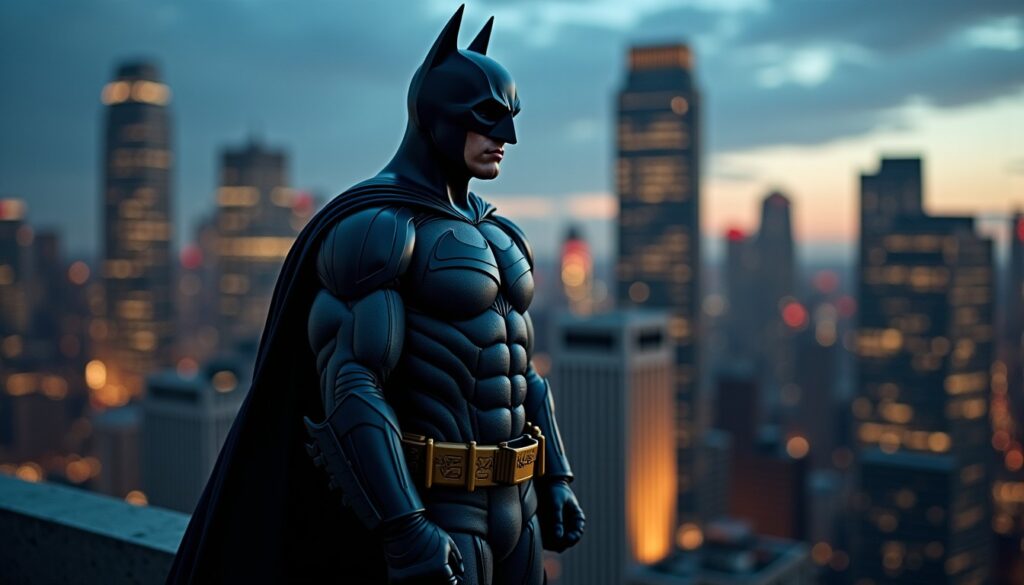
For all the fans of the DC Comics universe and its iconic masked vigilante, cinema has offered a myriad of remarkable works featuring Batman, the Dark Knight. Discover here the ultimate ranking of the ten best Batman films, selected based on their cultural impact, critical success, and popularity among fans. Throughout this exploration, you will find:
- The unmissable classics embodying Batman from different eras, from Burton to Nolan
- The modern reinventions that reconnect with renewed darkness and psychological depth
- An overview of memorable actor performances, visionary directors, and narrative stakes
- The technical and aesthetic innovations that have enriched the cinematic legend of Gotham’s vigilante
- A summary table combining popularity and reviews to better position the masterpieces of the genre
This selection will guide you through nearly six decades of cinema, highlighting films that have shaped the collective imagination around a superhero both dark and complex. Let’s dive together into this universe where Gotham City serves as the backdrop for these thrilling stories.
The foundations of the Batman myth in cinema: from Tim Burton to Joel Schumacher
Since the late 1980s, Batman has established himself as an icon of superhero cinema, with his big-screen debut profoundly influencing the perception of the masked hero. The 1989 film “Batman,” directed by Tim Burton, revolutionized the image of the vigilante by giving it a gothic atmosphere and a baroque aesthetic. Michael Keaton portrays a tormented Bruce Wayne, confronted by a terrifying Joker played by Jack Nicholson. This work grossed around 400 million dollars at the worldwide box office and marked a turning point toward more adult and stylistically daring superhero films.
The success of this film was followed by “Batman Returns” in 1992, also signed by Burton. The appearance of the Penguin played by Danny DeVito and Catwoman portrayed by Michelle Pfeiffer added dramatic complexity, while the direction emphasized darkness and visual sophistication. This second episode strengthened the status of the Dark Knight as a symbol of cinema that is both mainstream and culturally robust.
Subsequently, the Joel Schumacher era marked a notable shift with “Batman Forever” (1995) and “Batman & Robin” (1997). Val Kilmer then George Clooney donned the costume, in films decorated with a brighter color palette as well as a lighter and more flamboyant tone. While “Batman Forever” achieved some success with 336 million dollars in worldwide receipts, “Batman & Robin” received a more mixed reception, criticized for its excessive aesthetics and sometimes caricatural dialogues.
These first steps laid the narrative and visual foundations that would be reconsidered with Christopher Nolan’s trilogy. Before that, one notices that the films of this era offer:
- An immersion in a stylized and expressionist Gotham, close to the comic book
- Colorful antagonists with eccentric and memorable personalities
- An often theatrical approach, with a desire to transcend the limits of the superhero genre
This first cinematic act nourished the Batman myth, which would soon experience a profound shift toward more realism and sophistication.
Christopher Nolan’s trilogy: the revival of the Dark Knight in cinema
Released in 2005, “Batman Begins” laid the first stone of a trilogy that would redefine the superhero film genre. Christopher Nolan chose an approach rooted in psychological realism and moral complexity. Christian Bale portrays a vulnerable Bruce Wayne, whose transformation into a vigilante relies on rigorous training and a deep inner quest. The film explores the hero’s origins, facing the threat of the League of Shadows, embodied by Liam Neeson. With an estimated budget of 150 million dollars, “Batman Begins” grossed over 374 million dollars, confirming growing public interest.
The climax of this trilogy is undoubtedly “The Dark Knight” (2008). The film is a true cultural and cinematic phenomenon, currently accumulating over a billion dollars at the box office. Heath Ledger, in a terrifying Joker role, delivers an unforgettable performance, rewarded with a posthumous Oscar. This second installment transcends the simple opposition between hero and villain by questioning the fine line between justice and chaos. The plot invites the viewer to reflect on the ethical dilemmas of vigilantism, enriched by strong performances from Gary Oldman, Aaron Eckhart, and Maggie Gyllenhaal.
The conclusion “The Dark Knight Rises” (2012) expands the stakes toward systemic threats with the antagonist Bane, played by Tom Hardy, who threatens Gotham with total collapse. This third stage is as much a celebration as a vibrant farewell to the trilogy, reuniting around Bale beloved actors such as Michael Caine, Morgan Freeman, and Joseph Gordon-Levitt. The critical and public success of this saga is explained notably by:
- A complex and mature exploration of the Batman character
- A sharp balance between spectacular action scenes and dramatic reflection
- A high-profile cast and immersive direction, adding depth to the stakes
This trilogy remains a major reference in 2026, inspiring a generation of filmmakers and fans who see Nolan as an icon of superhero cinema.
The Matt Reeves era and the revival of the Batman film in 2020
After a decade dominated by various adaptations, Matt Reeves offered a new vision in 2022 with “The Batman.” The film presents a Bruce Wayne in his second year as the masked protector, more vulnerable and introspective than his predecessors. Robert Pattinson wears the costume in a very urban and dark atmosphere, where the investigation of the serial killer Riddler, played by Paul Dano, gives the film its breath of noir thriller.
The cast also includes Zoë Kravitz as Catwoman, whose relationship with Batman is both ambivalent and complex, John Turturro as the police chief, and Andy Serkis in a key role. “The Batman” is released amid the revival of introspective blockbusters, with a somewhat messy but immersive artistic direction that appeals to a new generation. The film’s tone is marked by:
- In-depth psychological treatment of the main characters
- A more realistic, dirty, and oppressive Gotham City, reflecting pervasive corruption
- An atmospheric soundtrack and a dark visual style, close to neo-noir
This approach renews the Batman myth, broadens superhero cinema themes toward more introspection and gravity, while maintaining the narrative tension needed for a successful action film.
The ranking of the 10 cinematic Batman masterpieces: analysis and reviews
The choice of the ten films composing this ranking is based on a balanced combination of:
- Worldwide box office success
- Critical reception on platforms like Rotten Tomatoes and Metacritic
- Enduring popularity among Batman and cinema fans
- Cultural importance and influence on the superhero genre
This summary table synthesizes the position of these films in our ultimate ranking:
| Rank | Film | Year of release | Worldwide box office (in M$) | Critical score (Rotten Tomatoes / Metacritic) | Main actor |
|---|---|---|---|---|---|
| 1 | The Dark Knight – The Dark Knight | 2008 | 1,005 | 94% / 84 | Christian Bale |
| 2 | Batman Begins | 2005 | 374 | 84% / 70 | Christian Bale |
| 3 | The Batman | 2022 | 770* | 85% / 72 | Robert Pattinson |
| 4 | Batman (1989) | 1989 | 400 | 72% / 69 | Michael Keaton |
| 5 | Batman Returns | 1992 | 266 | 69% / 57 | Michael Keaton |
| 6 | The Dark Knight Rises | 2012 | 1,081 | 87% / 78 | Christian Bale |
| 7 | Batman Forever | 1995 | 336 | 52% / 51 | Val Kilmer |
| 8 | Batman v Superman: Dawn of Justice | 2016 | 873 | 29% / 44 | Ben Affleck |
| 9 | Batman & Robin | 1997 | 238 | 12% / 28 | George Clooney |
| 10 | Batman (1966) | 1966 | 12* | N/A | Adam West |
* Estimated in millions
This ranking shows that Nolan’s films dominate in terms of influence and success, while the older and more colorful versions by Schumacher or the campier adaptations like the 1966 one remain cult classics by nostalgia or stylistic particularities. An interesting observation is the marked contrast between critical reception and fan enthusiasm, notably for titles like “Batman v Superman: Dawn of Justice” which remain emblematic of an expanded DC.
Batman’s place in the DC Comics universe and its impact on superhero cinema
Batman is not just a comic book hero; he is a true cinematic phenomenon that has helped set the codes for superhero cinema. His evolution on screen reflects the changing expectations of the public and the technical advances in cinema. The myth of Gotham and its Dark Knight illustrates:
- Narrative instinct characterized by moral dilemmas and sharp psychology
- The use of emblematic antagonists, often as complex as the hero, such as Joker, Riddler, or Bane
- A sensory palette marked by the use of gothic sets, immersive music, and innovative special effects
- Profound influence on other DC and Marvel adaptations, inspiring many directors
Batman films have paved the way for a more nuanced exploration of vigilantes, often avoiding clichés to offer more varied portraits embodying political, psychological, and social issues. The collaboration between actors, directors, and screenwriters has diversified approaches, giving each version its own fresh and renewed breath.
This work of interpretation and innovation is visible in the use of modern special effects, increasingly sophisticated costumes, and attention to visual ambiance, contributing to total immersion in Gotham’s dark universe. Batman cinema has thus helped elevate the genre into a broader category where spectacle and narrative construction are closely linked.