
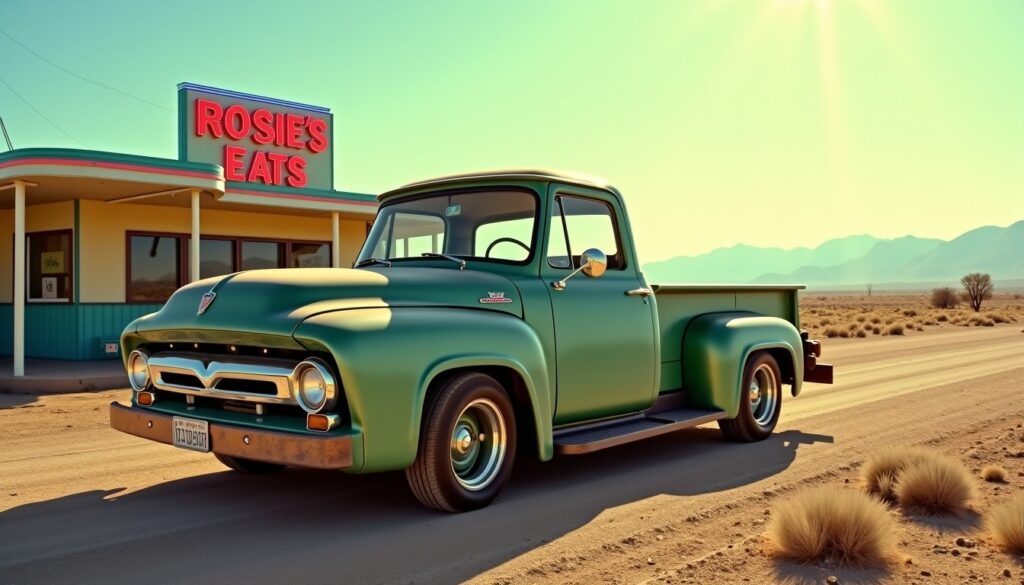
Netflix has officially ordered Other Worlds: A Stranger Things Adventure, a live-action prequel expected in 2028 and set in Marion, Nevada, in 1955. Announced on November 6, 2026, during Stranger Things Day, this new TV series will take place before the events of Hawkins and offer a different setting to explore the franchise’s mythology.
The project brings together brothers Matt and Ross Duffer and writer Kate Trefry, while Joe Wright will direct the first three episodes. The first teaser gives a precise timestamp, April 19, 1955, but does not reveal the full plot nor the actors who will make up this new cast. Filming is planned in New Mexico, and Netflix aims for a 2028 release, without announcing a more specific date.
- Location and time period: Marion, a fictional town in Nevada, in 1955.
- Format: a live-action prequel, distinct from a new season of the original series.
- Announced team: Kate Trefry in creative lead, the Duffer brothers producing, and Joe Wright directing the first three episodes.
- Still unknown elements: casting, number of episodes, and exact release schedule.
This move to the 1950s opens new ground for Stranger Things’ science fiction. To understand what this announcement really establishes, and what it deliberately leaves in the shadows, it is necessary to look separately at the setting, the project’s place in the chronology, and the production information already confirmed.
Other Worlds: the Stranger Things prequel set in Nevada in 1955
The change of setting is the first visible difference between Other Worlds and the original series. The action will not take place in Hawkins, Indiana, but in Marion, a fictional town in Nevada. This choice allows Netflix to maintain the link with the Stranger Things universe while avoiding simply reproducing the streets, familiar locations, and routines of the small community that carried the story of Eleven and her friends.
The geographical detail should be kept in mind: Marion is not Marion, Indiana. The series builds a new setting in a different state, with its own landmarks and an identity to establish on screen. A viewer who only saw the title or a few words about the series might easily believe it to be a return to a familiar setting; the available information rather indicates a clear shift towards the American West.
The teaser also provides an exact date, April 19, 1955. This marker anchors the story in a period several decades before the central events of Stranger Things. It suggests an intention to give the prequel an identifiable chronology rather than a vague retro backdrop. The date alone does not reveal the characters’ roles nor the nature of the mystery, but it offers a concrete starting point for situating future clues.
A new town to refresh the atmosphere
In a science fiction story tinged with horror, the setting can act as a character in its own right. Hawkins combined the everyday life of a small American town with secret experiments, disappearances, and the existence of a parallel universe. Marion offers the team the opportunity to build a different atmosphere, without abandoning the tension between ordinary life and unexplainable phenomena that define the franchise.
To imagine what this change can bring, picture a family settling in Marion in the spring of 1955. The inhabitants would have their own gathering places, rumors, and worries, and a supernatural anomaly could spread there through signs distinct from those observed in Hawkins. This example is not a confirmed part of the plot; it simply demonstrates why a new location can alter relationships between characters and how the mystery manifests.
This setting also allows welcoming new protagonists without requiring the plot to rely on familiar faces from the original series. The town can thus become the center of a standalone story, with local stakes and secrets, while remaining connected to a larger mythology. Marion is therefore not just a replacement backdrop: it is the promise of another entry point into Stranger Things.
A chronology prior to Hawkins and The First Shadow
Other Worlds presents itself as a prequel set before the main series, but also before the play Stranger Things: The First Shadow. This chronological position opens a period still little represented in the franchise’s works. Netflix is therefore not ordering an additional season that would directly reprise the consequences of the last episodes: the series goes further back, to a time when events known to the public have not yet occurred.
This temporal distance has an important consequence on the storytelling. The writers can show a community that does not yet know the supernatural codes associated with Hawkins, and develop characters whose decisions are not determined by Eleven’s adventures. For the audience, tension can come from the gap between what the inhabitants understand and what the viewers already know about the franchise. A simple unexplained phenomenon then takes on a different meaning when one is aware of the dangers related to the Upside Down.
What the 1955 date allows to imagine
The teaser highlights April 19, 1955, but Netflix has not published a detailed synopsis. It is therefore necessary to distinguish confirmed facts from theories discussed around the project. The presence of a new town, a new era, and a new cast is announced; the precise course of the plot is not. This distinction prevents turning a fan theory into official information.
One theory discussed around the series concerns a mysterious rock associated with Henry Creel, a character tied to the franchise’s mythology and to The First Shadow. This potential link could give Other Worlds a particular function: connecting elements already known to older events. At this stage, the idea has not been detailed by Netflix. We can therefore consider it a hypothesis to follow, without presenting it as the confirmed subject of the prequel.
This chronological principle also allows enriching the parallel universe without repeating the same revelations. A series can maintain suspense by showing traces of a phenomenon before its rules are understood. For example, an unusual object or a restricted area in the desert could fuel inhabitants’ questions before shedding light, later, on an element of the general mythology. Again, this is a way to envision the setting’s potential, not a confirmed detail of the story.
The prequel must thus find the balance between novelty and continuity. If it multiplies references to Hawkins, it risks reducing Marion to a stepping stone towards already known events; if it strays too far, the connection with Stranger Things may seem decorative. Its narrative interest will depend on its ability to tell a complete story while providing a fresh perspective on the origins of the mystery.
The creators and team of the new Netflix series
Creative continuity notably relies on Matt and Ross Duffer, the creators of Stranger Things, as well as on Kate Trefry. The latter already knows the franchise’s workings thanks to her work as a writer and producer on the original series. She will here take a central role as showrunner, writer, and executive producer, positioning her at the heart of the new story’s development.
The presence of the Duffer brothers in production helps preserve the link with the series’ identity while leaving the daily management of the project to a dedicated team. This organization can prove useful for a prequel: it favors mythology coherence but also leaves room for a tone and characters designed for Marion. The challenge is to keep credible rules for this universe without making each episode a catalogue of nods to previous seasons.
Joe Wright will direct the first three episodes
The direction of the first three episodes has been entrusted to Joe Wright, who is also among the executive producers. The announcement concerns this initial block and does not mean he will necessarily direct the entire season. This detail is useful to understand the scope of his role: the opening episodes will establish the visual codes, the pace, and the first impression of Marion, while the direction of other episodes has not been communicated.
Choosing a director for the first episodes can heavily influence a series’ identity. The beginning usually introduces the characters, environment, and initial anomalies, three essential elements in a suspense-based work. This work can be compared to setting up a theatrical stage: lighting, framing, and sounds guide the audience on whether they should feel safe, uneasy, or already in the presence of a threat. The series will however need to specify its own visual language rather than identically copying Hawkins’ style.
Shawn Levy and his company 21 Laps also participate in the executive production. Nothing in the available information confirms that he will direct episodes. Paul Dichter, Shelley Meals, Andrea Sperling, and Pavlina Hatoupis are also mentioned among the executive producers. The group thus brings together people linked to the franchise and collaborators tasked with supporting this new phase.
Filming is announced in New Mexico. This production location should not be confused with the story’s setting: the action takes place in Marion, Nevada, while filming will occur in another state. New Mexico’s landscapes can provide suitable backdrops for a fictional desert town, but the production will need to transform them with sets, props, and cinematography to give Marion a distinct identity. The announced team thus combines franchise continuity and new direction, without all production roles yet detailed.
Stranger Things release: confirmed information for 2028
Netflix plans to release Other Worlds in 2028. The platform has not announced a specific month or day, and no episode-by-episode release schedule is available. The 2028 horizon therefore constitutes a release window, not a complete launch date. For the public, this provides a concrete landmark after several years of development and speculation around a live-action spin-off.
The project now has an official title: Other Worlds: A Stranger Things Adventure. The plural “Other Worlds” is part of the announced title. This detail does not suffice to reveal the plot’s structure, but it resonates with the idea of a parallel universe and mysterious realities, themes familiar to the franchise. However, one should avoid deducing that several specific worlds will be explored: the title is set, but the story’s content remains largely protected.
The table below separates confirmed information from elements not yet made public. This distinction helps follow the announcement without confusing official data, such as the release year, with hypotheses about characters or plot.
| Element | Known information | Status of the announcement |
|---|---|---|
| Title | Other Worlds: A Stranger Things Adventure | Confirmed |
| Format | Live-action spin-off and prequel series | Confirmed |
| Setting | Marion, Nevada, in 1955 | Confirmed |
| Direction | Joe Wright for first three episodes | Confirmed |
| Filming | New Mexico | Announced |
| Release | Planned on Netflix in 2028 | Year confirmed, exact date unknown |
| Casting and season format | Actors, number of episodes, and duration | Not communicated |
The absence of casting is one of the main unknowns. No actor from the original series has been announced for this new production and no new character has yet been presented. As the action takes place in 1955, several decades before the Hawkins adventures, a renewed cast seems consistent with the project. This does not exclude any familiar appearance, but none can be taken as certain.
Netflix also has not specified the number of episodes or their duration. These data will directly affect expectations: a short season might tighten the story around a single mystery, while a broader format would allow more room for the Marion community. Until the platform communicates these details, it is better to stick to the 2028 window and confirmed creative elements. For now, the timeline is set, but the exact form of the series remains to be discovered.
Why this prequel could renew Stranger Things’ science fiction
A successful prequel does not merely recount what happened before a known work. It must give its new characters and era their own interest while enriching already familiar elements. Other Worlds has three announced levers for this: a new location, Marion; a clearly situated period in 1955; and a new mythology linked to the Stranger Things universe. Their association offers renewal potential but does not alone guarantee the series’ success.
The 1950s hold strong visual and cultural value for American fiction. Cars, clothing, shops, and communication devices can help create an immediately recognizable atmosphere. To tell a mystery, this era also imposes interesting constraints: inhabitants do not have contemporary digital tools to quickly share evidence or verify rumors. Information can therefore circulate through the local newspaper, conversations, or phone calls, and each detour can deepen the suspense.
The mystery rather than repeating Hawkins’ adventures
The risk of a story set before the original series would be to turn every new clue into a definitive explanation of what the audience already knows. A series can instead retain some unknown. It does not need to link everything to a single character or famous event to give the franchise depth. A phenomenon can remain partially understood by Marion’s inhabitants, making their experience unique even if viewers perceive echoes with Hawkins’ parallel universe.
One can imagine a plot where several residents interpret the same event differently: a light in the desert becomes a power outage for one, a military rumor for another, while a third notices an impossible-to-explain consequence. This storytelling model would allow the investigation to progress through complementary points of view. This is a possible construction example, not a synopsis announced by Netflix; the official plot remains unknown.
This approach could also make the story accessible to people who have not rewatched every Stranger Things season. A new group of characters, an autonomous town, and an identifiable mystery constitute a clear entry point. Loyal viewers, meanwhile, can seek links with known elements, like Henry Creel or manifestations of another world, provided the series actually develops them on screen.
The franchise must finally preserve tension between explanation and discovery. If every event is immediately linked to a major revelation, the mystery loses strength; if no clue has consequences, the audience might feel the questions are only postponed. The writers will therefore need to give Marion a story that progresses, with immediate stakes for its inhabitants, rather than make the whole series rest on references for fans.
At this stage, the available information sketches a direction, not a completed story: a live-action prequel, anchored in 1955 Nevada, carried by a partly familiar team. The teaser lays the first milestone, while the absence of synopsis and casting keeps the core plot in the shadows. The strength of Other Worlds will depend on its ability to make Marion a story in its own right, and not just a new step in Stranger Things’ chronology.