
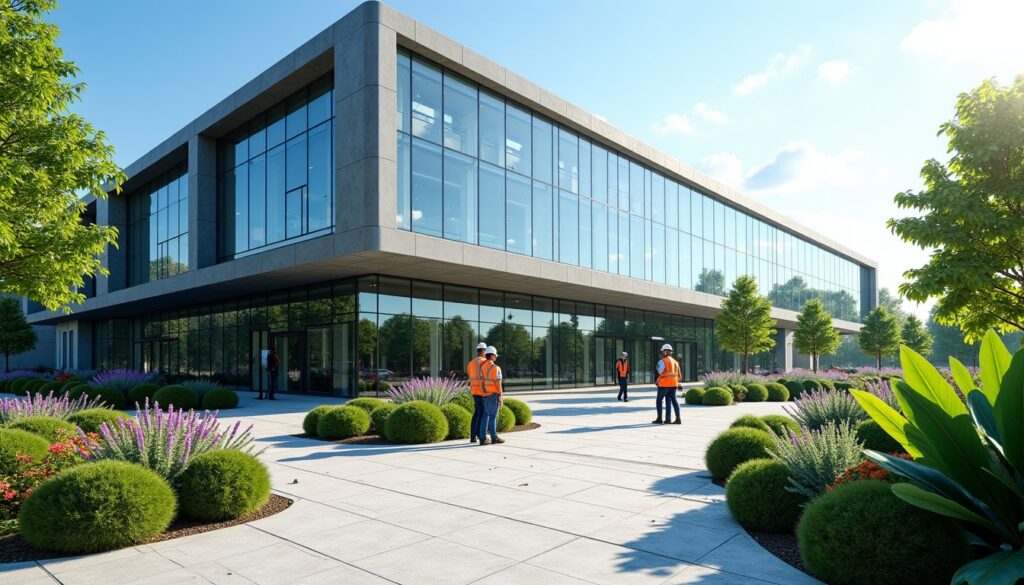
Nintendo is investing more than 600 million euros in a project that marks a historic turning point for the Japanese video game giant: the creation of a state-of-the-art research and development center. Located in the hometown of Kyoto, this new complex, named the Technology Development Center, is set to become the beating heart of technological innovation and the development of hardware and software, with delivery scheduled for March 2029. With a colossal investment exceeding 600 million euros, Nintendo asserts its desire to strengthen its internal capabilities to prepare consoles and gaming experiences that are increasingly powerful and captivating.
Here are the major topics we will address:
- The strategic importance of this R&D center for Nintendo and the video game industry.
- The innovative infrastructures and technologies planned to support hardware and software development.
- Delays in the schedule and what this means for the company.
- The economic and territorial impact of this project on Kyoto and its human stakes.
- The place of this investment within the competitive landscape of gaming technologies.
Let’s dive behind the scenes of this gigantic project that illustrates the adaptability and long-term vision of a global must-have brand.
A major strategic investment in a state-of-the-art research center in Kyoto
The choice to build a second research and development center in the heart of Kyoto highlights how much Nintendo wants to consolidate its technological mastery and strengthen its leadership in the video game sector. For several decades, the Japanese company has stood out not only for its iconic franchises but also for remarkable hardware innovations, such as the Switch, which recorded worldwide sales exceeding 115 million units in 2025.
This new building is officially named the Technology Development Center: a name that directly references its key role in creating the technologies of tomorrow. Located at 11-1 Hokotate-cho, Kamitoba, Minami-ku, this nearly 50,000 m² center will bring together teams dedicated to software and hardware development. Standing 67.57 meters tall over 9 floors plus a basement, this building is one of Nintendo’s most ambitious constructions in Kyoto.
This center will host a wide variety of infrastructures:
- Modern offices equipped for collaborative developer work.
- Technical facilities dedicated to the design and testing of new hardware components.
- Servers and virtualized environments essential for software innovations.
The goal is also to absorb a significant increase in R&D staff. Note that Nintendo recently confirmed a massive recruitment plan to expand its technical teams, and this center offers the necessary capacity to accommodate this growth.
By locating this project in Kyoto, Nintendo reinforces its local roots, a strategy that contributes to regional economic dynamism while ensuring perfect synergy with its other historic facilities.
An adjusted construction schedule to meet evolving R&D needs
The project has experienced several schedule adjustments since its launch. Initially planned for 2027, the completion of the Technology Development Center was postponed first to 2028 and finally to March 2029. This evolution reflects the often complex industrial reality of large technological projects where technical and human needs evolve rapidly.
According to official statements, this schedule shift allowed Nintendo to enlarge the dimensions of its new center, notably to anticipate the rapid growth of its teams as well as increased demands in terms of equipment and technical capacity. It is a pragmatic choice, assumed and aligned with the company’s long-term strategy.
Some figures illustrate this dynamic:
| Year | Initial planned date | Adjusted delivery date | Center area (m²) | Estimated cost (billion euros) |
|---|---|---|---|---|
| 2021 (call for proposals) | – | – | – | – |
| 2022 (land acquisition) | – | – | 10,028 m² (land) | – |
| 2024 (initial plan) | 2027 | – | 40,000 m² (initial estimate) | ~600 M€ |
| 2026 (final adjustment) | 2027 | 2029 | 49,305.87 m² | ~660 M€ |
Flexibility in the schedule and the changes made to the project show Nintendo’s concern for anticipation and adaptation, in a technological context where innovation requires permanent agility. Beyond the deadlines, this approach guarantees the group a solid foundation to support the development of future consoles and services.
Advanced technologies and innovative services at the heart of Nintendo’s research center
This state-of-the-art center aims to be a functional showcase of the most cutting-edge techniques used in the design of hardware and software for video games. Thanks to its imposing structure and state-of-the-art equipment, it will integrate innovations in several key areas:
- Hardware development: spaces for prototyping and testing new electronic components, embedded circuits, and peripheral accessories such as controllers with enhanced haptic feedback.
- Software research: laboratories equipped to create video games leveraging the latest advances in artificial intelligence, augmented reality, and virtual immersion – a field where Nintendo seems eager to strengthen its presence.
- Interdisciplinary collaborations: shared spaces between designers, engineers, and UX (user experience) specialists facilitating the emergence of innovative ideas and optimization of creative processes.
For example, in recent fiscal years, Nintendo has increased its R&D expenditures to record levels, consolidating its position among the most innovative companies in the sector. Centralization within the Technology Development Center will help improve responsiveness and coherence of internal projects.
Issues around energy performance and sustainability are also central concerns. The building is designed to optimize consumption and minimize environmental impact, a practice now essential within large corporations.
It should be noted that as part of its launch cycle, Nintendo also plans to invest long-term in equipment, ensuring that the center remains cutting-edge for several decades, particularly in the face of the increasing importance of immersive technologies and cloud gaming solutions.
This project is much more than just a construction: it is an economic boost that will revitalize Kyoto’s local ecosystem. By acquiring the land in 2022 from the municipality, Nintendo strengthened its regional commitment, creating a virtuous circle.
The opening of the Technology Development Center will lead to a significant increase in direct employment in the R&D sector, with several hundred new positions targeting specialized technical profiles (engineers, developers, designers). This skills mobilization will also strengthen collaborations with local universities and research centers.
Kyoto’s municipality will also see an indirect positive effect, notably on services, housing, and transportation infrastructure, which will have to adapt to the arrival of a new, often international, workforce. A recent study estimated that such a project could boost local growth by 1.5 to 2% over the decade following commissioning.
Finally, it is worth highlighting the cultural impact of keeping the R&D headquarters in a historic city like Kyoto, between tradition and innovation. This strategy helps maintain Nintendo’s uniqueness as an actor who values its roots while embracing progress.
Nintendo’s positioning in the race for technological innovation in video games
With this exceptional investment, Nintendo is resolutely positioning itself in the race for technology, a hypercompetitive sector where it is necessary to constantly anticipate hardware and software innovations. This center offers it flexibility and speed to develop unprecedented solutions that could define the next generation of consoles or interactive experiences.
While competitors advance on several fronts — virtual reality, artificial intelligence, cloud gaming — Nintendo bets on an intelligent integration of these technologies in a controlled environment. The future Technology Development Center will facilitate this approach, optimizing creation cycles and reducing intermediaries.
For example, the recent planned rise around a hypothetical Nintendo Switch 2 clearly shows the importance of having substantial internal means to master hardware innovations. Integrating R&D into a single location also helps secure technical advances against brain drain and the growing complexity of projects.
Meanwhile, this project is based on a philosophy of constant and sustainable innovation, supported by substantial medium- and long-term investments, showing that Nintendo is not only planning to create consoles but to build a lasting technological ecosystem in the world of video games.