
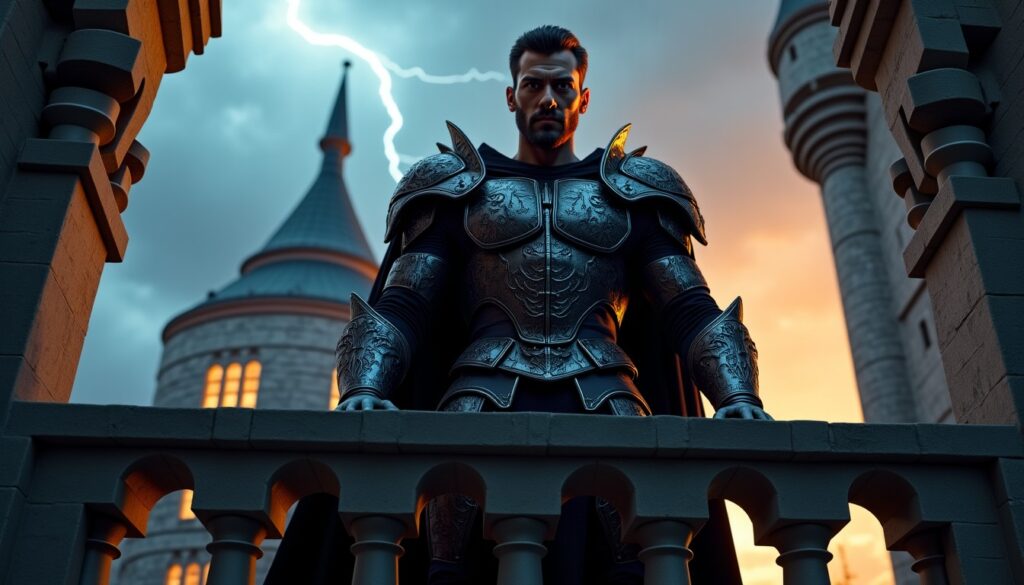
Netflix restores the prestige of the worst boss in the Devil May Cry saga by transforming Argosax, long considered a failed antagonist, into a central figure full of complexity and ambition. This narrative rebirth takes place through season 2 of the animated series, released on May 12, 2026, unveiling a bold adaptation of the character and an unprecedented deepening of Capcom’s universe. We will explore together:
- The trajectory of Argosax in the video game and its mixed reception among players.
- The major contributions of the Netflix anime that enrich the lore and redefine the final boss.
- The manipulation mechanics of Arius and its strategic impact on the plot.
- The dramatic stakes and the titanic confrontation highlighting a cosmic threat.
- The critical reception and the perspectives offered by this reinterpretation for the Devil May Cry saga.
These elements form a detailed analysis that recontextualizes this controversial chapter of the franchise, while highlighting how an adaptation can transform the image of a disliked character.
Argosax in Devil May Cry 2: a final boss with a controversial profile
The character Argosax initially appeared in the game Devil May Cry 2 released in 2003, positioned as a “former king of the demon world” and rival of Mundus, a major antagonist of the series. With such pedigree, one could expect a memorable and imposing final boss. Yet, players often felt a striking contrast between expectations and reality.
In the game, Argosax appears late, summoned by Arius at the very end of the adventure. His fight, perceived as a simple endurance trial, pits Dante against a massive demonic entity with changing forms, but without characterization or dialogue to support the dramatic stakes. This lack of narrative depth contributed to his unpopularity.
Contemporary reviews highlighted:
- A lack of explanations about the boss’s motivations, depriving the fight of real tension.
- A total absence of voice or interactions, making Argosax incomprehensible and distant.
- A design and combat mechanics judged repetitive and unengaging.
- A quick and unsatisfying endgame, reinforcing the feeling of incompletion.
These shortcomings led many to consider Argosax as “the worst boss” of the Devil May Cry saga, an antagonist who never managed to capture fans’ imaginations or justify his rank. The reputation of Devil May Cry 2 is thus often tarnished by this figure who seemed more like an obstacle to overcome than a complete character within the series’ fantastic universe.
The lack of narrative development around Argosax also illustrates the production constraints felt at the time, as if this final boss had been added hastily, without coherence with the franchise’s overall ambitions. This choice left a narrative void that many hoped would someday be filled.
A Netflix adaptation offering a new horizon to Argosax in the Devil May Cry saga
Launched just over a year after the first season, the second season of the Devil May Cry animated series on Netflix makes the rehabilitation of Argosax its central focus. Under the direction of Adi Shankar and the renowned production of Studio Mir, the anime fully embraces Capcom’s mythology to propose an ambitious reinterpretation of the saga’s worst boss.
This adaptation radically transforms the perception of Argosax into:
- A primordial demon lord with a tortured past, former king of Makai betrayed by Mundus.
- A major political and strategic presence, manipulating the human world through Arius.
- An antagonist bearing a clear and threatening objective: to regain his complete form to reclaim his throne.
This repositioning gives the character a rare dramatic density, bringing dialogues, precise motivations, and a narrative thread spanning several centuries. For video game fans, this new dimension resonates as symbolic repair, finally giving Argosax a voice and a role worthy of his mythological stature.
The anime uses fantasy and action codes to deepen the story. The complex relationships between Argosax, Mundus, and Arius are carefully detailed, illustrating a power struggle at the very heart of demonic power. The series thus manages to reconcile the expectations of fans with dense storytelling, restoring dignity to a figure long despised.
The manipulation of Arius: a narrative pivot between strategy and power in the Devil May Cry saga
One of the major revelations brought by the Netflix adaptation concerns the subtle mechanics between Argosax and Arius, a human character linked to demonic fate. The anime reveals that Argosax dispersed his residual power into four artifacts called Arcana, scattered through time and space.
About six centuries ago, Argosax contacted a young Arius via the Cane artifact. This meeting marks the beginning of a deep pact. Arius receives:
- Exceptional witchcraft powers.
- A form of immortality achieved through successive reincarnations.
- The role of collector of the four scattered Arcana.
With these gifts, Arius gradually becomes a key figure, mixing magic, business, and governmental manipulation:
- Billionaire founder of the Uroboros empire.
- Leader of the militarized and secret organization Darkcom.
- A political influencer capable of destabilizing American power.
This alliance makes Argosax no longer a brute threat but a strategic mind, orchestrating a war between demons and humans under the cover of a crusade against evil. The series thus shows how manipulation and long-term planning combine in fantasy, making the plot captivating.
Through this angle, the anime introduces an unexpected stake: Arius becomes both ally and victim, embodying a living link between the mortal world and the demonic universe. This dynamic helps to deepen the narrative by highlighting the multiple facets of power and sacrifice in Devil May Cry.
A titanic confrontation and an unknown cosmic threat in Devil May Cry
The animated version emphasizes the true scale of Argosax at full power, which far exceeds that of a simple video game final boss. Dante and Vergil, the iconic heroes, recognize that this demon would be almost impossible to stop if his ultimate form were reached. It is no longer just a fight against a powerful entity but a confrontation deeply impacting the balance between the human world and Makai.
To manage this threat, Dante and Vergil adopt an unprecedented strategy: they break the barrier between worlds, a boundary initially created by Sparda, their father. This bold move throws Argosax into Mundus’s territory, triggering a spectacular duel between these two former demonic sovereigns.
This “Godzilla-style” fight impresses by:
| Characteristics | Argosax | Mundus |
|---|---|---|
| Origin | Former king of Makai, betrayed and dethroned | Current ruler of the demon world |
| Power | Remaining (partial) percentage, aspiring to full form | Total mastery of demonic power |
| Goal | Reclaim the throne and annihilate humanity | Maintain control over Makai and humans |
| Relationship | Old and bitter rivalry | Fierce opposition to Argosax’s return |
This confrontation puts Argosax back at the center of the saga, as one of the two essential poles in the battle for demonic power. It offers a new immersion into the fantastic world of Devil May Cry, far denser and more spectacular than in the original video game.
Reception and perspectives: a successful gamble that redefines the saga’s worst boss
The return of Argosax in the Netflix series generates a varied enthusiasm. Longtime fans, often critical of Devil May Cry 2, welcome this reinterpretation as a kind of revenge on an episode that had divided the community. Professional critics mainly praise:
- An enriched and coherent narration with the overall mythology.
- An in-depth treatment that finally gives a voice to a forgotten antagonist.
- High-quality animation by Studio Mir, combining fluidity and narrative intensity.
- A dynamic soundtrack perfectly accompanying the action and fantasy elements.
This balance between respect for the original material and bold renewal makes season 2 a case study in video game adaptation for television. Argosax ceases to be a mere weak note in the Devil May Cry saga to become a key piece of the story, inviting reflection on the importance of reinterpretation and contextualization.
For amateurs as well as connoisseurs, this rebirth explains the factors that transform a hated boss into a major antagonist:
- A structured plot with a detailed past and clear motivations.
- Development of relationships with other key characters.
- A spectacular staging establishing a threat on a cosmic scale.
- The introduction of dramatic stakes linked to the survival of the human world.
Through this transformation, Netflix has managed to give its prestige to a character long misunderstood, contributing to a re-illumination of the fantastic in video game adaptations. This stands as an inspiring example for both creators and fans, attesting to the narrative richness that can emerge from a fresh perspective on the Devil May Cry universe.