
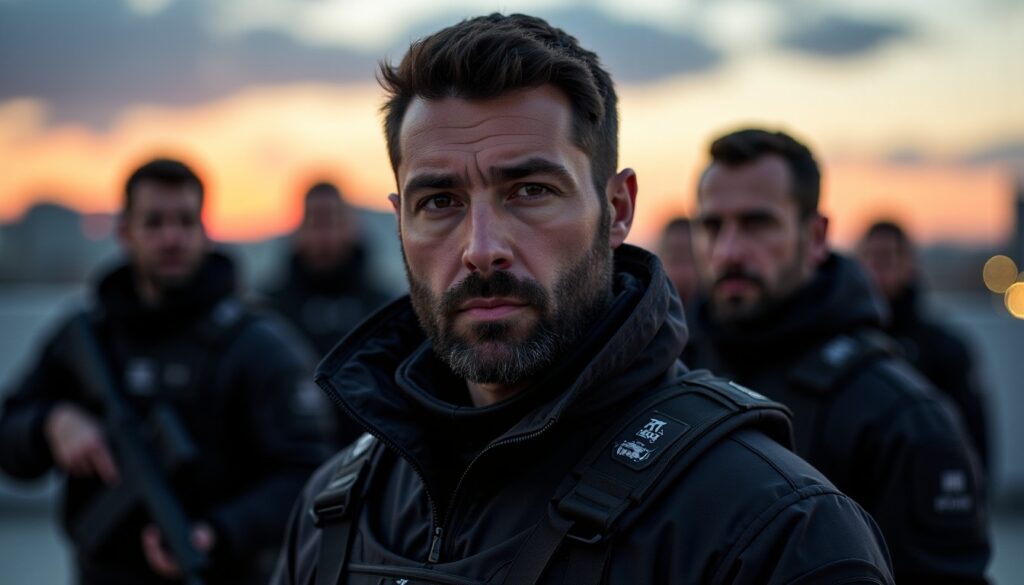
Since July 22, 2026, the mini-series GIGN has been making waves on Netflix, capturing the attention of fans of action, drama, and police suspense. This French production, led by Tomer Sisley and developed in six episodes, immerses us in the heart of the National Gendarmerie Intervention Group (GIGN), a famous elite unit. The series skillfully blends dramatic tension and authenticity, offering a show that is both realistic and thrilling. This success is based notably on the following points:
- A strong plot centered on an unprecedented attack directly targeting the GIGN.
- An immersive dive into special intervention protocols and the internal dynamics of the unit.
- A solid cast with Tomer Sisley invested in his role as a section chief under pressure.
- A short format allowing binge-watching, perfect for summer.
- A close partnership with the real GIGN to guarantee unparalleled realism.
We will analyze in detail every aspect of this mini-series, which redefines the French police thriller genre on the international platform. From the plot to behind-the-scenes and the actors’ performances, this dossier offers an in-depth analysis.
A powerful storyline: shedding light on an unprecedented attack against the GIGN
The mini-series begins with an intense twist: the GIGN barracks is targeted by a formidable criminal organization capable of stealing a ton of military explosives. This context immediately amplifies the suspense by imposing a fierce struggle against an invisible enemy, with all the psychological consequences this entails. At the center of this turmoil, the character of David Berger, played by Tomer Sisley, is an experienced section chief ready to hang up his gloves to regain a peaceful family life. The attack disrupts his plans, forcing him to return to duty to protect his men and control the crisis.
Simultaneously, the investigation focuses on the mysterious death of Laurent, David’s partner, who fell during a mission. His son Max, played by Tristan Zanchi, a young recruit within the GIGN, seeks to understand the circumstances of this tragedy, adding a human and emotional layer to the story. Thus, the series skillfully merges the spectacular aspect of operations with an intimate drama, where loyalty, guilt, and legacy play key roles.
The choice to address this dual storyline creates a balance between intense action and psychological suspense, making the series a gripping thriller. For fans of realistic police series, this unique treatment offers a new perspective on the world of French special forces.
Notable example: the enemy’s recovery of explosives endangers an entire population, perfectly illustrating the extreme challenges the GIGN must face, far from the conventional law enforcement affairs. This detail shows the creators Julien Leclercq and Sylvain Caron’s intent to craft a series where risk is tangible and constant.
Tactical realism at the heart of GIGN: full immersion with the real Intervention Group
The official collaboration with the GIGN authenticates every scene. This partnership goes beyond mere consultation: it directly influences the representation of interventions, trainings, and internal communication within this elite unit. One notices on screen a remarkable accuracy in hostage-taking management, assault maneuvers, as well as dialogues peppered with precise technical jargon. Realism is also evident in the induction phases, physically showing the rigor and demands required to join this elite corps.
Tomer Sisley underwent intensive training with GIGN members to portray as accurately as possible the posture and military gestures. His performance offers a captivating authenticity, far from the stereotypical action star bodybuilder improvising his moves. At each intervention, the attention to detail—whether in weapon handling, equipment, or field discipline—strengthens the viewer’s immersion in this demanding microcosm.
To better understand the professional investment and preparation required, here are the key elements highlighted in the series:
- Standard procedures during hostage release operations.
- Official chains of command and the hierarchical pressure that results.
- Essential mental preparations before each high-risk mission.
- Human repercussions such as post-traumatic stress, illustrating the weight of failed missions.
This attention to detail is no accident: Julien Leclercq, already director of L’Assaut, extends his passion to depict high-tension missions in a serial format, offering a realistic fresco that appeals equally to lovers of authentic facts and fans of high-intensity fiction.
Tomer Sisley: a unit chief at the crossroads of duty and private life
The choice of Tomer Sisley to play David Berger is far from accidental. The actor, known for his roles in Largo Winch or the series Balthazar, embodies here a rawer and more introspective role. David Berger is not a classic hero with an infallible silhouette: he is a man struggling with his own limits, who must manage the moral responsibility of leading a team on the verge of breaking.
This duality is expressed through the complex relationship with Max, David’s godson, who joins the GIGN while questioning his father’s death. This young/veteran, experience/impulsiveness opposition fuels suspense and humanizes a plot dominated by military stakes.
The cast brings together a group of established actors: Guillaume Gouix, Géraldine Pailhas, Thierry Neuvic, Judith El Zein, and Grégori Derangère, who contribute to building a credible unit, with its internal tensions, unspoken words, and fragile solidarity. The exchanges in the series avoid the usual over-the-top action scenes by emphasizing the weight of silence and hierarchical pressure.
The construction of this group acts as a mirror to the realities of special interventions in France, where violence often remains latent and psychologically heavy. Here, drama and action combine to offer a series of rare intensity on Netflix.
Format and pace: how GIGN asserts itself as a mini-series suited for summer binge-watching
With six episodes of about 52 minutes each, GIGN favors a succinct and paced format. This format maintains constant pressure on the viewer while offering necessary narrative breathing spaces to deepen the characters and their motivations. This construction favors total immersion and viewing over one or two evenings, ideal for a mini-series conceived as a compact block.
The summer 2026 weather did not slow down the enthusiasm of Netflix subscribers, who placed this novelty among the top positions in their France Top. The spectacular intervention scenes, mainly filmed in Île-de-France, provide the adrenaline dose needed for the genre, while the plot centered on the Berger family avoids the trap of a simple linear thriller.
The series fulfills several objectives:
- Captivating action fans with breathtaking and technically impressive sequences.
- Satisfying fans of psychological drama through the development of family ties and character introspection.
- Betting on controlled suspense that pushes to binge the episodes relentlessly.
| Element | Description | Impact on the viewer |
|---|---|---|
| Number of episodes | 6 episodes of about 52 minutes | Condensed viewing, continuous sensation of intensity |
| Narrative pace | Balanced between action scenes and psychological development | Maintains attention and emotional immersion |
| Main location | Île-de-France | Authenticity and realism of interventions |
| Main themes | Suspense, family drama, special intervention | Wide spectrum of interest for viewers |
This mini-series model illustrates Netflix’s current trend to focus on realistic and spectacular French productions, responding to growing demand for stories anchored in reality. The presence of Tomer Sisley in this complex role gives it a new face, more controlled and thoughtful.
GIGN and the new era of French action fictions on Netflix
Beyond the mini-series, GIGN fits into a broader evolution of French productions on Netflix, where police suspense and action are emphasized with recognized know-how. The collaboration between Julien Leclercq and Sylvain Caron symbolizes this ambition, offering a work that is both spectacular and human, moving beyond mere displays of force towards a reflection on responsibility and consequences.
This new generation of fictions favors increased realism, benefiting from in-depth knowledge of national special forces. The choice of Tomer Sisley also illustrates this anchoring in a less caricatural cinema, where heroes are fragile and complex.
It is observed that the series fuels interest in tense military stories, deeply rooted in French reality, bringing Netflix an ideal showcase to display French talent internationally. This phenomenon is accompanied by a renewal of action scenes, often criticized in the past, where precision and credibility now prevail.
Viewers can expect a mini-series that balances the brutality of combat and the human dimension of its protagonists, offering a unique look at these exceptional operatives subjected to constant pressure.