
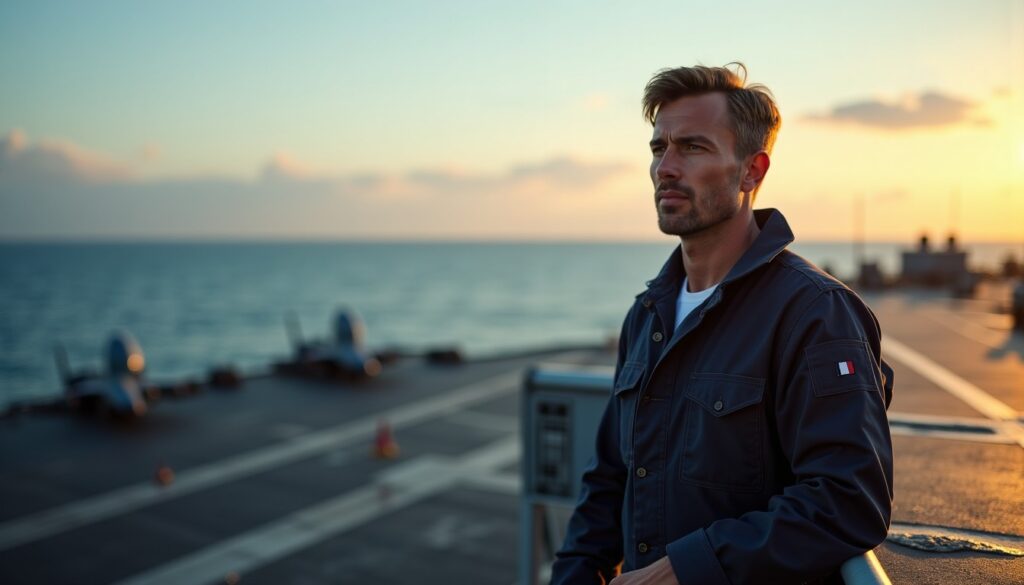
On board the Charles de Gaulle, the high-tension dive takes the form of a military thriller shot largely on the aircraft carrier itself. Scheduled for October 23, 2026, on Prime Video, then announced on M6, the series Le Charles combines criminal investigation, life on board, and naval operations in a closed setting where the mission cannot be interrupted.
A female crew member is found dead shortly after departure; another person has disappeared. As the ship heads towards the Eastern Mediterranean, a military investigator must advance an investigation that threatens both individuals and the ship’s balance. To understand what makes this setting so unique, three elements set the tone:
- A real and constrained space, with its corridors, facilities, and traffic rules.
- A closed environment of more than 2,000 people, organized around precise roles and schedules.
- An investigation under pressure, conducted while operational activities continue.
This combination sets the series apart from a classic thriller: on board, a movement or interrogation quickly clashes with the mission’s demands. We can thus follow an investigation while discovering the concrete constraints of a warship and the human tensions that arise.
The Charles de Gaulle, a full-scale military closed environment
According to data from the French Navy used for the series, the aircraft carrier hosts around 1,800 men and 240 women, for nearly 2,040 people. This number gives a different dimension to the closed environment: the suspects are not in an isolated house, but in the middle of a very large community, structured by roles, instructions, and a chain of command.
The density turns ordinary gestures into opportunities to observe or be noticed. In a narrow corridor, encountering a colleague can be inevitable; however, accessing a specific area or lingering there is subject to concrete constraints. For the investigator, every journey can provide a clue, but also complicate verifying testimonies.
The series begins after the discovery of the body of a female crew member and the worrying disappearance of another person. A new victim then broadens the danger, while the ship continues its course towards the Eastern Mediterranean, in a tense international context. The murder is therefore not a parenthesis: it threatens the trust necessary for collective functioning.
On board, no one can simply withdraw to a neutral place to escape suspicion. Colleagues meet in work and rest areas, with responsibilities that continue to apply. The tension comes as much from the forced proximity as from the criminal mystery.
The Charles de Gaulle imposes an effective dramatic rule: the mission does not stop to make way for the investigation. Communications, guard shifts, and aircraft-related activities must continue. An interrogation can therefore be interrupted by a duty obligation, while a staff member called to testify remains bound by their operational responsibilities.
This constraint makes the narrative more concrete than a simple succession of revelations. If an investigator wants to see someone again, he must work around their schedule and the ship’s procedures. On the other hand, a supervisor must protect the crew without weakening French defense or disrupting collective work. A decision made in urgency can then have effects far beyond the criminal case.
The setting also provides immediately understandable visual cues: watertight doors, metal corridors, control spaces, and the flight deck. These elements are not merely decorative. A brief order, regulated access, or sudden interruption can signal that an operational priority has just taken over.
To measure the story’s balance, we can observe four interacting levers:
- Safety: limiting risks for people and the ship.
- Mission continuity: maintaining operations despite events.
- Search for truth: gathering elements without jeopardizing procedures.
- Trust: continuing to work with colleagues who have become potential suspects.
The Rafale jets and catapults offer spectacular images, but their narrative interest depends on their connection to the story. Military power impresses; it is the human consequences of decisions that maintain the suspense.
Filming on board for real: the series’ credibility asset
A significant part of the filming took place on the Charles de Gaulle aircraft carrier, according to information shared about the production. This access provides staging details difficult to reproduce in a studio: the actual width of passages, the sounds of the ship, and how movements are organized in a functional space.
This real presence also sets a coherence requirement. As soon as a known set is filmed in its actual dimensions, gestures and movements become more visible: a scene seems convincing if characters respect the location’s constraints. Conversely, an action ignoring procedures or the ship’s layout risks breaking immersion.
The precedent of the film Le Chant du loup shows how a credible military environment can add weight to seemingly modest details. A door closing, a quick exchange, or a checkpoint can become tension elements when they fit in a coherent universe. Le Charles has an even larger scale, but Julien Despaux’s direction must avoid letting the ship take up all the space.
Success will therefore depend on a precise balance between spectacle and intimacy. The aircraft can highlight the scale of naval operations; the scenes in work and living spaces must, on the other hand, help us understand what this mission demands from people. The set strengthens the suspense when it serves the characters, not when it merely surrounds them.
Élodie Yung and Jacques Gamblin at the center of command tensions
Élodie Yung plays Héléna Duval, second-in-command of the ship. Her role concentrates a strong contradiction: she belongs to the institution responsible for maintaining order, but must also admit that a threat may lie within her own ranks. Every control measure can reassure part of the crew and unsettle another.
Opposite her, Jacques Gamblin embodies Daniel Devred, her superior officer. Their relationship is not limited to an opposition between two temperaments. On a ship where discipline contributes to collective safety, contesting a decision can complicate coordination, but sticking to a questionable authority can also harm the investigation.
The cast also includes Alban Lenoir, Patrick Mille, Constance Labbé, Antoine Gouy, and Bruno Sanches. The detailed roles of their characters are not all specified in the available information; it is therefore preferable to focus on the overall dynamic rather than assign unconfirmed roles. An avoided glance or a silence at the wrong moment can be enough to sow doubt in a group used to working together.
This human dimension prevents the ship from becoming a mere symbol of military power. The characters must arbitrate between loyalty, caution, and search for truth without the perspective that a land-based investigation would offer. The most captivating conflict could thus oppose less the investigator to the criminal than the trust required for service and the suspicion imposed by the facts.
Six episodes to merge thriller and French defense
The series is announced in six episodes of 52 minutes, totaling 5 hours and 12 minutes. This format allows space to establish the rules of life on board, develop relationships, and advance the investigation without multiplying detours. Writers Henri Debeurme and Mathilde Arnaud must hold together two threads: the search for a culprit and the stakes of a strategic mission.
The broadcast planned on Prime Video, followed by a slot on M6, places the program at the meeting point of several audiences. Crime series fans can enter through the murder and suspects; defense enthusiasts may be interested in the ship’s constraints and functioning. To maintain this balance, the fiction must remain accessible without turning the ship into a mere touristic set.
Presented at the La Rochelle Fiction Festival in September 2026, the series received a reportedly very warm welcome, culminating in an ovation mentioned by Le Parisien. This reaction is a first sign of interest, without replacing the public’s judgment at broadcast. The challenge remains that of any fiction set in a real institution: to show an impressive setting while maintaining narrative freedom and fallible characters.
| Reference | Announced information | What it brings to the story |
|---|---|---|
| Format | 6 episodes of 52 minutes | A tightly focused development of the investigation and characters |
| Crew mentioned | About 2,040 people | A dense, organized, and difficult-to-control closed environment |
| Launch | Prime Video, October 23, 2026 | A first national broadcast window |
| Later broadcast | M6 | Exposure to a wider audience |
The format alone does not guarantee a mastered thriller: everything will depend on the pace of revelations and the space given to the realities of service. If each episode advances the investigation while showing the human cost of the mission, Le Charles could offer a unique immersion into French defense, without losing sight of the people who bring the ship to life.