
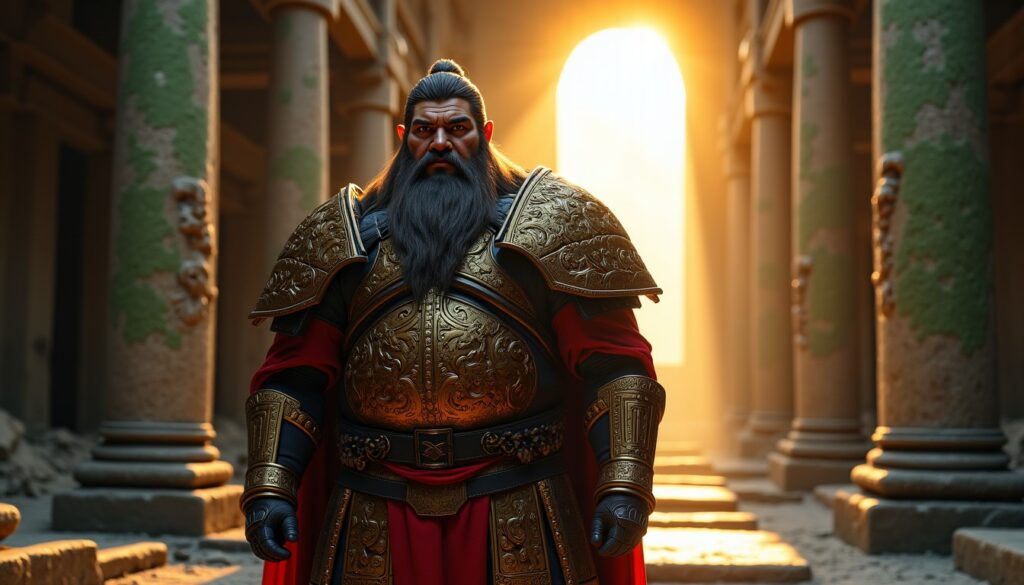
Yes, the remake of The Legend of Zelda: Ocarina of Time reveals a Ganondorf faithful to the memory of 1998, but entirely rebuilt for the Nintendo Switch 2. In its official clip of September 26, 2026, Nintendo stages the Gerudo lord on horseback, in slow motion, and hints at the first elements of a new voiceover. The game is expected on November 5, exclusively on its new console.
This approximately 16-second sequence is not limited to showing a modernized face: it sheds light on the artistic direction, the place of dialogue, and how the remake aims to bring a familiar scene back to life. To follow the main issues, we can focus on three questions:
- What does the new trailer change in the representation of Ganondorf?
- How does the revisited character fit into the identity of the 1998 game?
- What gameplay and staging evolutions accompany this overhaul?
By comparing the images to the Nintendo 64 and Nintendo 3DS versions, we can measure the gap without relying solely on nostalgia. The clip also provides a concrete glimpse of an adventure designed both for players who already know Hyrule and for those who will discover it on Switch 2.
The remake trailer of Zelda Ocarina of Time puts Ganondorf in the spotlight
The new video released on the Nintendo Today! app on September 26, 2026 lasts about 16 seconds. It revisits the first striking encounter between Link and Ganondorf: the Gerudo prince crosses the field on horseback while the young hero watches his passage. The moment belongs to the original story, but the remake modifies the pace to give more presence to the antagonist.
On Nintendo 64 and Nintendo 3DS, this appearance took place at normal speed. In the Switch 2 version, the slow motion allows time to distinguish facial features, armor ornaments, and the mount’s movements. This choice does not turn the scene into a long cinematic; rather, it highlights the contrast between Link’s apparent calm and the unease evoked by the unknown.
A familiar scene, viewed from a new angle
Slow motion plays a narrative as well as a visual role here. In the 1998 game, Ganondorf’s appearance is brief and imposes his threat through movement and context. The remake gives the audience a few extra seconds to read his expression and understand that this man is not simply passing through the scenery: he is already at the heart of the conflict that will upheave Hyrule.
The framing also allows appreciation of the character’s integration into the new cinematics. The red hair, jewelry, and armor stand out under more detailed lighting, while the facial animations bring a nuance absent from the models of the time. For players who remember the scene, the interest lies precisely in this double reading: recognizing the moment while noticing what current technology makes possible to show.
Nintendo accompanied the clip with comparisons between the Nintendo 64, Nintendo 3DS, and Switch 2 versions. This side-by-side presentation allows spotting modeling and staging changes without confusing personal memory with actual differences. To follow the schedule and the information already revealed, we can also consult this dossier dedicated to Ocarina of Time on Switch 2.
Revisited Ganondorf: a modernized face without breaking from Ocarina of Time
The main challenge of a remake devoted to such a famous game is to modernize its images without erasing their landmarks. Ganondorf is a particularly striking example: his silhouette, red hair, jewelry, and the sharp lines of his face are immediately associated with Ocarina of Time. Nintendo preserves these distinctive signs while reconstructing the model for a more precise presentation.
The result does not simply take up a recent interpretation of the character. It remains attached to the 1998 version, with a face that keeps its structure and a deliberately imposing appearance. The overhaul focuses mainly on the fineness of the details, materials, lighting, and expressions. Thus, a player can recognize Ganondorf at first glance and then notice the changes by observing close-up shots.
Between players’ memory and graphic expectations
The first comments posted on Reddit show how closely the public analyzes this model. Some focus on his profile, the length of his hair, or his appearance after the time skip; others discuss the glossy rendering, the jawline, or the nose. These reactions do not represent the opinion of all players, but they illustrate the difficulty of retouching a figure that several generations already have in mind.
An almost identical reproduction to that of the Nintendo 64 would have made little use of the graphical reconstruction. Conversely, a too radical change would have distanced the character from the original game’s visual identity. Nintendo seems to have chosen a middle ground: preserving the essential markers and giving the expressions a relief suitable for the new cinematics. This approach is consistent with the announcement made during the Zelda 40th Anniversary Direct on September 8, 2026, where the project was presented as a reconstruction of the adventure rather than a simple port.
The voice acting also contributes to this new presence. The trailer briefly lets hear Ganondorf’s voice, who will be able to express himself during important narrative moments. Link, for his part, will remain silent according to the information shared around the game. This contrast allows developing the antagonist without changing how the hero is embodied by the player.
The comparison between the three versions serves not only to measure an increase in definition. It reveals an intention: to preserve the memory of the character while giving him a more expressive place in the narration. This revisited Ganondorf seeks less to replace that of 1998 than to allow him to express himself differently.
A Zelda remake that also transforms narration and atmosphere
The sequence recalls that Ganondorf is presented as a Gerudo man born once every hundred years, driven by the will to seize the Triforce. This information links his ambition to the kingdom’s history and gives context to his appearance. In such a short video, Nintendo does not recount his entire trajectory; instead, it places some characterization elements at the heart of an already familiar moment.
The presence of voiceover in narrative scenes represents a significant change for players familiar with the original title. In the Nintendo 64 version, characters mainly relied on displayed text, their models’ expressions, and music to convey emotion. The remake can now combine spoken dialogue, facial animation, and framing, which changes how a scene is perceived, even when its general content remains recognizable.
A clearer direction for new players
Imagine someone discovering the saga with this version. They don’t need to know the old camera angles to understand that Ganondorf’s arrival is worrying: the slow movement, the character’s look, and the sound atmosphere direct their attention. Conversely, a long-time fan can compare the scene to their memories and appreciate the added details. A single scene can thus speak to two audiences without requiring the same references.
The choice to keep Link silent preserves a part of projection. The player remains at the center of the adventure, while the voices give more depth to the characters around him. For Ganondorf, this evolution can make the threat more concrete: his ambition no longer reads only in the text or his gestures; it also passes through vocal interpretation. Nintendo has yet to detail the total length of the voiced cinematics or the exact number of added lines.
The identity of the actors has also not been specified in the available information. It is therefore better to consider the video as a targeted preview rather than a complete presentation of the cast. Nevertheless, it confirms that sound and dialogue are part of the overhaul, on par with 3D models and environments.
In an adventure video game, direction can guide attention without interrupting exploration. Here, a few seconds are enough to make Ganondorf’s entrance a more poised and expressive moment. The trailer thus shows that modernization also concerns how the story is told, not just the appearance of the characters.
More information on the project can be found in this dossier dedicated to the Zelda: Ocarina of Time remake, which places these images within the whole set of announcements.
Visible differences in the scene
| Element | Nintendo 64 and 3DS Versions | Presented Switch 2 Version |
|---|---|---|
| Appearance pace | Passage at normal speed | Ganondorf’s entry presented in slow motion |
| Character model | Graphics matching original consoles | 3D model rebuilt with more details |
| Expressions | More limited facial animations | Face and movements highlighted in the cinematic |
| Voice | Scene carried by image, music and text | Short voiced line heard in the clip |
Graphics, music, and controls: what the remake changes in Hyrule
The overhaul is not limited to Ganondorf’s scene. Environments and characters are rebuilt, while the soundtrack adopts a symphonic orchestration. The images already presented cover several emblematic places: the Kokiri Forest, the Great Deku Tree, the plain and Hyrule city, the Lon Lon Ranch as well as the Water Temple. Each space plays a distinct role in the adventure’s pacing, from the tutorial zone to more demanding regions.
This variety matters because Ocarina of Time relies on alternating exploration, puzzles, and narrative progression. The Kokiri Forest familiarizes the player with the first interactions; the plain opens the horizon and gives a wider scope to the kingdom; the temples concentrate challenges and mechanisms specific to each place. Recreating these environments with more detail can enhance their readability, provided their layout and landmarks are preserved.
Smoother movement on Switch 2
Nintendo also showed several gameplay adjustments. Movement includes a free jump and a fast run in the form of a dash, while motions should respond more responsively. A free camera accompanies exploration, which can help examine a passage or better understand a room’s layout. Loading times are said to be shorter than in the original game.
These changes have concrete consequences. A player crossing the plain can gain fluidity thanks to the dash; in a tight space, the free camera can make observation more intuitive. These options do not remove the interest of puzzles: they rather modify the comfort with which one moves and looks around. The remake’s success will depend on the balance between these modernized controls and situations originally designed for another controller.
The game also plans to support Zelda Notes and a progression feature called Threads of Time. The full details of the latter have not yet been established. It is therefore better to distinguish what is confirmed — the existence of this feature — from what remains to be explained, notably its precise effect on the gameplay.
The music is another point of contact between old and new. The symphonic orchestration can give more breadth to known themes, while strengthening contrasts between peaceful areas and tense moments. For players who already associate certain melodies with specific places, the challenge will not only be to hear a richer version but to find a familiar emotion in a different interpretation.
Nintendo’s choices thus outline a modernization on several levels: environment, sound, movement, and supporting tools. Each evolution must remain at the service of exploration, which remains the guiding thread of the journey through Hyrule.
Ocarina of Time remake release: date, console, and confirmed information
The launch is set for November 5, 2026, exclusively on Nintendo Switch 2. No version intended for the original Switch has been announced. For players considering discovering the game on the new console, this exclusivity thus determines the necessary hardware, while the date gives a concrete horizon after the project’s presentation on September 8.
The new Ganondorf-focused clip arrives a few weeks before this release. Its approximately 16-second duration shows that Nintendo reveals information through targeted sequences rather than in a single long demonstration. The video highlights a specific scene, the visual comparisons inform on the game’s three generations, and the images of iconic places allow evaluating the extent of the reconstruction.
What is established and what remains to be discovered
To follow announcements without confusing confirmation and expectation, we can distinguish the elements already communicated from the details still missing. This caution is useful in the lead-up to launch: an official clip allows observing a scene but is not enough to describe the entire game content.
- Confirmed: release on November 5, 2026 on Nintendo Switch 2.
- Confirmed: rebuilt models and environments, orchestral soundtrack, and movement adjustments.
- Confirmed: presence of voiced scenes, with a short Ganondorf line in the clip.
- To specify: total duration of spoken dialogues and actors’ identities.
- To specify: detailed functioning of Threads of Time and exact scope of Zelda Notes.
The melody listening feature is also a particularity announced for Switch 2. The console’s microphone can be used to hum or play learned tunes, so that Link interprets them later on the ocarina. This interaction directly links the player to the melodies serving as landmarks in the adventure, rather than confining them to a simple control to select in a menu.
Fans can thus compare announcements as they come, keeping in mind that the Ganondorf scene is just a piece of the project. The exclusive release, control improvements, and voiced narration already give a clear idea of the adopted direction; the still undetailed areas leave room for discovery in upcoming presentations.
The remake ultimately seeks to reconcile two expectations: retracing the path that marked 1998 players and offering an adventure readable on a current console. Ganondorf becomes the best symbol of this, with his familiar silhouette, new expressions, and now perceptible voice. As the launch approaches, the threat remains recognizable, but its staging gains unprecedented precision.