
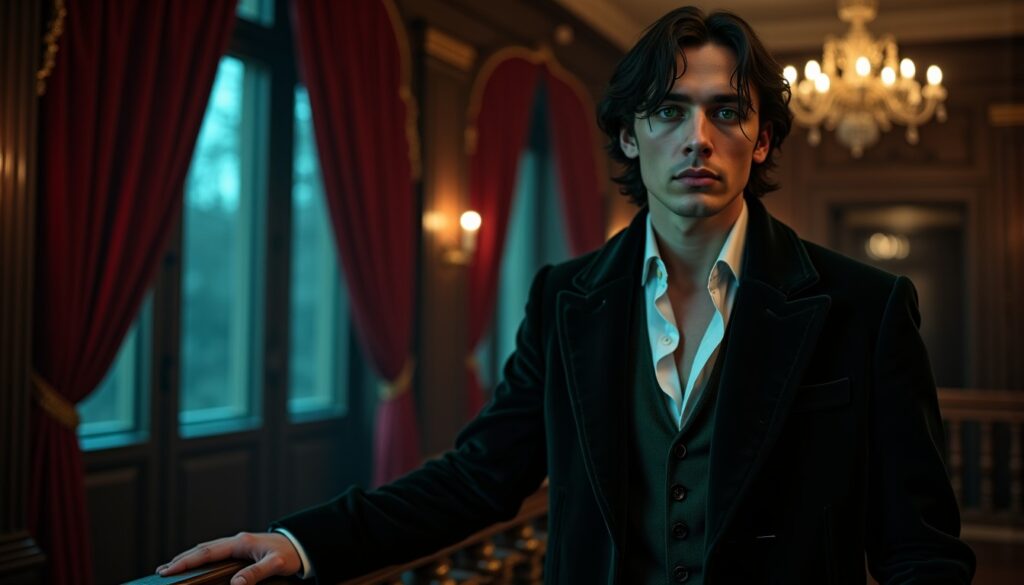
Netflix has decided to prematurely discontinue its vampire series after only one season, marking yet another cancellation in the streaming landscape. This early ending raises several questions about audience expectations, content strategies, and the competitiveness of the fantasy series market. The halt of this series, despite an engaged fan base, highlights several factors:
- The stakes of audience numbers in the competitive streaming universe.
- The difficulties in satisfying a demanding vampire-loving audience.
- The impact of reviews and ratings on the longevity of a production.
- The complexity of creating a coherent mythology in a shared universe.
- The specificities of narrative treatment and pacing imposed by the format.
These elements will be explored in the following sections to understand the reasons and consequences of the cancellation of this vampire series, as well as its insertion into AMC’s Immortal Universe and its mixed critical reception.
The reasons behind the premature end of the vampire series on Netflix
The main cause of the cancellation after just one season is audience numbers deemed insufficient to justify renewal. The streaming market is increasingly saturated, and Netflix is not lacking in fantasy series that do not always receive the expected attention in the face of tough competition. This series, which was part of the vampire universe, struggled to capture a broad enough audience despite the genre’s appeal.
The limited format of six episodes, often touted as a strength to maintain a dynamic pace, ultimately proved too short to fully develop the complex plots, characters, and universe that fans dreamed of. A pace perceived as rushed, underexplored narrative arcs, and a final cliffhanger contributed to viewers’ frustration.
At the same time, reviews were mixed, with an average Metascore of 63/100 based on 15 reviews, and a relatively positive user score of 7.5/10, reflecting some attachment but also uneven execution. This disparity can discourage new viewers who often await consensus before investing in a series.
It should also be considered that the series was added to Netflix in a rather discreet manner. Its arrival a few months after its cancellation on AMC signified a secondary content positioning, less promoted, which reduced its visibility and commercial impact.
Beyond the numbers, a broader issue emerges: how to ensure the longevity of a fantasy drama in an extended universe when audiences want immediate and captivating content? This question is essential to understand the series’ dynamics and its media environment.
Talamasca: a rich universe but uneven execution
The series Talamasca: The Secret Order, offered by Netflix, is part of AMC’s Immortal Universe, a shared universe encompassing several series revolving around Anne Rice’s stories. The ambition was to create a bridge between different mythological elements by placing at the center a mysterious organization, the Talamasca, which watches vampires, witches, and other supernatural phenomena.
This idea of a watchful and mysterious archive recalls creative references like the Watchers from cult series such as Buffy or Highlander, bringing an original dimension to the show. Nevertheless, this approach required delicate narrative construction, integrating many characters, conflicts, and secrets. Six episodes proved insufficient for thorough exploration.
The story follows Guy Anatole, a telepath who becomes a spy for the Talamasca, investigating corruption in the London Motherhouse. The British setting and inspiration from John le Carré’s espionage stories brought a unique tone by mixing drama, fantasy, and thriller. The introduction of key characters like Jasper, an ambitious vampire, and Helen, head of another Motherhouse, offered multiple narrative threads to develop.
Despite a rich plot, the series suffered from uneven pacing and a lack of development of secondary characters. Anne Rice fans could grasp the references, but newcomers might have felt lost. The cliffhanger ending, with no prospect of continuation, became a major obstacle for an audience wanting closure or plot progression.
Here is an overview of key elements established in this season:
- Guy Anatole: telepathic spy, investigating internal corruption.
- Jasper: manipulative vampire aiming for the mysterious file 752.
- Helen: leader seeking answers about her family past.
- File 752: coveted ancient artifact, source of conflict.
This narrative richness would have required a longer commitment, but the format and cancellation cut short this ambition.
Summary table of main characters and their stakes
| Character | Actor | Role in the season | Main stake |
|---|---|---|---|
| Guy Anatole | Nicholas Denton | Telepathic spy | Investigation on corruption via mental manipulation |
| Jasper | William Fichtner | Powerful vampire | Conquest of file 752 to overthrow the Talamasca |
| Helen | Elizabeth McGovern | Head of Motherhouse, former spy | Search for her missing sister |
Audience and the impact of reviews on the longevity of fantasy series on Netflix
On Netflix, a series’ success is closely tied to its audience numbers and viewers’ ability to engage quickly in watching. The vampire series failed to captivate a broad enough audience to justify long-term investment. A rapid drop in viewers from the first weeks hastened the cancellation.
Critics oscillated between appreciation for a polished aesthetic and a promising plot, and execution that struggles to fully convince. For example, a Metascore of 63 out of 100 reflects a mixed reception, while the 7.5/10 user rating indicates moderate satisfaction. This duality clearly illustrates the divide between critical expectations and those of the audience.
The binge-watching model, essential to the success of Netflix series, was evidently lacking in this case. Prior examples like the dramedy Everything Sucks! had already shown that a lack of quick engagement with the format could prompt immediate cancellation. The pressure to produce high-audience content rapidly is a hallmark of streaming.
Despite an attractive universe and mythology already well established through other series like Interview with the Vampire or Mayfair Witches, Talamasca did not manage to effectively expand the franchise on this platform. The discreet arrival of the content did not help maximize exposure, while the general trend to limit budget allocations on average-audience series tends to reinforce these early endings.
For fans of fantasy dramas, this illustrates how fierce the competition is and how audience loyalty is a determining factor that Netflix closely monitors for its catalog.
Being part of a shared mythology and having narrative ambition are assets, but they require duration and marketing support that are not always guaranteed, as seen with this rapid cancellation.
The links between Talamasca and the Anne Rice universe: a partially successful gamble for Netflix
Talamasca: The Secret Order extends the agreement between Netflix and AMC around the Immortal Universe, a rich franchise inspired by Anne Rice’s works. On this platform, viewers can already find series like Interview with the Vampire — which became The Vampire Lestat after the third season — as well as Mayfair Witches. Talamasca focuses differently by portraying a secret society monitoring vampires and other fantastical creatures.
This expansion aims to create a coherent and connected universe, with crossovers that enrich the experience for loyal viewers. For example, Guy Anatole meets Daniel Molloy, a journalist turned vampire from Interview with the Vampire. These interactions are strong points of the plot and opportunities to maintain links between the series.
For some critics and fans, these appearances and connections represent the most accomplished sections of Talamasca. They demonstrate that shared universes work when they manage to blend characters and events fluidly. However, the short format and the series’ termination make it difficult to exploit these bridges long term.
These crossed universes have the potential to build a rich and passionate audience seeking continuous deepening of supernatural mythologies. Nevertheless, exclusive availability on Netflix and low promotion at launch limit the scope and scale of success.
To better understand the stakes of vampire series and their adaptation in streaming, we can recall relevant examples such as the Buffy series, recently revived by a reboot attempting to meet current audience demands (see this article on the revival of Buffy).
Perspectives and lessons to be drawn from this premature cancellation on Netflix
The cancellation of Talamasca, stopping after just one season, offers several important lessons on the production and distribution of fantasy series in the streaming era. First, it highlights the necessity of balancing narrative ambition, development time, and an adapted format. Such a dense and rich universe requires more than a mere trial.
Audience expectations, especially for a genre as popular as vampires, translate into a need for immersion and continuity. When a series is abruptly stopped, it creates a break in the experience, a source of dissatisfaction for fans. This phenomenon is heightened in shared universes where series function like chapters of the same saga.
Next, visibility and marketing play a major role in a series’ success. A discreet release on Netflix combined with a lack of renewal can significantly reduce the show’s impact and memorability. This challenges producers to adapt their strategies to streaming mechanisms to maximize audience and loyalty.
Finally, the notion of rapid cancellation at Netflix fuels debate on the balance between creativity and profitability. The binge-watching model and the increasing demands for fast content renewal sometimes enforce tough trade-offs regarding series longevity.
These findings invite reflection on building ambitious projects aligned with the expectations of a demanding fantasy audience, as well as on the evolution of streaming platforms in their editorial policies.