
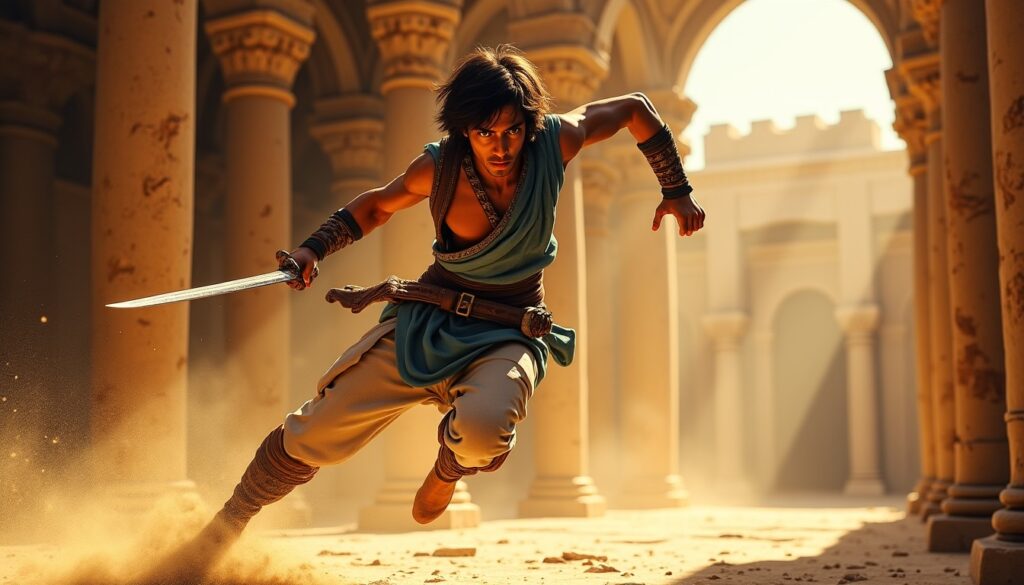
Prince of Persia: The Sands of Time makes a triumphant return on PC thanks to an optimized version released by GOG. This revival is aimed both at nostalgics and new players eager to discover this action-adventure classic that marked the early 2000s. Among the essential new features, you will find:
- The original 2003 version adapted to modern configurations
- Full support for widescreen and ultrawide displays
- A framerate limiter and native operation at 60 frames per second
- The guarantee of a faithful experience without compromising gameplay
- A convenient solution to play without technical complications on Windows 11
This reissue highlights the balance between preserving video game heritage and technical modernization, while fitting into a particular context related to Ubisoft’s cancellation of the remake. Let’s explore in the following sections this new opportunity to relive one of the best action-adventure video games.
A timeless classic refurbished for today’s PCs
The release of Prince of Persia: The Sands of Time by GOG is not a remaster or a remake, but an optimized version of the original 2003 release. This approach specifically aims to make the experience smooth and accessible on current devices, without altering the content or the iconic graphic style of the game. We can consider this edition as an example of successful digital preservation.
The title remains faithful to its DNA: the mysterious palace, acrobatic platforming mechanics, dynamic combat and above all, the famous dagger capable of rewinding time. No narrative or visual additions alter this legacy, reassuring purists wishing to find intact gameplay. However, a notable technical improvement can be seen: the field of view is finely adjusted to avoid distortions on wide or ultrawide screens, a common issue with older games adapted to different display formats.
This optimization goes beyond simple image stretching. By precisely recalculating the FOV (Field of View), GOG offers a visual output adapted for each user. This prevents the well-known zoom or deformation effect in non-updated versions, particularly annoying during exploration and combat phases where visual accuracy is crucial.
This initiative also modernizes the technical engine by integrating a framerate limiter and native compatibility at 60 frames per second, thus improving the overall smoothness of the game. Previously subject to variable performance depending on the PC, the title now benefits from a stable and pleasant experience. The wrapper developed for this version also facilitates the installation and launching of the game without the need for multiple tweaks, a major step forward in renewing the player base.
Key technical features of the GOG version
| Feature | Description |
|---|---|
| Compatibility | Windows 11 verified, crash-free |
| Resolutions | Support for 16:9, widescreen, ultrawide formats |
| Framerate | Framerate limiter accessible via overlay |
| Graphics | Unchanged textures and models, 4:3 menu to avoid interface bugs |
| Installation | Offline installer without dependency on GOG Galaxy |
This edition is not a product in the modern sense, but an invitation to extend the life of a classic video game under comfortable conditions, like a museum piece accessible to all. This philosophy reinforces GOG’s legitimacy in preserving titles that have shaped video game history.
Ubisoft’s remake cancellation: an important context for understanding this return
The return of Prince of Persia: The Sands of Time on PC in 2026 cannot be separated from Ubisoft’s announcement earlier this year regarding the cancellation of the highly anticipated remake. Initially unveiled in 2020, this remake experienced several delays and development changes, until it was finally canceled in January 2026.
Ubisoft explained that this project did not sufficiently meet their quality standards, and that it would require a long and costly investment to achieve a satisfactory result. In a broader strategic review context entailing project cancellations, delays, and closures, it became clear the remake would not see the light of day, leaving a void in the franchise.
Faced with this disappointment, the return of the original version through GOG appears as an act of continuity rather than a replacement attempt. It can be seen as an outstretched hand to fans who wish to rediscover the charm of a turn-of-the-millennium masterpiece, without expecting new content or an aesthetic overhaul.
Creator Jordan Mechner himself expressed his sadness over the cancellation, highlighting the emotional impact this title has for players and developers. Nevertheless, Ubisoft assured that the Prince of Persia franchise is not abandoned, leaving the door open to future projects without any concrete announcements made to date.
For those wanting to learn more about Ubisoft’s context, you can read this article on initiatives around Ubisoft games on PC for a better understanding of the studio’s current challenges.
The tangible benefits of the version optimized by GOG for today’s players
One of the main interests of this reissue lies in ease of use and quality of experience. Unlike older versions that often required tedious technical tweaks, this version is ready to play immediately after installation, thanks to an offline installer and verified compatibility with Windows 11.
GOG thus offers an almost seamless interface between the classic era and our modern machines, which is essential for a title dating back nearly a quarter of a century. The system takes into account the specifics of current hardware:
- A neat display that adapts to your screen, even if it’s ultrawide, to avoid the usual distortion
- On-the-fly framerate control to balance smoothness and performance according to the setup
- The guarantee that no crashes or incompatibility bugs spoil the experience
Thanks to this update, the charm of Prince of Persia can continue to inspire both veteran players and newcomers alike, with greatly improved technical accessibility. In this sense, the version signed by GOG also consolidates this game’s place among the must-plays of its era, giving everyone the opportunity to relive its fascinating universe without worrying about computer constraints.
These qualities explain the growing interest around this reissue, which is offered at a promotional price until the end of August 2026. An attractive figure for a legendary classic digital video game, especially knowing the historical and gameplay value of this title.
The weight of nostalgia and the importance of preserving video game classics
The return of The Sands of Time on PC illustrates a broader trend in the industry: the desire to preserve classics while offering a refreshed experience. Nostalgia plays an important role, gathering a loyal community around shared memories and emotions linked to impactful gaming journeys.
More than just a pastime, this rediscovery reflects the evolution of the medium and renews focus on the game design that inspired many subsequent titles. For example, the rewind mechanic in The Sands of Time influenced dozens of recent productions that adopt this idea of correcting mistakes in real time, demonstrating how innovative this episode was.
Preserving these works in an accessible and stable format on modern systems amounts to protecting part of the digital cultural heritage. It also gives younger generations the chance to explore the roots of current action-adventure games, as well as the quality of a captivating interactive narrative.
Here are some arguments explaining the relevance of such a reissue:
- Maintain the original gameplay intact to preserve the emotion and challenge of the time
- Facilitate technical access on recent PCs, avoiding compatibility complications
- Offer an opportunity for new players to discover a classic without excessive cost
- Value the historical legitimacy of Prince of Persia in the video game world
- Foster a generational link between old and new fans through a shared experience
This preservation work, in which GOG excels, is not limited to a simple commercial repackaging, but constitutes a strong gesture for the longevity of video game culture. This approach is an invitation to bring back to life universes whose modernity transcends time.