
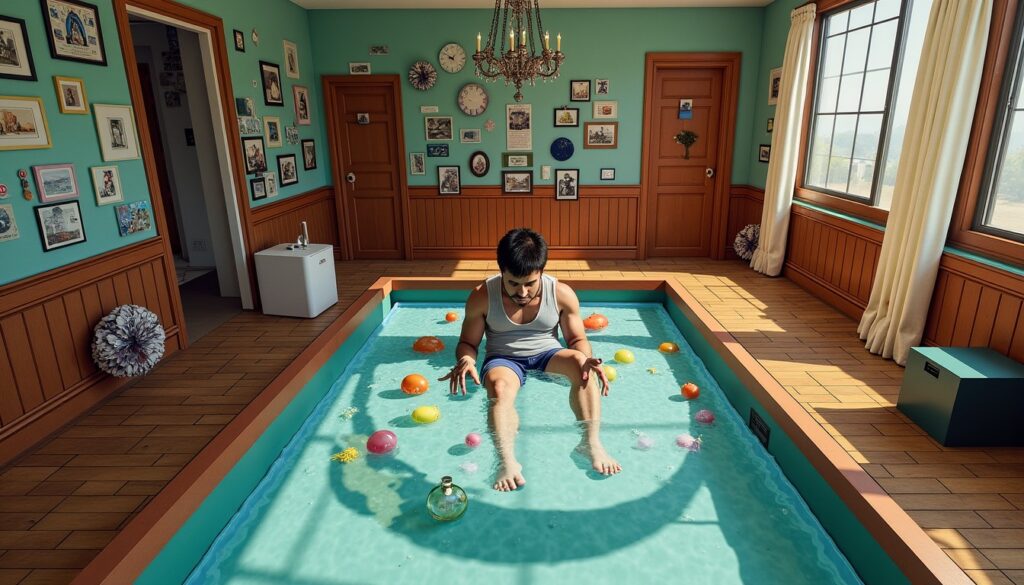
Vertigo by Quentin Dupieux is a daring cinematic work that pushes the conventional boundaries of animation by brilliantly merging the retro world of PlayStation 1 games with the distinctive aesthetic of the Sims style. Released in theaters in France on June 10, 2026, after its noteworthy presentation closing the Directors’ Fortnight at the Cannes Film Festival, this first feature-length animated film by the director stands out from the very first scene with its radical visual approach and its absurd-tinged screenplay. Here, we address several essential points to understand the uniqueness and impact of this film:
- The conceptual and technical approach that transforms live shooting into a pixelated simulation.
- The retro aesthetic inspired by old video games, playing on rendering and glitches.
- The prominent role of simulation as a theme and narrative driver.
- The influence of gameplay and games like Sims in building the visual and narrative universe.
- The stakes of a work that questions the viewer about the very nature of reality and cinema.
We will explore these dimensions with detailed analyses, precise examples, and technical insights, in order to grasp the scope of this unique creation signed by Quentin Dupieux.
A powerful retro aesthetic: the deliberate choice of PlayStation 1 and Sims rendering
The first thing that strikes in Vertigo is its intentionally retro aesthetic, a choice that plays a fundamental role in the perception of the film. By explicitly drawing inspiration from the characteristic graphics of the PlayStation 1 and the famous Sims mode, Dupieux creates a fascinating bridge between animated cinema and video games of the 90s-2000s. This style, with angular polygons and rudimentary textures, evokes an era where each pixel had its own physical dimension, far from today’s ultra-realistic standards. This visual identity is not merely a nostalgic nod but serves the film’s theme, which questions reality as an imperfect simulation.
The film’s retro aesthetic relies on several visual mechanisms that can be summarized as follows:
- Limited polygonal rendering: characters and settings are drawn with simplified geometric shapes, similar to the early major action-adventure games on PlayStation 1.
- Minimalist textures: solid colors and basic gradients reinforce the raw simulation effect, far from complex shading or current photorealism.
- Visual glitches and bugs: these imperfections become a cinematic language, revealing malfunctions in the world’s “programming”.
- Mechanical movements: animations exhibit deliberate stiffness, with quasi-scripted movements and expressions, reminiscent of the limited gameplay of the Sims.
For example, in an emblematic scene, a pigeon frozen mid-flight perfectly illustrates this approach, creating a disconcerting effect where the almost archaic visuals become a vector for a sensation of instability of the world itself. This is not a clumsiness but a sharp artistic construction that pushes the viewer to feel that the fictional reality is altered at its root, a flawed video game universe reflecting the simulation theory underpinning the film.
This style recalls how old games handled the limits of physics engines and technical capabilities, which matches wonderfully with Dupieux’s desire to make visible the cracks of a simulated world. This unique proposal is a remarkable example of artistic boldness, demonstrating how an “old school” style can be used to tell a strong story, far from any visual ease.
Simulation and its anomalies: how the world of Vertigo questions our reality
At the center of the plot of Vertigo is the idea that our universe might be nothing but a simulation, a theme that intuitively mingles with its retro and video game-inspired aesthetic. The main character, Jacky, announces the news to his friend Bruno, triggering a series of troubling observations about anomalies in a world that fluctuates between realism and artifice. The film thus deploys an entire gallery of details where the laws of physics or common sense seem to waver under noticeable glitches.
Here are some concrete examples of perceptible anomalies in the narrative that materialize the notion of a failing simulation:
- A baker endowed with eight fingers, a visual aberration questioning the normality and coherence of beings in this reality.
- Approximate collisions, notably characters sometimes passing through objects, recalling the famous collision bugs of old 3D engines.
- Frozen behaviors, like the pigeon immobilized in the air, or empty, mechanical gazes evoking a world governed by code rather than a soul.
- Strange bodily deformations, where the texture and geometry of bodies seem unstable or even “poorly animated.”
These elements are not just simple visual gags; on the contrary, they become powerful narrative markers. The film treats these anomalies as clues to its intrinsically unstable universe, pushing viewers to question the very nature of reality. All these imperfections are visible manifestations of an imperfect simulation that fails to hide its flaws. The device recalls some current philosophies about the universe as a “game” or a digital simulation, which have fascinated geek culture and science fiction for several years.
This way of making form and content interact also fits into a software continuity: the film itself is a cinematic “simulation,” between the truth of acting and the artifice of polygonal 3D imagery. This idea reinforces the reflection brought to the viewer, who becomes sometimes actor, sometimes observer of a world both familiar and deceptive.
A hybrid technical process: from live shooting to animation via Blender
The technical genesis of Vertigo is as audacious as its aesthetic. Quentin Dupieux did not settle for creating a classic animation: he opted for a hybrid approach mixing live shooting with real actors and a polygonal 3D animation process based on motion capture. This innovative production chain is essential to understanding the final rendering, both rudimentary and charged with a palpable form of humanity.
Here is the general sequence of the process:
- Filming with actors: scenes are first played in live-action shooting with Alain Chabat, Jonathan Cohen, and Anaïs Demoustier. This step provides authentic acting direction and offers a solid basis of expressions and gestures.
- Motion capture: recorded performances are automatically transformed into digital data via motion capture technologies, ensuring each physical nuance is preserved.
- 3D animation with Blender: Data from capture is imported into the free software Blender to model and animate in 3D each character in the desired polygonal style.
This sequenced production reveals a collaborative work between Dupieux and a team of five young graduates from Les Gobelins, including Yann Roussel and Max Nicolas, who fully embraced the artisanal and fluid aesthetic of the rendering, rejecting technological excess. Result: animation where movement seems deliberately limited, expressions sometimes frozen, and gestures imbued with stiffness recalling at times early video games and at others a comic absurd universe.
This process combines the warmth of human acting and the graphic coldness of simulation, deepening the fracture between texture and interpretation. It also develops a dialogue between cinema and gameplay, recalling the crucial importance of games for Dupieux’s universe in this work.
The Sims style as a key to interpretation: stakes and reception of the singular aesthetic
Calling Vertigo a “film in Sims mode” is for its part not just a simple marketing argument. This comparison is based on several precise features that reinforce the idea that the characters evolve in a world governed by mechanical and sometimes failing rules. These include notably:
- Scripted movements, where each gesture seems programmed and sometimes repetitive.
- Stereotyped looks and interactions evoking the mechanical behaviors of simulated avatars.
- A palpable sensation that no actor interacts spontaneously with their environment but obeys coded logic.
- Visual “bugs” that harken back to the imperfect gameplay of early video games, creating a feeling of familiarity and slight unease.
These elements provide the viewer with a specific filter, leading to the acceptance of stiff animation and unfinished rendering as an integral part of the narrative pact. This acceptance opens the way to a deeper understanding of the themes, as the form illustrates what the content defends: a glitchy, perilous, and fragile universe.
For video game enthusiasts, this approach refers to a pivotal era where the gaming experience was technically limited but infinitely creative. It is not a backward-looking tribute, but a reinterpretation both critical and affectionate of those ancestral game design and gameplay codes.
At the crossroads of several media, this work also questions identification with virtual characters. The non-fluid animation gives it an almost pathological dimension, as if our avatars in any game suddenly became aware of their condition, an idea recalling some recent animated films and narrative games. Public reception can be binary: viewers seeking technical perfection risk feeling out of sync, while those sensitive to artistic experimentation will find a form of aesthetic and conceptual happiness.
To deepen these avenues, you can consult analyses of works with similar biases, notably those blending cinema and video games, like other detailed productions such as remarkable films in the video game landscape.
A film that rethinks the relationship to reality through visual and narrative boldness
Vertigo fits into the continuum of Quentin Dupieux’s obsessions with surrealism and absurdity, while proposing a phenomenal turning point through radical animation. This 67-minute work symbolizes a reinvention of contemporary cinema where the very texture of the visible trembles, just like the perception we have of our own reality.
The strong presence of seasoned actors, blending their voices with polygonal animation, generates a striking contrast that contributes to the film’s strangeness. Alain Chabat, Jonathan Cohen, and Anaïs Demoustier bring the warmth and naturalness necessary to a visual universe otherwise cold and mechanical. This gap between the naturalness of the performers and the artificiality of the rendering creates a unique, almost vertiginous experience, inviting us to question the boundary between human and machine.
This kind of work directly dialogues with the expectations of an audience familiar with the video game universe, notably nostalgics of early polygonal video games, while seducing lovers of experimental cinema. This subtle balance shapes the strength of a work whose radicalism asserts itself as a genuine aesthetic and narrative stance. In this, Vertigo is a striking example of how cinema can integrate and reinterpret gameplay and simulation codes to produce a fresh perspective.
For those interested in deep crossovers between films and video game universes, other fascinating stories exist, such as the epic tales evoked in the Attack on Titan universe or the intense intrigues of Time To Hunt. These works show how narration can unfold in different but always rich and innovative frameworks.