
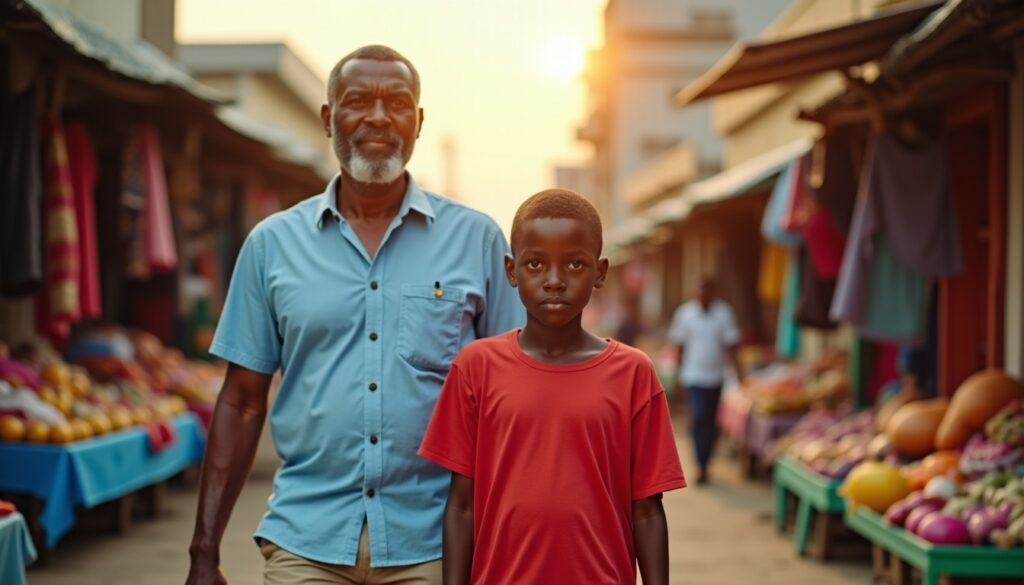
Diving into a day in Lagos with a father at the heart of the Nigerian dictatorship is to immerse oneself in an intense testimony where history and memories intertwine. Just one day will be enough to reveal:
- The palpable weight of political repression in everyday life;
- The deep traces left by the dictatorship on a family and a city in turmoil;
- The intimate story of a father guiding his children through the megacity in crisis;
- The constant pressure of a political atmosphere heavy with threats;
- The way personal memories become a historical and artistic testimony.
This journey to Lagos during the 1993 electoral crisis is much more than just a film. It is a mirror held up at a moment when the dictatorship leaves an indelible mark on society and the intimate. We will discover together how this semi-autobiographical narrative, carried by Akinola Davies Jr., conveys these moments of tension, hope, and heavy shadow.
Exploring a pivotal day in Lagos: a father’s story facing the dictatorship
The setting of the film “A Day in Lagos with My Father” rests on the apparent simplicity of a single day in 1993 during the Nigerian electoral crisis. This critical moment in Nigerian history is marked by a fragile transition between military dictatorship and democratic aspirations. The father takes his two sons through Lagos, an environment laden with anxiety and uncertainty.
The megacity is not limited to a backdrop: it becomes a character in its own right, vibrant, unpredictable, and sometimes threatening. The film captures this day as a true testimony, showing how dictatorship manifests not through grand speeches but through a dull presence weighing on family life and society.
Tension rises throughout the story, as the announcement of imminent electoral results raises the fear of a military intervention. Under this climate, every gesture of the father, every decision, is wrapped in heavy responsibility. The film illustrates the difficulty of guiding his children in a world where politics dictates the rules of everyday life.
We thus witness a subtle navigation between personal stories and political events. The father is both a landmark for his children and a vehicle through which the shadow of repression is incarnated. His role is not limited to physical protection but extends to the transmission of memories, stories of survival, and hope.
Through this day, the work offers a precise example of how political dramas are experienced intimately, with universal values while remaining anchored in a local context heavily marked by dictatorship. It is this dual dimension that gives the film its power and reach.
The indelible traces of dictatorship in everyday life in Lagos in 1993
In Lagos, in 1993, the dictatorship left behind subtle but deep traces, visible in the very atmosphere of the city. It is not only about massive demonstrations or spectacular violence but about a climate of fear, mistrust, and uncertainty that seeps into the crevices of daily life.
This heavy political context is expressed through several concrete manifestations:
- Constant surveillance: the population knows it is being watched, that every movement can be interpreted as a subversive act;
- Restriction of freedoms: freedom of expression is stifled, and even in the family sphere, conversations are cautious;
- Movement and anxiety: movements in Lagos are marked by the constant fear of military control or an escalation of violence;
- An unstable economy: the dictatorship is accompanied by an economic crisis that worsens the precariousness of inhabitants.
These elements give the film an almost documentary dimension, showing repression through its tangible effects rather than explanatory speeches. The visual and narrative testimony installs a sensation of suffocation, a city holding its breath, where every detail matters.
To speak about this context, we can judge by historical data: during this period, General Ibrahim Babangida exercised militarized power, at the helm of a regime that suspended democratic institutions. The 1993 electoral crisis, one of the tensest in Nigerian history, led to the invalidation of results in favor of an opposition candidate. This decision fueled anger and fear, making every interaction in Lagos uncertain and heavy with meaning.
In this context, the father-children relationship becomes a fragile sanctuary. The stakes are enormous: to protect while exposing, to transmit traces of personal history so these memories do not disappear under dictatorship and repression.
| Aspect | Manifestation of dictatorship in Lagos | Impact on the population |
|---|---|---|
| Police and military surveillance | Frequent patrols, identity checks, repression of dissent | Permanent feeling of insecurity, fear of denunciation |
| Media repression | Censorship, arrests of journalists, bans on gatherings | Biased information, media self-discipline |
| Restriction of movement | Military checkpoints, curfews, limited travel | Economic inefficiency, reduced social life |
| Economic crisis | Raging inflation, shortage of essential goods | Increased poverty, exacerbated social tensions |
Immersion in the artistic direction and staging of Akinola Davies Jr.
Akinola Davies Jr.’s first feature film stands out for its bold aesthetic choice, marked by deliberately deconstructed staging. The direction captures and restitutes this day in Lagos with an approach that prioritizes atmosphere over narrative linearity.
The film opts for:
- Fixed and off-centered shots, sometimes a little blurry, giving an impression of fragmented memory;
- A jerky rhythm, with image jumps reflecting the confusion and tension of the moment;
- An aesthetic close to super 8 films, evoking nostalgia and the fragility of memories;
- An enveloping sound work, amplifying sensations of anxiety and waiting.
This artistic approach allows for an immersive dive into the characters’ feelings, especially the children experiencing these events with innocence and anxiety. The choice not to resort to explanatory narration makes this sensory experience more powerful, leaving room for the viewer’s personal interpretation.
Every image becomes a trace, a mark left on the film stock to testify to an era but also an intimate experience. This approach makes “A Day in Lagos with My Father” an artistic gesture as important as it is political.
Akinola Davies Jr. skillfully connects the historical past to a sensitive perception, embodying collective memory through a family prism. The view of Lagos is that of a living city, haunted by dictatorship but also full of humanity, through the bond between a father and his children.
Memories and transmission: the weight of testimonies in the film A Day in Lagos
At the heart of this story, memories act as a bridge between past and present. This semi-autobiographical film bears the strength of testimony, where political history is imprinted on the body, gestures, and words of a family.
The dictatorship, by leaving visible and invisible traces, reveals how essential memories are not to forget:
- They help understand the repressive context of this period, without necessarily resorting to heavy explanations;
- They nourish family and collective memory, acting as symbolic resistance to oblivion;
- They inscribe politics into a human story, revealing its impacts on a family unit;
- They offer space for intergenerational dialogue around the painful past.
This intimate testimony shows how children grow up learning to decipher a hostile world, making this narrative a source of indirect education and shared emotion. The father thus becomes a pillar of resilience, while Lagos remains a place charged with living memory.
We understand that these traces are also scars, marks that will continue to influence future generations. Welcoming this film to theaters in 2026 sheds light on a little-known part of Nigerian history and underscores the fundamental role of cinema as a vector of political memory.
The political resonance of A Day in Lagos: understanding the impact of dictatorship on contemporary society
This story, closely anchored in a precise historical moment, invites reflection on the legacy the dictatorship has left on contemporary Nigeria. The tensions and repressions experienced during this period are not entirely erased; they still mark Nigerian society.
The power of the film lies in its ability to convey the complexity of emotions related to an authoritarian regime, showing:
- The fragility of freedoms gained after a decade of military government;
- The psychological and social repercussions of political fear;
- The necessity to remain vigilant against risks of authoritarian returns;
- The real echoes in current political and civil life, where the memory of these events remains vivid.
This point of view is essential to understand how dictatorship has shaped behaviors, political attitudes, and culture of protest in today’s Nigeria. It is interesting to note that this type of cinema, by highlighting personal stories, helps raise awareness while remaining accessible to a wide audience.
We can draw parallels with other forms of art and media exploring repression around the world, for example by following the evolution of fictional stories influenced by tense political contexts. This shows that cinema like ‘A Day in Lagos with My Father’ participates in the global reflection on political memory and resistance.