
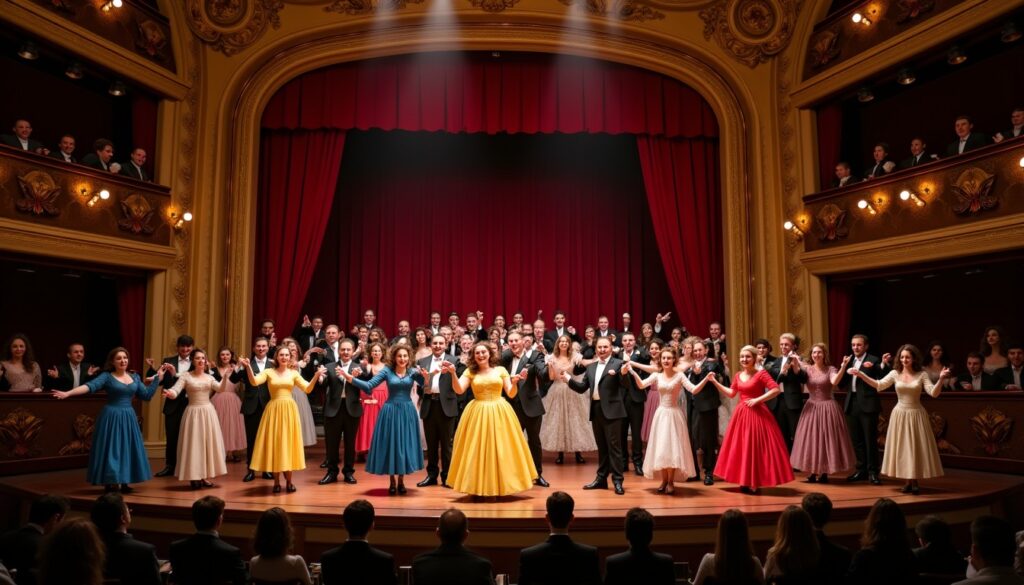
Musical comedies have always held a privileged place in the world of entertainment, blending theater, music, and dance to offer a unique experience. Whether driven by timeless melodies, spectacular choreographies, or captivating storylines, some productions have established themselves as essential works over the decades. These musicals, originating from Broadway or film, have marked history by:
- their lasting influence on popular culture,
- their major contribution to live performance,
- their ability to reinvent musical and stage styles,
- the emotional power of their songs and performances,
- their critical and commercial successes through the ages.
This article invites you to explore in detail ten essential musicals that have, each in their own way, contributed to shaping the history of entertainment.
- 1 Gentlemen Prefer Blondes: a classic of Hollywood musical theater in 1953
- 2 Phantom of the Paradise: innovation at the crossroads of theater, music, and horror
- 3 Victor/Victoria: the finesse of a musical show in Paris in 1982
- 4 Contemporary musicals redefining entertainment in 2026
- 5 Iconic musicals of the early 21st century: between tradition and innovation
Gentlemen Prefer Blondes: a classic of Hollywood musical theater in 1953
Gentlemen Prefer Blondes, directed by Howard Hawks, remains a major reference in the history of musicals. Released in 1953, this film skillfully blends lightness and charm, notably thanks to the iconic performances of Marilyn Monroe and Jane Russell. The story follows two showgirls in Paris, mixing comedy and musical numbers that have transcended generations.
The film was particularly highlighted by the song Diamonds Are a Girl’s Best Friend, which became more than just a tune but a true global cultural icon. This is evidenced by the Oscar nominations, including one honoring Marilyn Monroe as best actress and another for sound quality. This recognition granted it an indispensable stature in Hollywood musicals, even long after its release.
This live performance stands out for its lively rhythm and the dynamic between its characters, elements that continue to charm a diverse audience. The film perfectly illustrates how music and dance can unite to offer an entertaining and refined experience, while leaving an indelible mark on the history of musical theater.
Gentlemen Prefer Blondes reminds us that the combination of charm and technical mastery in a musical show can successfully transcend time. For enthusiasts and connoisseurs, this film is not only a piece of history but also a continuous source of inspiration for modern artistic creation.
Phantom of the Paradise: innovation at the crossroads of theater, music, and horror
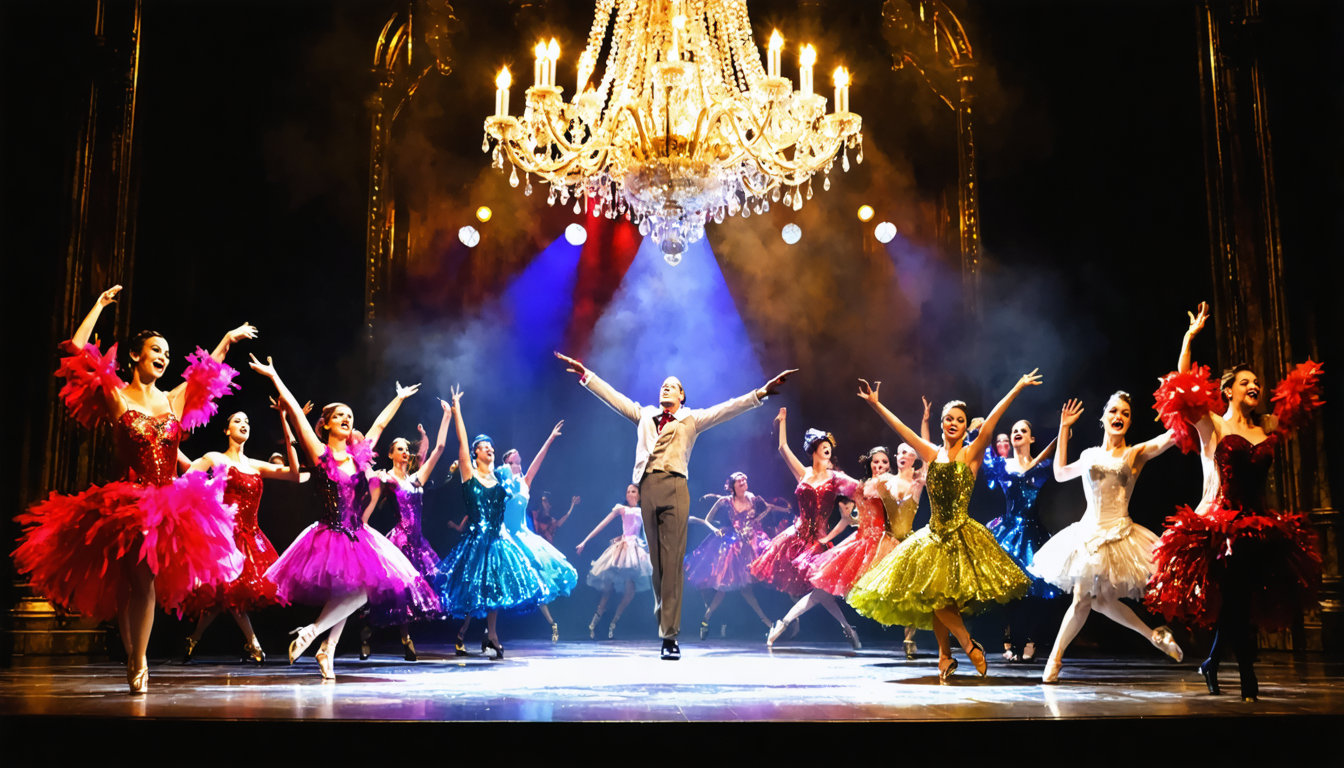
Released in 1974, Phantom of the Paradise established itself as an unusual musical comedy that breaks traditional codes. Under the direction of Brian De Palma, this film subtly blends several genres: horror, musical theater, and fantasy. Inspired by both Phantom of the Opera and the Faust legends, it presents a striking story about a composer who sells his soul to a music mogul.
This show is fascinating for its narrative boldness, combining original stage performances with a profound reflection on artistic sacrifices. The energetic performance of Paul Williams and William Finley contributes to the film’s cutting-edge and offbeat universe. It even won a Saturn Award in the Best Horror Film category, highlighting its quality despite its unique nature within the genre.
Phantom of the Paradise illustrates how the musical comedy can also be a vehicle for social and moral critique, while remaining a vibrant live show. Its unique atmosphere oscillates between embraced strangeness and the beauty of its musical compositions. This mix of styles helped make it a cult work, still celebrated among the unclassifiable in musical theater.
This work demonstrates that musical theater is not limited to lightness and gaiety but can become a field for bold artistic experiments that leave a lasting impression on collective memory.
Victor/Victoria: the finesse of a musical show in Paris in 1982
Victor/Victoria, directed by Blake Edwards, is a musical that became an icon since its release in 1982. In this film, Julie Andrews plays a Parisian singer who pretends to be a drag queen man, introducing narrative stakes rich in humor and ambiguity.
This live show offers a successful blend of comedy, music, and dance, perfectly orchestrated to captivate the viewer. The fluidity of the story and the quality of the performances earned the film several major awards, including the Oscar for Best Sound as well as a Golden Globe for Julie Andrews as Best Actress in a comedy. It was nominated in seven Oscar categories, emphasizing recognition of its technical and artistic excellence.
The ingenuity of the show also lies in its ability to address contemporary themes lightly yet deeply, while maintaining a dynamic and smooth rhythm. The choreographies and songs are integrated without ever breaking the audience’s immersion, giving Victor/Victoria that “almost perfect” feeling cited by many critics.
This film is a true gem of live entertainment, combining finesse, boldness, and timeless charm. It illustrates as much the importance of music as that of dance and theater in the success of a show.
Contemporary musicals redefining entertainment in 2026
As we move further into the 21st century, some modern productions continue the traditions while deeply renewing the musical comedy genre. Tick, Tick… BOOM! (2021), for example, starring Andrew Garfield and directed by Lin-Manuel Miranda, captured the spirit of live performance with an intimate approach blending artistic creation and the pressure of success.
Its critical success and placement at the top of a recent list (May 2025) demonstrate its current influence. This film benefits from a narration adapted to the streaming format, reassuring the public about the vitality of the genre, even in today’s digital context.
At the same time, Wicked: Part One, released in 2024, met resounding box-office success thanks to its ambitious production and performers like Cynthia Erivo and Ariana Grande. This musical, rooted in popular culture and sometimes considered essential by audiences and critics, announced a sequel for 2025, a strong sign of its lasting impact.
These contemporary musicals clearly show the current direction of entertainment: a subtle fusion of theatrical scripting, vibrant songs, and expressive dance, brought together in works that resonate with today’s viewers.
Here is a comparative overview of the standout features of these two recent productions:
| Feature | Tick, Tick… BOOM! | Wicked: Part One |
|---|---|---|
| Year of release | 2021 | 2024 |
| Director | Lin-Manuel Miranda | Jon M. Chu |
| Main actors | Andrew Garfield | Cynthia Erivo, Ariana Grande |
| Critical success | Number 1 of a top 50 in 2025 | Second place in a recent ranking |
| Artistic approach | Intimate, narrative, adapted to streaming | Large-scale production, high-profile show |
| Cultural impact | Influence on modern musical theater | Massive success and announced sequel |
Iconic musicals of the early 21st century: between tradition and innovation
The first decades of the 2000s saw the birth of several musicals that continue to rank among the top live performance productions. Among these, Chicago (2002), directed by Rob Marshall, stands out for its perfect balance between storytelling, songs, and choreography. Awarded six Oscars, including Best Picture, the show combines narrative darkness and dynamic numbers, embodying a new era for blockbuster musicals.
La La Land (2016), by Damien Chazelle, represents another facet, more melancholic and contemporary, of the genre. With six Oscars to its name, this film renewed interest in musicals by tackling modern themes while paying homage to the golden age of musical theater.
In the realm of powerful performances, Dreamgirls (2006) remains striking, notably for Jennifer Hudson’s Oscar win for Best Supporting Actress. The emotional strength conveyed by this film demonstrates that musicals rely as much on songs as on artists’ performances to touch the audience.
Finally, Moulin Rouge! (2001) by Baz Luhrmann stands out for its flamboyant aesthetic and spectacular integration of music and dance. This visual and sound experimentation made this film an immersive experience and a must-see for anyone interested in the history of live entertainment.
The table below summarizes the key points of these iconic musicals:
| Film | Year | Director | Major awards | Main characteristic |
|---|---|---|---|---|
| Chicago | 2002 | Rob Marshall | 6 Oscars, including Best Picture | Balance between narrative and spectacle |
| La La Land | 2016 | Damien Chazelle | 6 Oscars | Modernity and homage to musical theater |
| Dreamgirls | 2006 | Bill Condon | Oscar for Best Supporting Actress (Jennifer Hudson) | Emotional power and interpretation |
| Moulin Rouge! | 2001 | Baz Luhrmann | Unprecedented visual aesthetics | Immersive & musical experience |