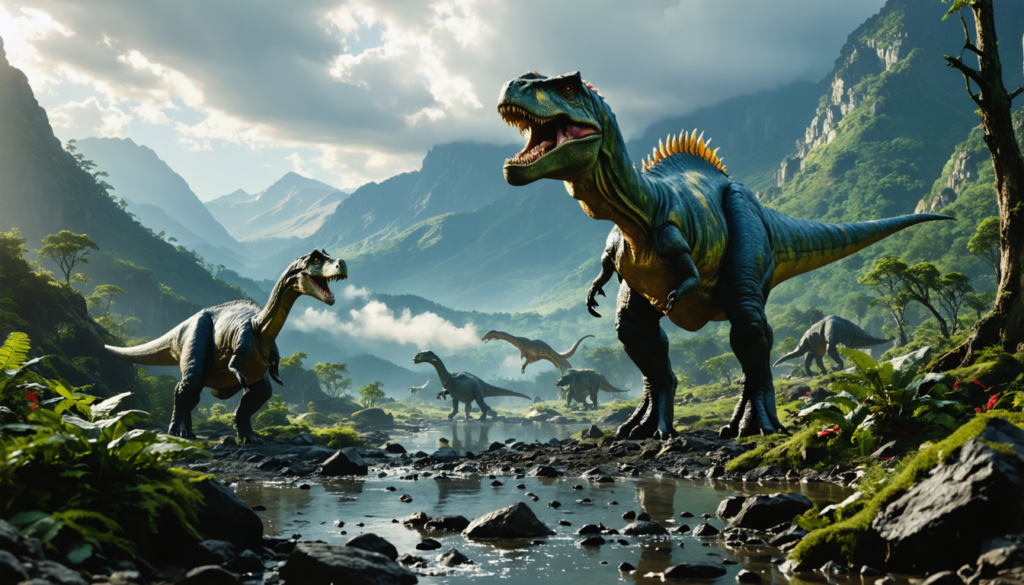
Discover now the documentary miniseries The Dinosaurs, an ambitious creation produced by Steven Spielberg and narrated by the unforgettable voice of Morgan Freeman. For all fans of dinosaurs and natural history, this series promises a unique journey through more than 170 million years of evolution. Available for streaming on Netflix, it offers carefully structured content in four episodes, unveiling the fascinating secrets of these captivating creatures. Here is what you need to know to watch this unmissable series, the key dates, and the locations featured in this complete guide.
- Release date and availability of the series on Netflix
- Structure and format of the episodes for optimal immersion
- The essential role of Morgan Freeman in the narration
- The use of Industrial Light & Magic’s innovative technologies
- The species and historical periods highlighted
Explore all the details of this exceptional production, as well as the ways to watch it with ease. Follow us to dive into this fascinating prehistoric universe.
- 1 Release date and platform to watch Spielberg’s documentary series The Dinosaurs
- 2 The narration by Morgan Freeman: a major asset for understanding the documentary series The Dinosaurs
- 3 Visual effects by Industrial Light & Magic for a spectacular and realistic rendering
- 4 Key locations and periods explored in Spielberg’s The Dinosaurs series
Release date and platform to watch Spielberg’s documentary series The Dinosaurs
The documentary series The Dinosaurs has been available on Netflix since March 6, 2026, a date to remember for all nature, science, and quality documentary enthusiasts. The simultaneous worldwide release facilitates access to this major work, ensuring massive distribution to a broad audience, from amateurs to the most experienced. This distribution choice allows instant immersion in the series and the freedom to approach the episodes at one’s own pace.
This miniseries consists of four precise and well-paced episodes, each focused on a key period in dinosaur history. This concentrated timeframe helps avoid excessive length. The short format is an invitation to discover this fresco in several stages:
- Presentation of the first dinosaurs of the Triassic and their emergence
- The Jurassic golden age and the explosion of species
- The Cretaceous and the dinosaurs’ final domination
- The mechanisms of the Cretaceous-Paleogene extinction
For those wishing to stay informed about the latest news related to this series, the official communication was very clear at the beginning of 2026. The announcement was made in January, followed by a spectacular trailer unveiled in February, thus reinforcing anticipation and preliminary dialogue among fan communities and the curious. This strategy increases visibility and offers ideal preparation before the launch.
Access is simple: you just need to be subscribed to Netflix, and no special equipment is required beyond a stable internet connection. Thus, streaming quality varies according to plans, but for maximum immersion, prioritizing HD or 4K options is recommended, especially to appreciate the breathtaking visuals. This worldwide accessibility ensures broad reach across generations, strengthening the series’ status as a major cultural event of 2026.
The narration by Morgan Freeman: a major asset for understanding the documentary series The Dinosaurs
The dinosaur saga told over a period spanning 170 to 235 million years is a complex challenge. To facilitate understanding, the narration, provided by Morgan Freeman in the original version, plays a key role. His deep and calm voice adds a solemn and immersive dimension, making the transitions across millions of years clear and dynamic.
The choice of Morgan Freeman is no coincidence, as his vocal presence is a guarantee of credibility, widely recognized in the documentary and film world. By pacing the story, the narration makes this dense scientific content accessible while maintaining an emotional connection with the viewer. Freeman’s ability to rely on measured inflections allows each segment of the series to be highlighted without losing attention.
Besides the multiple dubbed voices, the original version allows full appreciation of this iconic narration. This aspect provides continuity between episodes, essential for complete immersion in such a vast universe. The artist verbalizes evolutionary mutations, social behaviors, and changing environments of dinosaurs, calling upon up-to-date science while delivering lively and human narration.
To illustrate this approach, each episode contains narrative pauses where Morgan Freeman explains details such as:
- How species adapted to environmental pressures
- Complex interactions between predators and prey within various ecosystems
- Climatic phenomena that influenced the life cycles of dinosaurs
- The impact of the Cretaceous-Paleogene extinction on terrestrial biodiversity
Through this narration, the series does not just display facts: it brings a global story to life, placing dinosaurs within an ever-moving evolutionary dynamic. This audiovisual choice reflects a desire for intrinsic blending between education and spectacle, allowing everyone to find their place, whether a knowledgeable enthusiast or a curious beginner.
Visual effects by Industrial Light & Magic for a spectacular and realistic rendering
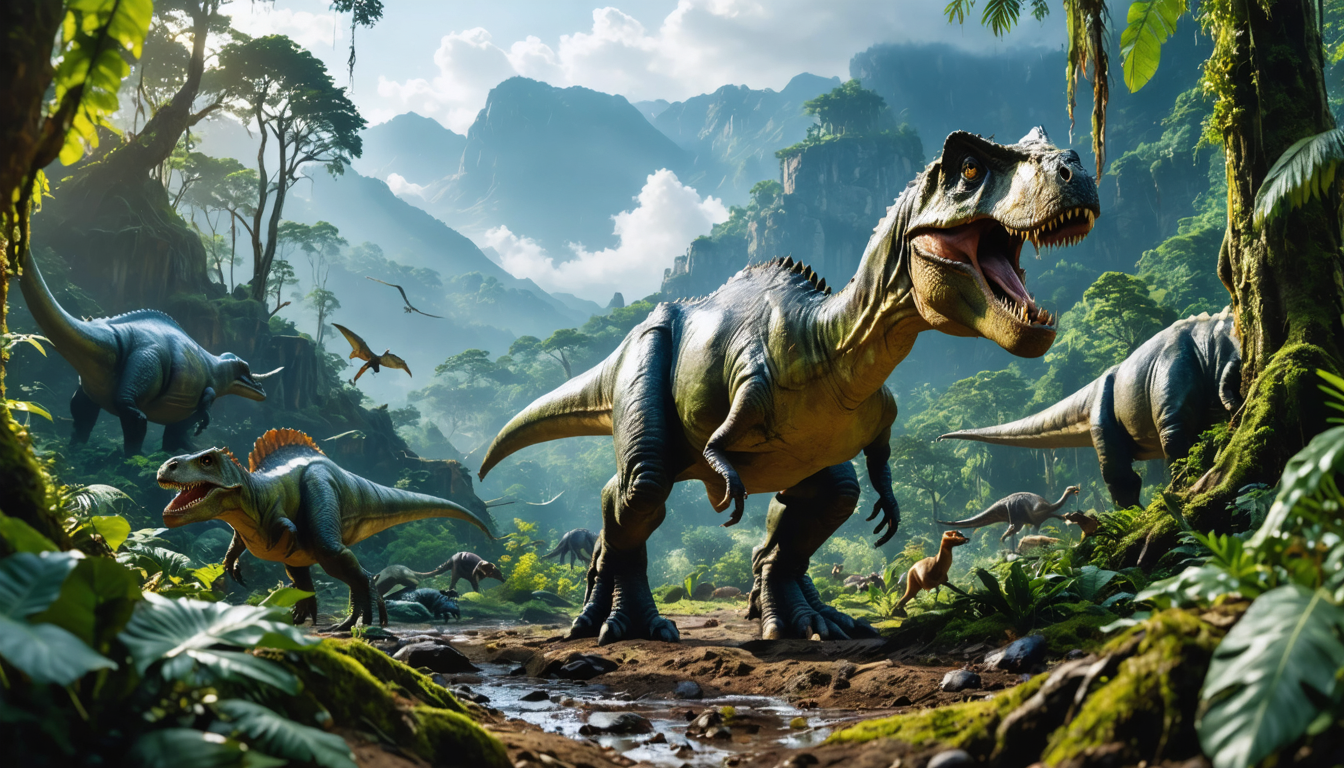
One of the pillars of this miniseries is the use of digital visual effects developed by Industrial Light & Magic (ILM), an iconic studio founded by George Lucas. To make this vanished world tangible, three-dimensional reconstructions combine scientific rigor with cinematic quality. This process goes beyond simple illustration, creating a real immersive and educational experience.
ILM’s ability to recreate varied environments, dinosaur movements, and simulate behaviors based on paleontological data is impressive. Far from being limited to the classics, the series showcases a range of often little-known species, such as:
- Plateosaurus, a terrestrial herbivore from the Triassic
- Mamenchisaurus, a long-necked dinosaur from the Jurassic
- Pliosaurus, a marine reptile from the late Cretaceous
- Anchiornis and Longipteryx, prehistoric birds
- Marasuchus, ancestor of dinosaurs
- Stegosaurus, famous for its dorsal plates
These sequences are designed with attention to detail that goes well beyond simple aesthetics. The team closely collaborated with paleontologists to ensure that every movement, landscape, and interaction is supported by current scientific evidence. The primary interest is to convey ecological and evolutionary complexity, inviting contemplation not only of the creatures but also the invisible forces that shaped them.
This special effects work also offers a new window into paleontology. For example, thanks to these images, it becomes possible to observe hypothetical yet plausible behaviors, such as hunting or defense strategies, mating displays, or social organization within groups. These scenes thus add soul and emotion, captivating and educating simultaneously.
In the movement of democratizing science through imagery, this collaboration highlights the essential role digital technologies play in scientific popularization in 2026 and beyond.
Key locations and periods explored in Spielberg’s The Dinosaurs series
The series offers an impressive chronological and geographical panorama, allowing exploration of the great eras during which dinosaurs evolved, prospered, and then disappeared. These key periods are highlighted in each episode, reinforcing understanding of the profound mutations experienced by planet Earth.
The Triassic opens this fresco, highlighting pioneering species that marked the beginning of dinosaur evolution. It was an era when Earth was very different, with supercontinents and harsh climates. The development of terrestrial life on this challenging terrain reveals the tenacity and adaptability of these reptiles, the first actors in a long story.
The Jurassic, meanwhile, is presented as the golden age of giants. This episode relies on dense forests and vast plains to describe behaviors and interactions among the largest herbivores and carnivores. The recreated landscapes show rich biodiversity and diverse ecological niches, with precise examples such as the astonishingly proportioned Mamenchisaurus.
The third episode focuses on the Cretaceous, a period when some dinosaurs reached their peak before the mass extinction. This era is illustrated by the iconic presence of the Tyrannosaurus rex, but not limited to it. The episode also highlights several marine and avian species, placing dinosaurs within a broad ecological network.
The final installment concentrates on the Cretaceous-Paleogene extinction, 66 million years ago. The series analyzes the multiple factors that led to the collapse of a biodiversity that had dominated the Earth for more than a century. This segment combines a scientific approach with spectacular images to convey the scale of this cataclysm, which paved the way for the rise of mammals and ultimately our own civilization.
| Geological period | Major species presented | Main themes explored |
|---|---|---|
| Triassic | Marasuchus, Plateosaurus | Origins of dinosaurs, adaptation to hostile environments |
| Jurassic | Mamenchisaurus, Stegosaurus | Dynamics of terrestrial ecosystems, coexistence and feeding |
| Cretaceous | Tyrannosaurus rex, Pliosaurus, Anchiornis | Predator dominance, marine and aerial diversity, evolution of behaviors |
| Cretaceous-Paleogene | Mass extinction | Causes and consequences of extinction, ecological transition |
This clear temporal breakdown promotes progressive immersion and better narrative readability. The visual spectacles, combined with narration and scientific elements, make this miniseries a must-watch for all prehistoric enthusiasts and curious minds.