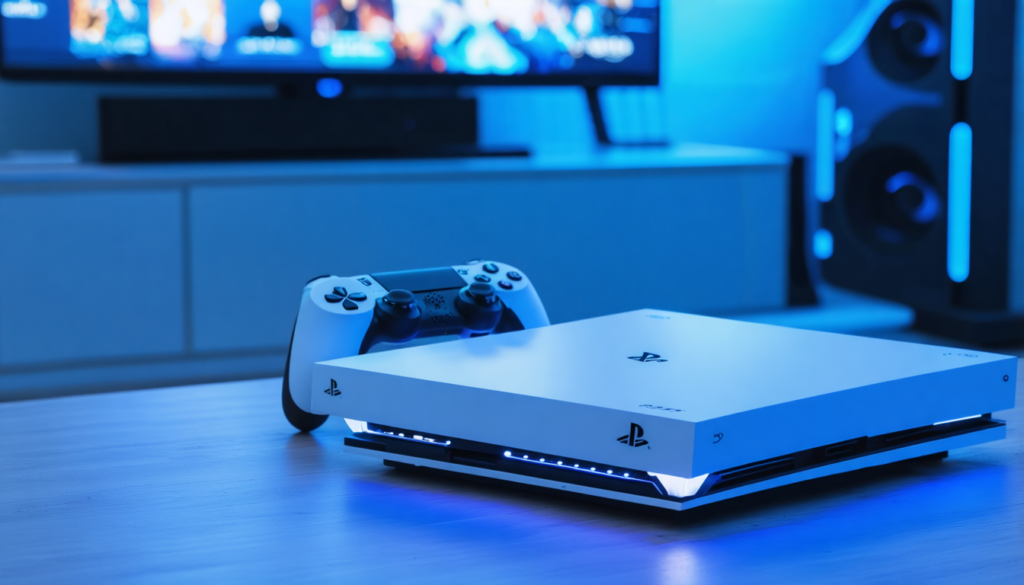
The PS6 will be a true surprise for gaming console enthusiasts and experts, notably thanks to a price set below the PS5 Pro. This new generation, expected by the end of 2027 or early 2028, promises extended backward compatibility, covering the entire lineage of PlayStation video games, from the first model to the latest generation. We will also observe significant technological advances that will mark a turning point in the gaming experience offered by Sony.
Here is what we will discover together:
- The release schedule details as well as the industrial challenges related to the PS6.
- The advanced technical features, particularly regarding power and consumption.
- Backward compatibility that promises to be a central and revolutionary argument.
- Sony’s pricing and marketing ambitions to attract a broad audience.
- Perspectives around the handheld console associated with this generation.
Let us explore in depth these essential aspects that place the PS6 at the heart of expectations for the end of the decade.
- 1 PS6 Release Schedule: a window set between late 2027 and early 2028
- 2 Technology and performance: an aggressive PS6 under the hood with a controlled energy envelope
- 3 Backward compatibility: the PS6 wants to embrace the entire history of PlayStation games
- 4 Pricing strategy: how Sony will surprise below the PS5 Pro’s price point
- 5 Discovering Canis, the handheld console that will accompany the PS6 in 2028
PS6 Release Schedule: a window set between late 2027 and early 2028
The release of the PS6 aligns with a meticulous respect for Sony’s historical industrial cycle, with about seven years between each major generation. According to the strongest rumors from insiders and technical analysts, production of the PS6 would start mid-2027. Marketing would then occur in autumn 2027 or at the latest early 2028, thus offering consumers a fully developed console.
Tangible evidence has emerged around the so-called “pre-silicon validation” phase which would have been completed by the end of 2024, while the final design would have been known since early 2025. This means that Sony was able to anticipate early enough to adjust manufacturing and optimize the entire process.
Rushing seems excluded, especially since the desire to avoid supply difficulties, often glaring in the gaming technology sector, dictates a carefully calibrated strategic choice. Indeed, shortage problems, notably related to RAM, could delay production if the supply chain encounters an unexpected obstacle.
Furthermore, some speculations announced a release in 2026, fueled by influencers and analysts sometimes drawn to a shorter schedule. However, these hypotheses lack consistency compared to confirmed industrial and technical data.
The ability to balance sufficient production while maintaining quality and performance remains a key parameter for the successful launch of the new Sony console. Thus, the launch scheduled around late 2027 presents itself as a pragmatic, thoughtful option perfectly aligned with the manufacturer’s ambitions.
This temporal positioning also coheres with the current market dynamics of consoles at the moment when the PS5 Pro still needs to stabilize its presence, underlining Sony’s desire to chain innovations without brusquing its clientele.
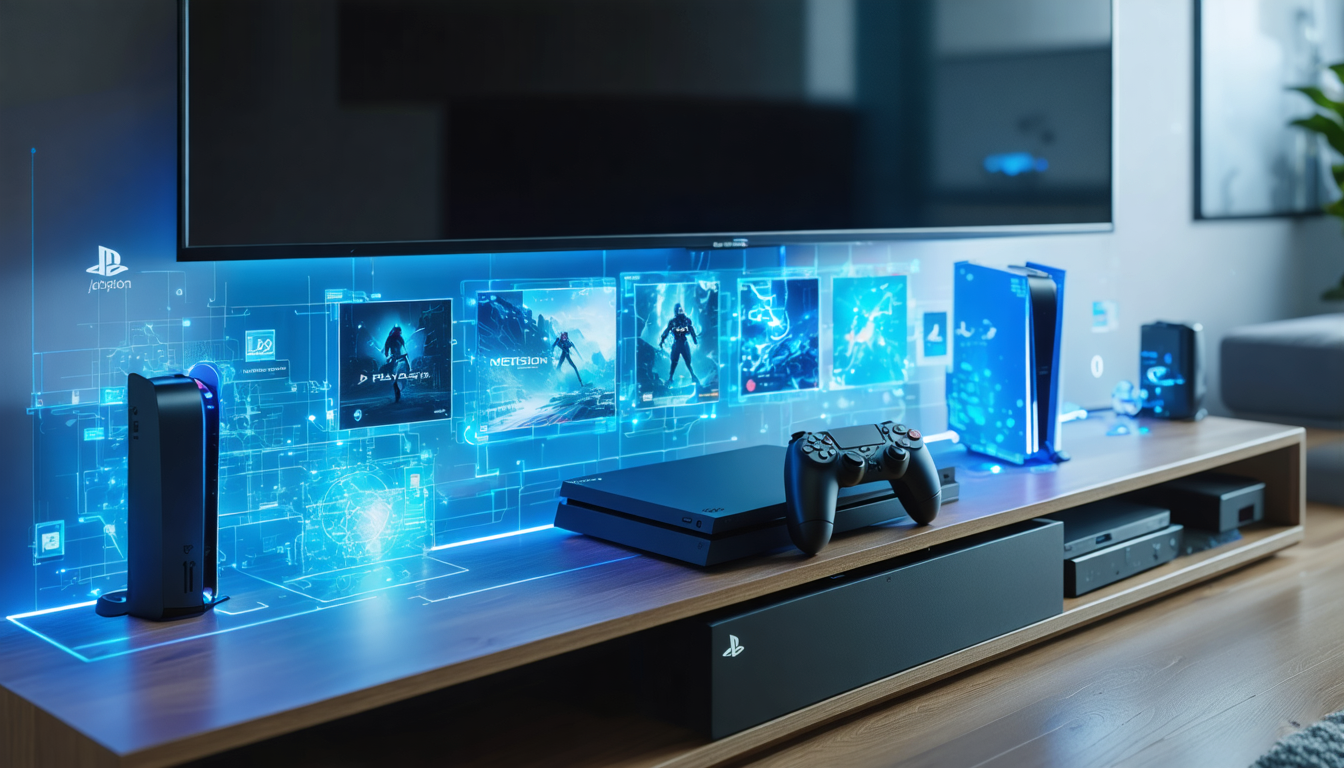
Technology and performance: an aggressive PS6 under the hood with a controlled energy envelope
The PS6 announces a significant leap in computing power, propelling graphical performance to a new level. Equipped with an eight-core Zen 6 processor, it benefits from a modern architecture that optimizes multitasking and favors a smooth and immersive gaming experience.
The GPU is based on an RDNA 5 chip integrating between 40 and 48 compute units, clocked at over 3 GHz. This configuration allows delivering 4K rendering at 60 frames per second, with stable ray tracing, an essential feature for the realism of current and future video games.
Sony does not seek to impose excessive energy consumption; power is balanced with only a 160-watt envelope, a remarkable figure when considering the anticipated performance. This reflects a thorough optimization of components and a desire to offer a durable and energy-efficient console.
Another essential technical point lies in adopting advanced technologies such as AMD’s FSR4 (FidelityFX Super Resolution 4), designed to improve image quality while respecting energy limits. This update replaces the old PSSR system present on the PS5 Pro, offering better fluidity with less impact on resources.
The approach to architecture and software optimization aims for balance: rather than relying solely on brute force, Sony favors execution finesse and overall system coherence. This allows the console to maintain high performance over a long lifespan, without overheating or causing frame rate drops.
To illustrate, a game like Horizon Forbidden West could run effortlessly in ultra-high definition with ray tracing activated, offering players a visual experience even more impressive than with the PS5 Pro while consuming less energy.
Comparative table of key specifications PS5 Pro vs PS6 (forecasts)
| Characteristic | PS5 Pro | PS6 |
|---|---|---|
| Processor | 8-core Zen 5 | 8-core Zen 6 |
| GPU | RDNA 4 – 36 units | RDNA 5 – 40-48 units |
| GPU Frequency | 2.5 GHz | 3 GHz+ |
| Power consumption | 200 watts | 160 watts |
| Ray Tracing | Partial, 30-45 fps | Stable 60 fps |
Backward compatibility: the PS6 wants to embrace the entire history of PlayStation games
One of the major and genuinely exciting axes of this future gaming console is its total backward compatibility. Sony wants the PS6 to run all titles from previous generations without any difficulty, from the PS1 catalog up to the PS5, a colossal technical challenge.
Patents filed by Sony reveal an automated software emulation system capable of analyzing games and dynamically adjusting parameters, such as frame rate and latency, without requiring manual interventions or explosive power. This flexibility would allow each title to benefit from specific optimization, thus guaranteeing quality and smooth gameplay.
The ongoing partnership between Sony and AMD plays a key role in this strategy. Their collaboration on similar CPU and GPU architectures greatly facilitates upward compatibility, ensuring a smooth transition for players who already own a significant digital library.
Practically, this means players will no longer have to worry about losing access to their old games. Cloud saves and digital versions will be fully exploited, strengthening the PlayStation ecosystem and increasing the added value of the console.
To give you an idea, the PS4 already offers impressive backward compatibility with about 4000 supported games, many of them optimized. The PS6 could expand this experience to nearly the entire PlayStation collection to date, a rare and precious advantage.
Pricing strategy: how Sony will surprise below the PS5 Pro’s price point
Sony would be preparing an amazingly accessible price offer for the PS6, targeting a price below that of the PS5 Pro. A strategically thought-out change aimed at democratizing access to this new ultra-high-performance console.
By comparison, the PS5 Pro was launched at a price around 800 euros, an amount that remains high for many enthusiasts while limiting sales volumes. Sony seems to want to shift towards a more aggressive pricing policy for the PS6:
- The expected average price would be slightly under 700 euros, offering better value for money.
- This approach could encourage broader adoption, with a clear target on console sales volume.
- Cost reduction is enabled by technical optimization and controlled production.
- This positioning also addresses competition from Microsoft, notably facing the rising power of Xbox consoles.
This pricing surprise will therefore invite reconsideration of the new generation’s value, which sacrifices nothing of its technical capabilities nor its global connectivity. Moreover, it will reinforce Sony’s position in the home gaming market, signifying a strong desire to balance innovation and accessibility.
Discovering Canis, the handheld console that will accompany the PS6 in 2028
Besides the home console, persistent rumors mention the arrival of a handheld console called Canis or Jupiter, planned for 2028. This machine aims to complement the PlayStation universe with a mobile and powerful experience, combining power and autonomy.
Collaborating directly with AMD and Samsung, Sony would be working on low-consumption technologies, adapted for use on the go, while ensuring compatibility with the PS4 and PS5 catalog.
This handheld console could become an ideal companion for players wanting to maintain continuity between their home and mobile sessions. Such coherence would make the PlayStation ecosystem a model to follow, strengthening player engagement and brand loyalty.
With Canis, gaming sessions would no longer be limited to home, giving access to favorite titles, cloud gaming, and a perfectly integrated hybrid experience.
The planned launch in 2028 gives Sony time to perfect this mobile console, whose goal will be to offer an experience as qualitative as the PS6, but in a lighter and more portable format.