Mario Kart World arrives at a record price of €90 on the new Nintendo Switch 2, a phenomenon that raises major questions about the place of video games in the luxury sphere. This unprecedented price marking a sharp break in the industry raises questions about the factors driving such inflation and its consequences for players. We will explore:
- The technical and economic reasons behind the increase in video game prices, focusing on the case of Mario Kart World.
- The comparison with historical and current standards in the video game market, notably across different platforms.
- The impact of this trend on player consumption, between collector’s editions, second-hand market, and gaming subscriptions.
- The distinct strategies adopted by major players like Nintendo, Sony, and Microsoft in response to these new prices.
- The future prospects for gaming in a context where the video game experience dangerously approaches the luxury sector.
These points will highlight the profound evolution the video game market is undergoing on the cusp of 2026, where passion for geek culture must now contend with tighter budget choices.
- 1 Why Mario Kart World at €90 illustrates a new pricing era in video games
- 2 The economic and industrial factors behind the price increase in the video game market
- 3 How the price increase influences gaming consumption and the relationship with luxury
- 4 Divergent strategies of giants Nintendo, Sony, and Microsoft in the face of price surges
- 5 Perspectives and challenges for a video game market where luxury and accessibility coexist
Why Mario Kart World at €90 illustrates a new pricing era in video games
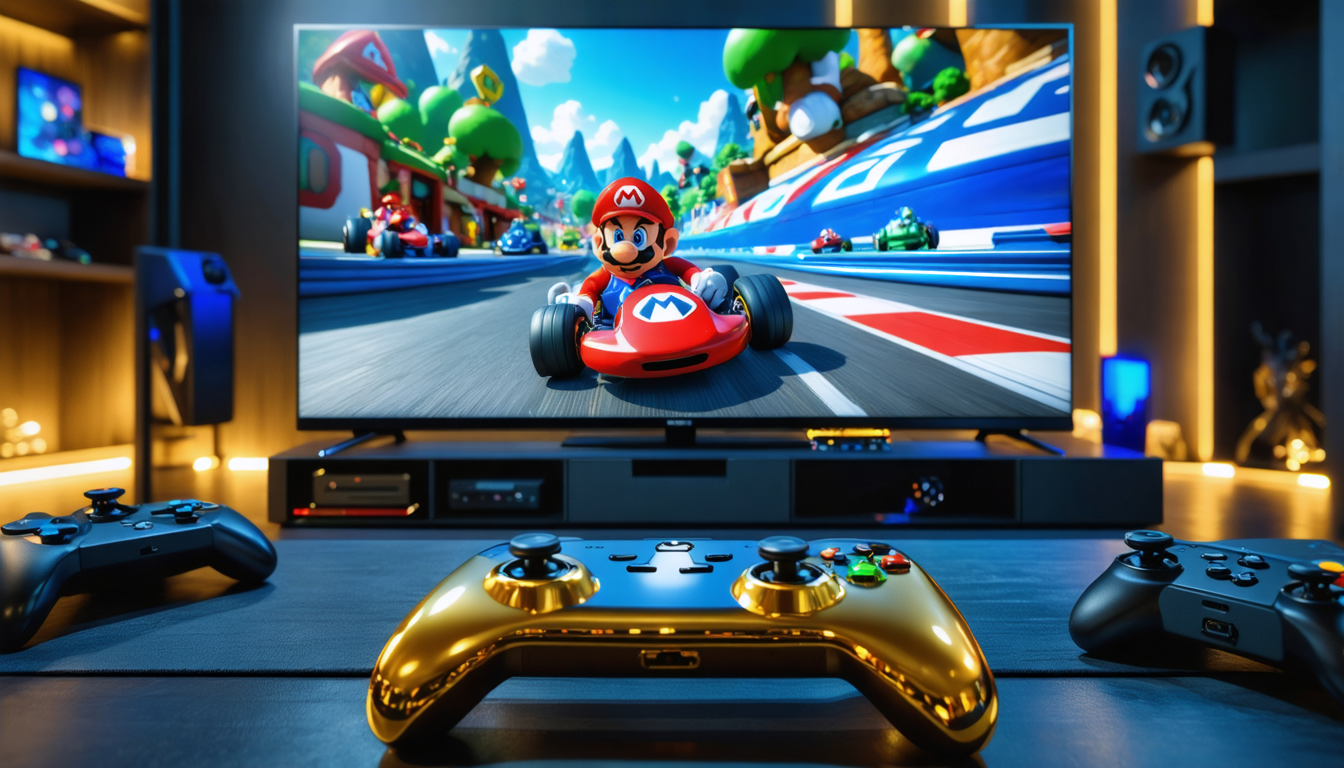
Mario Kart World, offered at €89.99, exceeds the traditional Nintendo price ceilings and clearly illustrates the ongoing shift in the sector. Since 2020, with the arrival of next-generation consoles such as the PS5 or Xbox Series X/S, AAA game prices have risen from the €60-70 range to €79.99, a trend quickly adopted. Nintendo, which had always maintained a more stable pricing policy averaging €69.99, innovates here.
The high price reflects several realities. First, development costs are skyrocketing – Mario Kart World incorporates an unprecedented wealth of content with extended game modes, cutting-edge graphic and sound design, as well as replayability designed to make the experience difficult to match. This price increase is also linked to new hardware constraints: the Switch 2 uses cartridges more expensive to produce than traditional optical discs, raising the unit value of the physical product.
Technically, price increases for essential components such as RAM and graphics cards also impact the cost of accessing the game on PC or console, as these elements guarantee a smooth and visually successful experience. Consequently, players must allocate larger budgets not only to acquire the game but also to fully benefit from its qualities.
This new pricing grid does not apply uniformly to all Nintendo games. The “variable pricing” policy means that only major titles, blockbusters carrying the brand and the machine, will reach this threshold, while other productions will remain at more accessible prices. This positioning attempts to reconcile innovation with respect for a player base more sensitive to price.
To better understand this dynamic, it is interesting to compare Mario Kart World to other major upcoming games. For example, the next GTA VI, scheduled for May 2026, could cross this €90 threshold in certain markets, firmly establishing the arrival of a new pricing standard.
The economic and industrial factors behind the price increase in the video game market
The price increase of games like Mario Kart World is not only explained by Nintendo’s desire to position its product as a luxury. The industrial context plays a decisive role.
Since the semiconductor crisis between 2020 and 2022, the production costs of electronic components have risen by about 20%. This surge affected the entire sector, impacting not only consoles and PC components but also the hardware necessary for game creation. Additionally, logistics costs – transport, packaging, distribution – quadrupled between 2020 and 2021, making any commercial chain more expensive.
The market has also undergone a profound change in distribution formats. The digital sector is becoming dominant with about 80% of global sales, drastically reducing physical volumes. This decrease modifies prices, as the physical product becomes more exclusive, often perceived as a collector’s edition, with specific added value.
At Nintendo, the question of physical cartridges adds an extra layer of costs. Unlike the optical discs still common on PS5 or Xbox, the Switch cartridge remains more expensive to produce, helping maintain high prices longer, even several months after initial release.
One must also consider a generalized inflation of raw materials affecting all industrial sectors, thus increasing the final bill for the consumer. This inflation, combined with precise marketing choices, contributes to establishing a price considered by some as a luxury, where video games were intended to be accessible to everyone.
Facing this economic reality, the second-hand game market thrives, offering consumers less expensive alternatives. Nintendo games, notably Mario Kart World, retain strong resale value, sometimes selling between €20 and €35 less than new on specialized platforms.
Comparative table of average AAA game prices for consoles and PC
| Platform | Average Price 2015-2019 | Average Price 2020-2025 | Average Price 2026 |
|---|---|---|---|
| Nintendo Switch | €59.99 | €69.99 | €79-90 (Mario Kart World) |
| PlayStation 5 | €59.99 | €79.99 | €79.99 – 90 (premium AAA games) |
| Xbox Series X/S | €59.99 | €79.99 | €79.99 (preferred subscriptions) |
| PC (digital version) | €50-60 | €70-80 | €80-90+ (hardware included) |
How the price increase influences gaming consumption and the relationship with luxury
Prices rising to €90 force players to adopt more thoughtful purchasing strategies, marking a shift towards consumption closer to luxury than popular leisure. For families or enthusiasts considering buying several titles per year, the overall bill becomes significantly heavier, deeply changing the way gaming is approached.
A first response to this challenge is expressed through the rise of collector’s editions, often limited, whose price can far exceed that of the standard version. These editions provide a notion of collector’s item, thus reinforcing the “luxurious” character of certain games.
Moreover, the second-hand market is finding a second wind. Players seek alternatives to limit their budgets, using resale platforms where Mario Kart and other titles remain highly attractive. This trend is easily explained by the fact that the average economy realized by buying second-hand can reach up to 40% compared to a new game. This allows access to recent productions at a lower cost.
Subscription services, such as Xbox Game Pass or similar offers, are becoming preferred options for many users. By paying a reasonable monthly subscription, players gain access to a large catalog, smoothing out their budget devoted to gaming and avoiding systematic purchases at high prices.
Finally, another notable change is the anticipation of promotions. On digital platforms, it has become common to watch for significant price drops within three to six months following release. This form of budget patience redefines consumption practices, suggesting that the initial high price becomes a transient luxury only a limited audience can immediately afford.
The emergence of this new reality forces players to rethink their priorities, between passion for geek culture and economic management. It invites consideration, now more than ever, of the implications of a video game market moving toward a form of consumer segmentation.
Divergent strategies of giants Nintendo, Sony, and Microsoft in the face of price surges
Each major video game player adopts a different approach to these new pricing challenges, illustrating their vision of the market and consumption.
Nintendo relies on a variable pricing policy. The release of Mario Kart World as a premium title at €90 reflects this strategy. Rather than applying a generalized increase, Nintendo focuses on a few blockbusters by playing on content richness. This approach is accompanied by measured communication, where the high price is not highlighted despite its potential impact.
Sony follows another method, launching games at a high price (up to €79.99) but quickly offering significant discounts on the PlayStation Store. For example, a title initially sold at €79.99 may be available at €49.99 within a few months, facilitating deferred access for price-sensitive players. This method maintains a balance between profitability and attractiveness over the long term.
Microsoft stands out with its subscription model through Game Pass, which offers unlimited access to a large catalog for a monthly price of €14.99. This strategy mitigates the impact of rising unit prices of games by changing the way gaming is consumed and perceived. Today, Microsoft has not yet crossed the €90 threshold for its major games, preferring to experiment with this innovative formula.
The differences in these approaches are based on each company’s history, their console base in circulation, and their relationship with their audience. These strategies will play a major role in shaping the future of the market and the perception of video games as a luxury product or an accessible leisure activity.
Perspectives and challenges for a video game market where luxury and accessibility coexist
As the video game industry prepares to cross the symbolic €90 mark on certain flagship titles, we must consider the medium-term consequences. The coexistence of luxury and accessibility represents a fragile balance that can influence both production and consumption.
For some players, this upgrade revalues gaming, bringing it closer to sectors such as fashion or automotive where price reflects the importance of quality, innovation, and rarity. A collector’s edition or a big title sold at a high price becomes a desired and prized object, strengthening the emotional connection to these universes.
Nevertheless, it is evident that this trend can exclude a less wealthy or casual audience. The risk is transforming a cultural leisure activity into a financial privilege, accentuating inequalities within the gaming community. This is truly a question of social and economic balance that industry players are testing and adjusting.
Alternatives also hold hope: subscriptions, targeted promotions, second-hand markets, and intermediate formats offer players a range of choices to continue enjoying the market’s richness without breaking their budget constraints.
Finally, this shift poses an essential reflection on the place of video games in geek culture. Moving from simple entertainment to a high-value asset redefines its role, its players, and its community. To support this change, constant adaptation of commercial strategies and careful listening to players’ expectations will be necessary.
The rise of Mario Kart World to €90 embodies this major transition. We are living in a time when video games are shaking up their fundamentals and inserting themselves into a universe where luxury and passion now tangibly coexist.
For more information on new trends and offers in the gaming world, you can consult this link detailing attractive options around the video game market.