
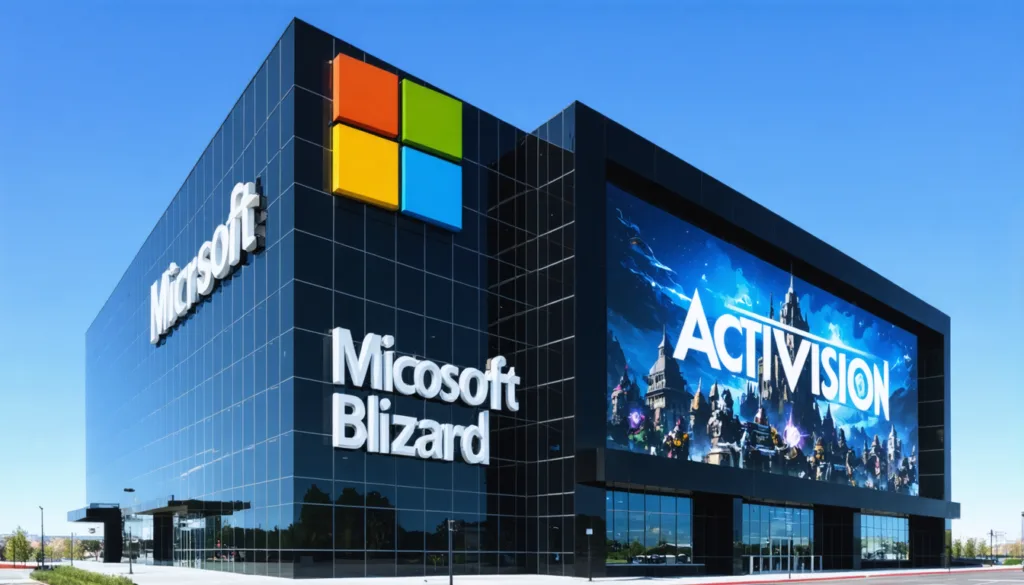
The acquisition of Activision Blizzard by Microsoft is now a tangible reality and closely followed by the entire video game community. We can clearly see that this operation, which ranks among the most significant acquisitions in the history of the sector, has profoundly shaken the gaming market. By addressing this progress status, here is what we will explore:
- The key steps and regulatory evolution of this monumental acquisition.
- The legal and judicial implications that have marked the process.
- The organizational transformations at Activision Blizzard since the integration.
- The current state of flagship platforms such as Battle.net.
- The future prospects for this merger and its impact on the market.
Let us examine carefully each aspect to better understand where Microsoft truly stands in this operation, as well as the influence it has on the video game sector.
Major steps and regulatory evolution of Activision Blizzard’s acquisition by Microsoft
The acquisition of Activision Blizzard, initially announced in January 2022 for an amount approaching 68.7 billion dollars, represents an unprecedented transaction in the video game industry. This project clearly aimed to strengthen Microsoft’s gaming division, particularly Xbox Game Studios, by incorporating iconic franchises such as Call of Duty, Warcraft, Diablo, and Candy Crush. The regulatory process was however long and complex.
At the European level, the European Commission was one of the first bodies to carefully examine the matter. The main issue was maintaining healthy competition, ensuring that Microsoft would not turn the acquisition into a de facto monopoly. The commitments made by the company, notably regarding the availability of titles on multiple platforms, allowed a conditional agreement. This alleviated fears about possible exclusivity that could have harmed other market players.
The United Kingdom marked a point of tension, as its regulator initially recommended a complete block. To circumvent this injunction, Microsoft committed to ceding certain cloud gaming rights of Activision Blizzard titles to Ubisoft, which led to approval of the deal in this revised form.
This regulatory dimension was essential because it set precise limits on Microsoft’s strategy, forcing it not to restrict access to flagship licenses. This framework proved decisive for the sustainability of the acquisition and for maintaining balance in the video game market.
Here is a summary table of the decisions made by the major authorities regarding the acquisition:
| Authority | Decision | Key Commitments | Essential Date |
|---|---|---|---|
| European Union | Conditional approval | Multi-platform maintenance, cloud access | Mid 2023 |
| United Kingdom | Initial block, then restructured agreement | Ceding cloud rights to Ubisoft | End 2023 |
| United States (FTC) | Prolonged debate, complaint filed, then dropped | No imposed exclusivity | Jan 2022 – May 2025 |
This stage shows how global regulation sought to frame the operation to guarantee competitive balance.

Judicial proceedings in the United States: a crucial issue of the acquisition
In the United States, the Federal Trade Commission (FTC) embodied the main legal obstacle to the rapid progress of this acquisition. Under the leadership of Lina Khan, an institution known for its zeal in regulating tech giants, the FTC filed a complaint at the end of 2022 arguing that the merger risked favoring an abuse of dominant position. The risk particularly concerned cloud gaming, subscription services, and control over consoles. The idea was that Microsoft could become an actor capable of excluding competitors by locking down major licenses.
The trial involved a broad exchange of arguments: Microsoft defended itself by assuring that games would remain on competing platforms and committed to limited-time exclusivity agreements. The federal judge rejected the request to suspend the transaction in July 2023, considering that the FTC did not provide evidence of sufficiently tangible harm to consumers.
The appellate courts upheld this decision in May 2025. The 9th Circuit Court emphasized that the risks highlighted did not exceed the threshold of probable harm. This judicial outcome marked a turning point, pushing the FTC to officially abandon its proceedings a few days later.
This development illustrates the legal complexity surrounding the largest mergers in the technology sector and shows how legislation must adapt to an industry in constant flux. We also observed the growing influence of issues related to the subscription economy and cloud platforms in regulatory challenges.
The favorable outcome for Microsoft consolidates its expansion strategy and opens the way for the group’s consolidation in the global video game industry. This legal victory is also a strong signal for other merger projects in the sector.
Organizational transformation at Activision Blizzard after integration by Microsoft
The official completion of the acquisition in October 2023 immediately triggered an important integration phase. Microsoft Gaming incorporated Activision Blizzard alongside its other subsidiaries such as Xbox Game Studios and Bethesda/ZeniMax, thus forming a powerful conglomerate in the video game domain.
Bobby Kotick, then iconic CEO of Activision Blizzard, left his position at the end of December 2023. This departure symbolized not only a leadership change but also a new direction more aligned with Microsoft’s culture and objectives. This period was marked by a profound reorganization, notably with the elimination of around 1,900 jobs, mostly affecting support functions within the various gaming activities.
Microsoft ensured that these cuts did not impact developers or creative studios, thereby preserving the production of flagship titles. This strategy aimed at streamlining resources reflects the desire to better focus efforts on the most promising projects without diluting innovation.
We can thus observe a classic approach in large-scale mergers: optimizing structures to control costs while stimulating creativity through better coordination between Xbox, Blizzard, and Bethesda teams.
This integration also proves strategic to leverage Microsoft’s proprietary technologies, notably in cloud and online services, and to strengthen synergy between studios, promoting multiplatform development.
Current state of Battle.net and technical integration within the Microsoft ecosystem
Battle.net, Blizzard’s historic platform, continues to be a central pillar of the video game offering despite transformations within the group. Microsoft has invested in strengthening the infrastructures of this platform to guarantee better stability, increased storage capacities, and smoother integration with the Game Pass subscription service.
Players can now benefit from a more seamless experience thanks to improvements in connectivity and cross-platform features, responding to a growing industry demand for interoperability between consoles, PC, and cloud services.
For example, major titles like Warcraft and Diablo have seen their technical updates aligned with Microsoft standards, enabling better exploitation of the cloud for hosting online matches and unified management of player profiles.
The link between Xbox and Blizzard teams generates a multiplication of hybrid projects, combining classic production strengths with cutting-edge technologies in streaming and cloud gaming. The goal is clearly to offer users richer, faster, and more accessible services regardless of the delivery medium.
- Improvement of stability and reduction of service interruptions.
- Extension of storage capacities to allow more simultaneously downloaded content.
- Reinforced integration with Game Pass for easier and simplified access to Blizzard titles.
- Development of multiplatform features.
- Optimization of cloud gaming and better online game performance.
Future prospects and challenges for Microsoft and the video game market
With all regulatory barriers now lifted and integration well advanced, Microsoft clearly displays a major ambition: to support a cross-platform dynamic that does not limit Activision Blizzard franchises to Xbox only. The exclusivity agreement with other platforms, notably PlayStation, PC, and Nintendo, has been renewed until 2033, which guarantees wide access for players to these universes.
This multi-accessibility strategy is primarily designed to maximize the adoption of Game Pass, which stands as a key lever in the growth of subscription-based video games. The cross-technological integration also benefits strongly developing segments such as virtual reality (VR) and augmented reality (AR), areas where Microsoft is investing massively.
Besides expanding traditional franchises, Microsoft also aims to strengthen its position in e-sports and mobile games. Activision Blizzard’s portfolio brings a diversity of licenses and styles allowing exploitation of different economic models and supporting an offer adapted to contemporary consumption trends.
Here is a summary of the main challenges and future directions:
- Maintaining key titles on multiple platforms until 2033 to secure the player base.
- Expanding Game Pass with Activision Blizzard games, thereby enhancing attractiveness and retention.
- Technological development in cloud gaming, AR/VR, and online services for an innovative user experience.
- Increased support for e-sport competitions through better visibility and integrated events.
- Optimization of synergies between studios to accelerate creation and commercialization.
These points reflect Microsoft’s marked determination to establish itself sustainably among the global leaders in interactive entertainment, with a rich, open, and community-oriented ecosystem.