
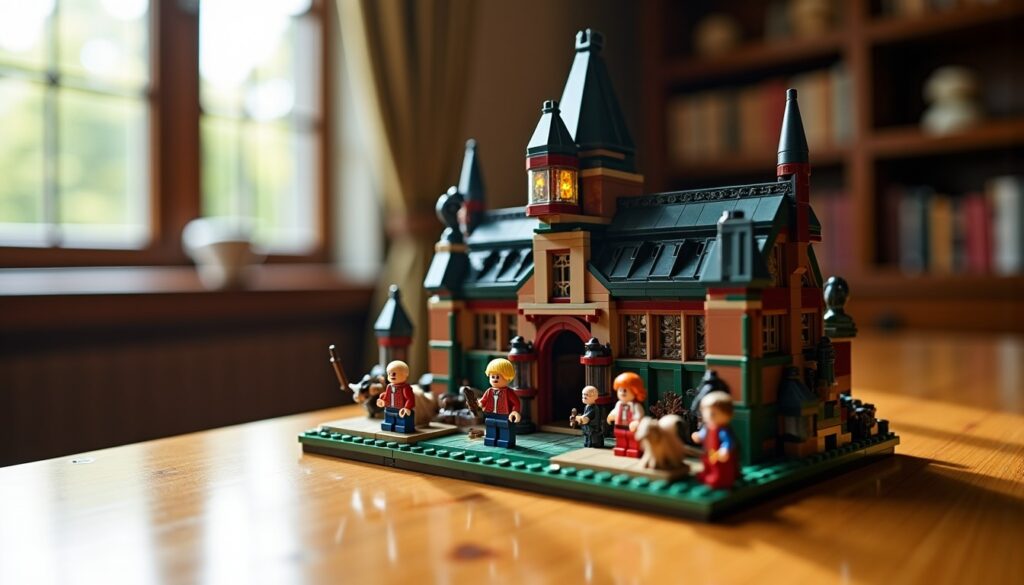
The first official images of the LEGO Harry Potter collection inspired by the HBO series reveal two iconic locations: the Gryffindor common room and the Hogwarts Express with Platform 9¾. Both sets are announced for January 1, 2027. They provide a first tangible glimpse of how the sets of this TV adaptation could take shape in bricks, without revealing the full scope of its visual identity.
For now, the most firmly established information concerns two boxes for which prices and the number of pieces are indicated. Other products, such as a Privet Drive house and LEGO BrickHeadz minifigures, are mentioned, but their status requires more caution.
- Gryffindor common room: 738 pieces, $89.99, recommended for ages 9 and up.
- Hogwarts Express and Platform 9¾: reference 76487, 771 pieces, $99.99.
- Release date announced: January 1, 2027, for both confirmed references.
By examining the available details and information, we can distinguish what the LEGO sheets confirm from what remains to be clarified. This difference helps to understand what these new models bring to fans and what to expect before their release.
Gryffindor common room: the first official images of the LEGO set
With 738 pieces and a listed price of $89.99 in the United States, the Gryffindor common room is one of two products officially referenced by LEGO linked to the HBO series. Its sheet targets builders from 9 years old and indicates a release on January 1, 2027. No reference number is mentioned in the available information, which distinguishes it from the Hogwarts Express, whose identifier is already known.
The images show an interior organized around a large fireplace, topped by a stone mantle. The Gryffindor crest is placed above the hearth, while mineral arches and dark wood paneling compose the décor. The whole thus relies on signs immediately associated with the house, without needing to imagine a specific action scene to recognize the location.
The construction also seems to exploit height: the boys’ and girls’ dormitories are arranged upstairs. This choice gives the model several spaces to observe and explore, rather than a single façade meant to be displayed. For a young builder, this can encourage roleplay; for a collector, the vertical layout offers a way to showcase different levels within a relatively compact space.
One detail draws attention: a Quidditch table is associated with the set. The available elements present it as a particularity linked to the series, which could allow the new LEGO set to stand out from other representations of the common room. This observation should be kept in proper perspective: the presence of this element is noted, but the images and descriptions are insufficient to establish how it fits into all the scenes of the production.
Visual similarities can also be noted with the Gryffindor common room in the game Hogwarts Legacy, notably for the fireplace, arches, stone mantle, and dark woodwork. This proximity is a visual comparison, not proof of creative connection between the game, LEGO, and HBO. To judge the set, we can therefore focus on observable features: its architecture, various spaces, and emphasis on the house’s symbols.
At $89.99 for 738 pieces, the box sits in a range where a more developed construction than a small accessory décor is expected. The number of pieces alone does not measure the assembly time or richness of the result, but it provides a first point of reference for comparing offerings. The model’s value will also depend on its finish, display potential, and included elements, the full list of which remains to be consulted on the detailed sheet.
For fans who collect Hogwarts locations, this common room offers a different angle than a complete castle: it emphasizes students’ daily life and the atmosphere of a house. The first official images indicate a construction designed as a lived-in space, where architectural details serve both presentation and play.
Hogwarts Express and Platform 9¾: a LEGO set focused on travel
The second officially identified product is named Hogwarts Express & Platform 9¾ and bears reference 76487. Its box contains 771 pieces and its announced price in the United States is $99.99. Like the common room, it is set to arrive on January 1, 2027, and its sheet explicitly ties it to the original HBO series.
The model brings together two inseparable elements of the journey to school: the station and the train. Platform 9¾ represents the threshold between the mundane world of Muggles and the magical universe, while the Hogwarts Express embodies the group journey to the castle. Combining them in one box allows staging the start of the journey rather than choosing between the platform or the locomotive.
This association also offers several display possibilities. The train can become the focal point of a shelf, while the platform provides visual context to the whole. For families, this setup can support an easy-to-understand play: students arrive, pass through the passage, and board. For adults displaying their models, the station serves as a backdrop and helps tell a scene without multiplying constructions.
The number of pieces exceeds that of the common room by 33, while the announced price is $10 higher. This comparison allows a direct contrast, without claiming that the cost per piece sums up the value of a box. A train involves an elongated shape and track elements, whereas a vertical interior favors space arrangement and furniture details. Both models thus satisfy different construction desires, even if they belong to a close price range.
| LEGO Harry Potter Set | Pieces | Price announced in the United States | Date indicated |
|---|---|---|---|
| Gryffindor common room | 738 | $89.99 | January 1, 2027 |
| Hogwarts Express and Platform 9¾, reference 76487 | 771 | $99.99 | January 1, 2027 |
The table allows identifying confirmed data without confusing pieces, price, and launch date. The quoted amounts are those announced for the United States; they do not allow deduction of prices applicable in each country. Local prices may be communicated separately, urging buyers to check their market before budgeting.
The train holds a particular narrative force in the Harry Potter universe: it marks the start of the school year and gathers students before their arrival at Hogwarts. LEGO is banking here on a scene that many readers and viewers immediately recognize. The final result will depend on details visible in the full sheet, but the combination of the platform and locomotive already makes this reference a central piece of the first wave.
Two new LEGO sets with different uses and prices
Comparing these two references helps better understand the logic of this first announcement. The common room favors an indoor décor, organized around a fireplace and multiple levels, while the Hogwarts Express relies on a transit location and a train. We therefore have two ways to bring the HBO series into a LEGO collection: reconstituting a familiar space or staging a symbolic departure.
The budget may guide the choice. The common room is announced at $89.99 and the train at $99.99, a $10 gap. For a family wishing to buy a single box, this difference remains limited at the scale of these two products, but the number of pieces alone does not determine which will suit best. It is useful to ask whether one prefers an environment to explore or a model evoking movement and travel.
The format also affects display. A common room built vertically can find its place on a shelf where depth is limited, subject to dimensions not specified here. A train, by its shape, rather requires an elongated surface. If you prepare a display space, measuring available room before purchase remains a practical method: a width of 60 centimeters, for example, can accommodate more compositions than a narrow shelf, but exact box and model dimensions should be verified.
Both references address builders starting from a similar age or are presented in a range aimed at both young and adult builders, but they may not offer the same experience. The common room could encourage creating small scenes around Gryffindor living spaces. The train naturally lends itself to step-by-step narration: arrival at the platform, boarding, then departure to school. These are plausible uses deduced from the presented sets, not exclusive functions guaranteed by LEGO.
Collectors can also think complementarily. Together, the two models cover a school life moment and the journey thereto: one shows an interior home, the other the path to Hogwarts. At their announced prices, buying both would represent $189.98 before taxes and possible fees. This addition serves as a budgetary reference for American buyers, not a universal price estimate internationally.
The comparison also helps distinguish quantity of pieces from the nature of the construction. The Hogwarts Express counts 771 pieces versus 738 for the common room, only 33 pieces difference. The train’s price being $10 higher, the gap may be explained by the composition and type of model; currently available data does not provide enough detail to precisely attribute this surcharge to a particular element.
If you hesitate, start from your main use: playing, displaying, or completing an existing collection. An interior decor enthusiast might favor the common room, whereas a fan of trains or return-to-school scenes might prefer the platform. Both products form a coherent initial pair, without it being necessary to choose one as the “best” absolutely.
LEGO announcements and commercial promotions can also help plan a purchase. We can follow promotional periods with the LEGO Black Friday 2026 calendar, while keeping in mind that 2026 offers do not guarantee discounts on models expected in 2027.
What the first images reveal about the HBO series’ visual identity
A TV adaptation is not limited to replicating familiar locations: it reinterprets them through its sets, costumes, lighting, and directorial choices. The two LEGO models referenced offer a first glimpse of this transposition, but they do not alone reveal the production’s full appearance. We can observe shapes and set elements, without turning these clues into certainties about the entire series.
In the Gryffindor common room, the mineral arches, dark woodwork, and fireplace compose a warm atmosphere, marked by contrasting materials. This combination gives the place an appearance of a lived-in room, rather than just a showroom. The multi-level layout also suggests the set may represent different zones of student life, even if the available sheet does not detail all functions of each part.
The Hogwarts Express brings another visual register. Whereas the common room focuses attention on interior architecture, the train evokes movement and transition. The platform and locomotive connect ordinary station life with access to magic, a contrast at the heart of this scene. LEGO thus assembles strong images of the Harry Potter universe without announcing, at this stage, a complete reconstruction of the castle or school.
For fans, the sets can serve as comparison points when new images of the series are released. They can then see if volumes, colors, and brick details match the on-screen sets. This approach is more solid than drawing conclusions from an isolated resemblance: LEGO ranges necessarily simplify some elements to adapt them to construction and piece scale.
It is also necessary to distinguish visual fidelity from official relation. A similarity with a video game or another common room representation is not proof that teams shared references or artistic choices. The images show a LEGO model associated with the HBO series; any comparison with another work should be presented as a personal observation, not production information.
This caution does not detract from the value of the first official images. They show that LEGO chooses locations quickly identifiable by a broad audience, while leaving room for details specific to this adaptation. The Quidditch table noted in the set is an example: a small object can guide the interpretation of the set, even if its exact role in the series is not specified.
To follow the range’s evolution, you can compare product sheets as LEGO publishes their complete information, then examine the series visuals when they become available. Two research videos also help situate the topics around the models, without replacing official data from product sheets.
The right approach is to separate three levels: what LEGO states, what the images let us observe, and what we interpret as resemblance. This method avoids presenting an aesthetic hypothesis as an established fact and allows following the official announcement’s development more calmly.
Privet Drive and BrickHeadz: mentioned products remain to be confirmed
Available information also mentions a product dedicated to 4 Privet Drive, priced at $59.99, as well as a BrickHeadz assortment featuring Harry Potter, Draco Malfoy, and Hagrid for $24.99. A common launch date of January 1, 2027, is mentioned for these references. Their confirmation level remains less solid than that of the common room and Hogwarts Express, already presented in more detailed LEGO sheets.
This difference in status matters for buyers. The two confirmed sets have precise data on piece count, price, and announced date; additional products are known from information that lacks the same level of detail. We can thus consider them as possible leads for an expanded range, but not as elements as firmly established as references 76487 and the Gryffindor common room.
A Privet Drive set would have a complementary function: it would represent Harry’s everyday world before his entry into the magical universe. In terms of collecting, this contrast could dialogue with the Platform 9¾, which represents precisely the passage from one world to another. This reading is a projection based on the mentioned locations; without visuals and complete details, we cannot assign specific content to the model.
The BrickHeadz would address another expectation. Instead of building a location, the buyer would have stylized characters intended for display. The cited selection — Harry, Draco, and Hagrid — would gather three figures with very different profiles, from the central hero to his rival to the housekeeper. The listed price of $24.99 concerns the mentioned set, but the number of pieces and exact presentation are not specified in the available elements.
To verify this information, the simplest way is to search for a complete LEGO sheet and check several elements together: a product reference, a description, piece count, availability date, and official image. When these data are absent or partial, it is better to avoid ordering solely based on a preliminary list. This verification is particularly useful for a derivative product expected several months before its sale.
The first official wave therefore remains understandable around two axes: a house interior and the journey to Hogwarts. Privet Drive and the figures could broaden this panorama to the story’s beginnings and its characters, but their exact place in the range still requires confirmation at the same level. This distinction preserves the value of information already published without presenting the mentioned elements as definitive announcements.
As LEGO completes its sheets, fans will be able to compare the range, set their budgets, and decide if the models fit into their LEGO collection. For now, the most concrete data are those of the two sets scheduled for January 1, 2027. Other references would expand the choice if confirmed, but the Gryffindor common room and Hogwarts Express already constitute the first tangible preview of this new collaboration.
To follow new announcements and availability, you can check our update on LEGO promotions planned for Black Friday 2026, keeping commercial information for this period separate from characteristics of the Harry Potter sets expected the following year.