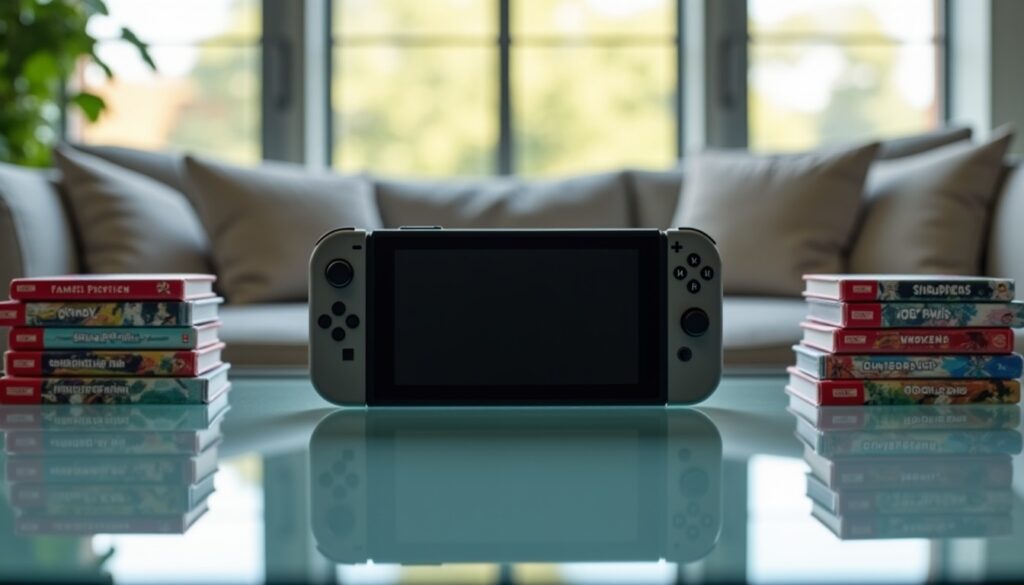
Yes, eight projects are associated with the upcoming exclusives of the Nintendo Switch 2, but only one bundled launch is officially confirmed for 2027: Pokémon Winds and Pokémon Waves. The other seven names circulating remain to be verified, and their dates or features should not be taken as established announcements. This distinction changes the interpretation of the schedule: there is a selection of games mentioned, but not eight guaranteed releases.
To follow the exclusive games without confusing rumor and confirmed information, we can keep in mind three reference points:
- Confirmed: Pokémon Winds and Pokémon Waves are announced worldwide for 2027, exclusively on the console.
- Not confirmed: the projects associated with Metroid, Kirby, Ninjala, Onyx, The Duskbloods, and Xenoblade have no identifiable official validation.
- Aside: Mouse Work is announced in unverified information with a date in December 2026, not 2027.
The Nintendo Switch 2 already has an important commercial foothold with the remake of The Legend of Zelda: Ocarina of Time, indicated as available since November 5, 2026, and sold over 5.2 million copies in four days. For the coming months, we can therefore examine game announcements enthusiastically, while keeping a release schedule based on real confirmations.
Nintendo Switch 2 in 2027: what we really know about the eight projects
The figure of eight here refers to eight projects or grouped announcements, not eight games whose release would be guaranteed. Pokémon Winds and Pokémon Waves form a single generation announcement, even though they are two distinct titles. The other seven projects mentioned are Mouse Work, Metroid Ravenous, Kirby and the World Beyond, Ninjala 2: The Uncharted Planet, Onyx: The Dark Grip, The Duskbloods, and Xenoblade Genesis.
This nuance matters for players who organize their purchases based on Nintendo releases. A game name accompanied by a genre, a launch window, or even a precise date may seem official at first glance. However, these details do not amount to confirmation: without communication from Nintendo, a publisher, or a relevant studio, they remain information to be treated conditionally.
The difference between announcement and rumor is particularly visible with Mouse Work. The circulating information attributes to it a release on December 7, 2026, and a cooperative mode using Joy-Con 2 mouse controls. This idea seems suited to the functions of the game console, but no official page or publisher announcement allows validating the project, its operation, or its date.
To give a concrete reference, let’s imagine Léa, who wants to buy two games to play with her family before the holidays. She can put Pokémon Winds and Pokémon Waves in her forecasts for 2027, while reserving a separate line for Mouse Work as an unconfirmed project. This method avoids confusing a reported date with a guaranteed date and helps keep a realistic budget.
The Switch 2 also already has a title installed in its catalog: The Legend of Zelda: Ocarina of Time, a complete remake of the Nintendo 64 game released in 1998. The over 5.2 million sales announced in four days show that a major exclusive can quickly attract a large audience. This result gives context to the expectations for 2027, without proving that the mentioned projects will follow the same pace.
We can therefore talk about a promising selection, not a fully locked-in schedule. The only verifiable appointment for 2027 in this list is the Pokémon duo; the other announcements must pass the stage of a public confirmation before entering a reliable schedule.
Pokémon Winds and Pokémon Waves: the confirmed Nintendo exclusives
Pokémon Winds and Pokémon Waves are the most solid titles in the selection. Their worldwide release is announced for 2027, exclusively on Nintendo Switch 2. The names are distinct, even if the expression Pokémon Winds and Waves is sometimes used to designate the whole. The precise date, however, is not yet known: we therefore know which year to aim for, but not which month to reserve.
The first elements describe an open world made up of islands, between lands exposed to wind and vast ocean. This geography already gives a direction to the adventure: movements could link terrestrial and maritime environments, while the islands would offer distinct spaces to explore. We cannot yet deduce the size of the map, navigation systems, or how Pokémon will be integrated into each area.
Caution does not prevent evaluating the interest of this announcement. For a player who appreciates exploration, an archipelago might promise a less linear progression than a route-based sequence. For someone who prefers classic episodes, the available information does not yet say if battles, capturing, and progression will maintain a familiar structure. These details will be decisive to understand the series’ evolution.
Fans who follow the franchise’s history can also place this announcement in a symbolic year: 2026 marks 30 years of Pokémon. The events linked to this anniversary give context to discussions around the next generation; this reference can be found in this article dedicated to the Pokémon Day and the 30 years of the franchise. However, this anniversary should not be assigned game features that have not been announced.
To prepare their budget, a player can keep a simple rule: consider 2027 as the planned window, without choosing a purchase date as long as Nintendo has not communicated a more precise schedule. The cost of the console may also be part of the decision; our note on the price of the Nintendo Switch 2 helps to place the purchase in an overall expense, with games and accessories.
These two titles thus provide the most concrete basis for the video games expected on the machine in 2027. Their exclusivity and release year are established, while the detailed experience remains to be discovered. It is this contrast that allows us to talk about a real announcement without turning the still unknown areas into promises.
The other seven exclusive games mentioned: dates and statuses to watch
The seven unconfirmed projects cover varied genres, which explains the interest they generate. Their presence in lists or articles is not enough to establish their development. The table below separates reported information from verifiable facts, so that you can distinguish attractive leads from official announcements.
| Project Mentioned | Reported Information | Status to Keep |
|---|---|---|
| Mouse Work | Cooperation with Joy-Con 2 mouse controls; December 7, 2026 | Not confirmed; date outside 2027 |
| Metroid Ravenous | 2D game, supposed sequel to Metroid Dread; January 28, 2027 | Not confirmed |
| Kirby and the World Beyond | Open world adventure, spring 2027 | Not confirmed |
| Ninjala 2: The Uncharted Planet | Supposed sequel, spring 2027 | Not confirmed |
| Onyx: The Dark Grip | Horror, project assigned to Bloober Team, year 2027 | Attribution and release not confirmed |
| The Duskbloods | PvPvE project assigned to FromSoftware, year 2027 | Genre, studio, and window to verify |
| Xenoblade Genesis | New supposed episode for 2027 | Not confirmed |
Metroid Ravenous attracts attention with the promise of a two-dimensional adventure after Metroid Dread. The date of January 28, 2027, if confirmed, would place the game early in the year. For now, neither the title, nor its narrative link with Dread, nor this date rests on an identifiable official announcement. We can therefore talk about a supposed sequel, not a fixed appointment.
The Kirby and Ninjala projects are associated with spring 2027, but the proposals are very different. The first would evolve Kirby toward an open world; the second would be a new step for a license focused on action and online play. Without gameplay presentation, it is impossible to evaluate the structure, number of players, or differences with previous episodes. The terms “open world” and “sequel” remain reported descriptions here.
Onyx: The Dark Grip and The Duskbloods could, if they exist in the described form, bring darker and more competitive tones to the catalog. The first is attributed to Bloober Team, the second to FromSoftware and the PvPvE genre, which combines player versus player battles and game-controlled threats. These associations are suggestive, but are not validation: a studio, a genre, and a launch window must be confirmed by an official source.
Xenoblade Genesis completes this list with the prospect of a large-scale role-playing game. No verifiable details are provided about its universe or characters, and it should not be confused with a possible enhanced edition of Xenoblade Chronicles 3, which is also not confirmed. In this selection, each name therefore deserves distinct monitoring rather than a fixed place in planned purchases.
Varied genres, but still uneven promises
If the reported descriptions materialized, these projects would outline a very diverse catalog: local cooperation, 2D action, exploration, horror, competitive play, and role-playing game. This variety would be useful to a console that must respond to different habits. A household that plays together does not expect the same experiences as a fan of long narrative adventures or a devotee of demanding fights.
Mouse Work illustrates the potential of hardware features. The supposed use of Joy-Con 2 as pointing devices could make precision tasks more natural, or open the way to cooperative mini-games. But an interesting feature does not prove the existence of the software. Before planning a game night around this idea, we must wait for a presentation showing the controls and the number of participants.
A two-dimensional Metroid would meet a different expectation: that of a progression built around exploration, new abilities, and revisitable zones. If Metroid Ravenous were announced as a direct sequel to Dread, players could hope to find Samus in an adventure linked to that episode. The supposed title and its place in the chronology remain to be confirmed, which forbids drawing conclusions about the story.
Kirby and the World Beyond, for its part, would be associated with an open map. Such a structure could give more freedom, but it also raises questions of pacing: how to guide players without turning exploration into a series of dispersed tasks? A successful evolution should preserve Kirby’s accessibility while providing a clear reason to explore each zone. We do not yet have elements to judge this design choice.
The projects attributed to Bloober Team and FromSoftware would represent darker or more competitive options. A horror game can broaden the audience of a family console by offering a tension-filled experience, while a PvPvE title can combine cooperation and rivalry. Again, these are leads, not established characteristics. The quality of a catalog depends as much on execution as on the announced genre.
Finally, a new Xenoblade episode might interest players seeking long campaigns and rich game systems. A complete announcement should specify the studio, the narrative setting, and the differences with previous episodes. The categories are therefore useful to imagine possibilities, but they do not replace concrete information about content and operation.
To compare these genres with other ecosystem projects, we can also consult this dossier on massively multiplayer open world role-playing games on Switch and PC. This comparison helps situate expectations, without establishing a development link with the projects mentioned here.
Nintendo Switch 2 release schedule: following announcements without error
A useful schedule should not mix an official date, a reported window, and a simple assumed year. In the available information, Pokémon Winds and Pokémon Waves have a worldwide confirmed window in 2027, without a precise date. The other seven projects remain to be watched; Mouse Work stands out because the circulating date, December 7, 2026, does not even correspond to the announced year by the title of this selection.
We can organize this monitoring with three simple levels. The first groups together announcements confirmed by Nintendo or the concerned publisher. The second gathers reported information, to verify before any purchase or reservation. The third keeps hypotheses that do not yet have sufficiently solid details. This method avoids a precise date, copied into several calendars, being wrongly taken as a guarantee.
For a player preparing expenses, it is useful to distinguish the price of the console, that of games, and accessory purchases. A title announced for “2027” can release in January or December; planning an exact sum or taking leave with no confirmed date is therefore premature. We can rather reserve an overall budget, then specify it when dates, editions, and prices are revealed.
The commercial performance of The Legend of Zelda: Ocarina of Time provides a comparison point, not a prediction. Over 5.2 million copies sold in four days indicate strong demand for a major exclusive, according to the figures communicated. This success strengthens interest around upcoming Nintendo releases, but it does not allow stating that each of the mentioned projects will reach a similar audience.
We can also follow announcements during official presentations, dedicated events, and studio communications. For each title, three questions suffice to make the selection: has the game been announced by an official source, is the platform specified, and is the date formulated as an exact day or a simple window? If an answer is missing, it is better to keep a “to be confirmed” mention in notes.
This discipline does not take away the pleasure of imagining upcoming video games. It rather allows enjoying rumors without confusing desire and release commitment, while keeping an honest view of what the Nintendo Switch 2 will really offer. At this stage, Pokémon Winds and Pokémon Waves form the only established 2027 milestone in this list; the rest awaits a proper announcement.