
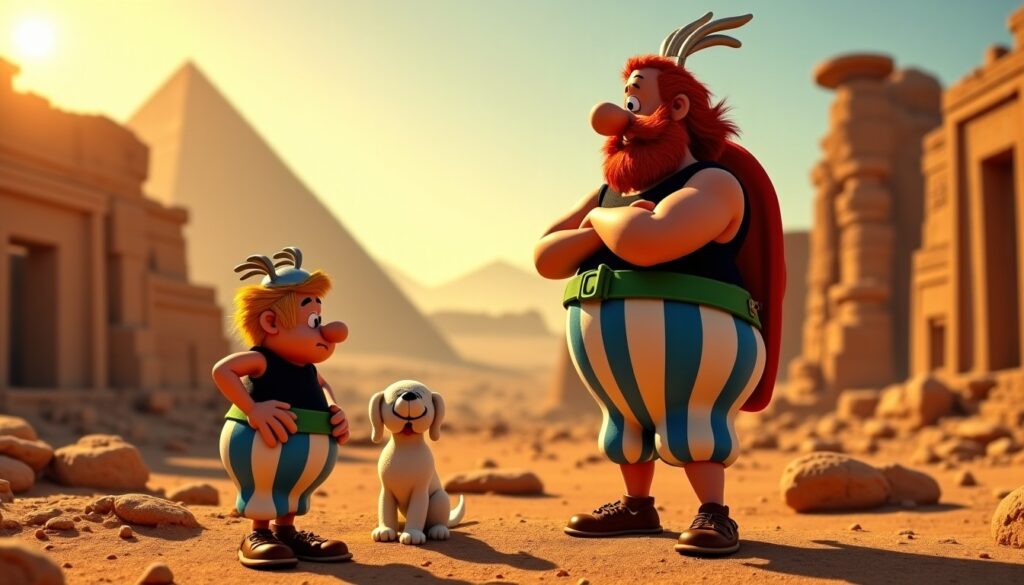
Astérix in the Kingdom of Nubia has the potential to become a future classic, provided that its initial idea serves a real adventure rather than a succession of easy gags. Expected in French theaters on December 2, 2026, the animated film places Astérix and Obélix facing a village transformed into children, while the Roman threat grows. This reversal gives the saga a fresh comedic angle and removes part of the usual invulnerability of the Gauls.
The bet rests on three balances: exploiting the humor related to the metamorphosis without being confined to it, making Nubia a living territory rather than just a setting, and giving both the voices and the script a strong identity. To judge what could tip the film towards classic or disappointment, we can examine :
- the mechanics of the elixir and its consequences for the village;
- the representation of Nubia and the renewal of the adventure;
- the vocal casting, the creative team, and the expectations raised by Astérix’s legacy.
Astérix in the Kingdom of Nubia: a rejuvenation elixir that upends the village
The starting point is simple to understand: a rejuvenation elixir accidentally ends up in Panoramix’s magic potion and turns the inhabitants of the village into children. Astérix and Obélix escape the phenomenon and set out to find a remedy in the Kingdom of Nubia, while the Romans see in this weakness an opportunity to attack. The situation combines comic catastrophe, geographical displacement, and concrete threat, three familiar devices of the comic strip.
The novelty comes from the magic potion, which no longer constitutes only the decisive advantage of the Gauls. In many adventures, one sip is enough to repel legionnaires and restore order; here, an accident related to this power tool weakens the village. For Astérix and Obélix, the mission is therefore less about winning a battle than protecting loved ones who can no longer defend themselves as before.
A transformation that can renew Astérix’s humor
The metamorphosis offers comedic possibilities that go beyond falls and high-pitched voices. Imagine Abraracourcix as a child, always convinced that his authority is enough to settle a conflict: the discrepancy between his chief temperament and his small size can produce a funny scene, but also reveal his attachment to the village. Similarly, Agecanonix could retain his habits and reflexes despite a rejuvenated body.
This contrast works if the characters keep their personality. A gag can arise from a quarrel over the banquet, a political decision taken with the seriousness of an adult, or the inability of a chief to convince inhabitants who are now the same age as his former interlocutors. The comedy then stems from character, not just appearance.
The announced duration in the consulted files varies from 86 to 88 minutes. For a family adventure, this format can favor a tightened narrative: establishment of the accident, departure of the heroes, travel complications, and resolution. If the film repeats the same joke for a large part of these 86 to 88 minutes, the concept risks wearing out before the denouement.
The magic potion becomes a narrative weakness
This inversion recalls an evolution already noticeable in Astérix: The Land of the Gods. In that film, the Gauls must respond to a Roman strategy that is not resolved solely by punches: the installation of a city challenges their way of life. The Kingdom of Nubia can extend this idea by forcing the heroes to act without relying on a fully grown and protected village.
To measure the solidity of the script, we can observe three elements: the real vulnerability of the inhabitants, the decisions made by Astérix and Obélix, and then Caesar’s role in the escalation. If the opponent smartly takes advantage of the situation, the stakes will be tangible; if he simply waits for the heroes to return, the journey will lose some of its tension. The elixir promises a good mechanism, but it is its consequences that will need to carry the story.
The Kingdom of Nubia: a historical setting that must advance the story
The choice of Nubia distinguishes this adventure from a new quarrel in the village. A historical region located south of ancient Egypt, it opens a space less frequently explored in animated adaptations of Astérix. This displacement can broaden the film’s visual imagination and modify the relationships between characters: far from their landmarks, the two heroes cannot simply rely on the habits of the Gaulish village.
The setting alone is not enough to renew a saga. A succession of dunes, palaces, and exotic references could give the impression of a journey without real content. Nubia must influence the obstacles encountered, the alliances formed, and the solutions found by Astérix and Obélix, so that the place contributes to the story rather than serving merely as a backdrop.
Active Nubian characters, not just silhouettes
Astérix’s heritage includes a gallery of peoples met throughout the travels, often drawn with recognizable comic codes. This tradition now requires particular attention: a portrait reduced to a few caricatural habits may seem dated and weaken the adventure. The film would benefit from entrusting Nubian characters with their own objectives, decisions that change the course of the plot, and a voice that is not limited to guiding the Gaulish visitors.
We can imagine, for example, a Nubian ally who knows the routes and political stakes of her territory but refuses to help Astérix as long as he does not understand what threatens her community. This relationship would shift the hero from an automatic savior role to that of a partner who must listen and adapt. Obélix, whose bluntness often destabilizes situations, could also create misunderstandings without the kingdom’s inhabitants being reduced to suffering their consequences.
This approach would echo the best comedy of Astérix: characters from elsewhere are not only the targets of jokes; they also highlight the Gauls’ flaws. The journey can thereby reverse the perspective. The two heroes would discover that their own beliefs — the effectiveness of force, trust in the potion, or the way to settle disputes — do not apply everywhere.
A balance between historical reference and fantasy
Astérix’s adventures are not strict historical recreations. They blend anachronisms, puns, and wink references, while drawing inspiration from real places and periods. Nubia thus provides rich visual and cultural material, but fantasy must let us perceive a territory made up of societies, exchanges, and choices rather than a postcard designed to amuse the Gauls.
The film can strengthen this balance by making the environment an element of the action. A difficult road can slow the quest; a local organization can impose negotiations; knowledge of the terrain can help outwit the Romans. Each step then gives a function to the setting and a reason for the presence of new characters. It is this construction, more than the mere geographical novelty, that can give the Kingdom of Nubia its uniqueness.
After the setting, the question becomes that of the voices that will carry this adventure: a nostalgic return can attract the audience, but it will not replace a convincing performance.
The vocal cast of Astérix in the Kingdom of Nubia: nostalgia and new landmarks
Christian Clavier reprises the voice of Astérix, with François-Xavier Demaison in the role of Obélix and Bernard Alane in that of Panoramix, according to production information released so far. This cast pairs a familiar figure of the saga with performers whose voices must establish their own dynamic. For the audience, Clavier’s return naturally evokes Astérix and Cleopatra; for the film, the challenge is to create a duo that works in animation without trying to reproduce the presence of live-action actors.
Christian Clavier facing the legacy of his Astérix
Clavier’s voice carries a strong cultural memory, especially for viewers who associate his performance with the 2002 film. But animation imposes a different rhythm: the acting relies on inflections, the precision of lines, and how a voice responds to a character’s movement. Animated Astérix must be lively and determined without becoming a mere copy of a well-known role.
An example illustrates the difficulty: when Astérix becomes impatient with an Obélix decision, a slightly dry tone can be enough to make people laugh. If the voice constantly forces irritation, the character risks losing his calm intelligence. Comedy often arises from restraint, especially when the events around the heroes become more and more absurd.
François-Xavier Demaison and Bernard Alane, two balances to find
Obélix is based on a very particular sincerity. He is greedy, powerful, and sometimes naïve, but his emotions are not a joke in themselves: he is attached to Idéfix, takes his friendships seriously, and does not always measure the effect of his strength. François-Xavier Demaison will have to give the character a recognizable warmth without turning his good-naturedness into a sequence of shouts.
Bernard Alane brings to Panoramix an experience already linked to Astérix animation, notably with The Secret of the Magic Potion. His performance can extend the mix of authority and amused fatigue that suits the druid. In this story, Panoramix being directly related to the accident, his reactions could also give a personal dimension to the search for the remedy: fixing a mistake becomes a stake stronger than a simple plot step.
The quality of the casting will be measured by the cohesion of the trio. Astérix observes and reasons, Obélix acts with the heart, Panoramix carries the knowledge and responsibility of the potion. When these functions respond to each other, a scene can advance the plot while making the audience smile; when each performer only seeks their effect, the film loses its collective rhythm.
For viewers, nostalgia is a doorway, not a guarantee. It helps to rediscover the universe, but the film must also convince children discovering the saga and fans able to recognize references to the comic book. A good adaptation makes these audiences coexist without making the winks indispensable to understanding.
Script and direction: the conditions for a classic Astérix
The script is attributed to Matthieu Delaporte and Alexandre de La Patellière, with Mathieu Leblanc and Thomas Mansuy also mentioned among the contributors. The first two worked on The First Name, a comedy based on dialogues and the escalation of tensions, then on The Count of Monte Cristo, a popular large-scale story. These references indicate know-how that can serve Astérix: precise lines for arguments, a readable plot to support the journey, and a sense of spectacle to give scope to the adventure.
The difficulty is to unite these registers without losing the series’ tone. A joke must work on the first listen, while a pun or an allusion can offer a second reading to adults. Astérix: Mission Cleopatra is often cited for this ability to multiply reading levels without interrupting the action. The Kingdom of Nubia does not have to reproduce its gags but can be inspired by this requirement: each exchange must characterize the heroes or advance the situation.
Alexandre Heboyan and animated direction
Alexandre Heboyan, director of Mune: The Guardian of the Moon, brings experience in 3D animation and the creation of stylized universes. This skill suits an adventure that must contrast very different spaces: the vulnerable Gaulish village, the journey to Nubia, and the places where the search for the remedy takes place. The visual challenge will be to make each setting immediately recognizable while maintaining the readability of action scenes.
A pursuit, for example, may take advantage of the difference between the small size of transformed Gauls and the obstacles of the landscape. But a visually inventive scene is only worth it if the audience understands the stakes and follows the characters. Movements must serve the joke, tension, or emotion, not merely display technical virtuosity.
Romain Trouillet is announced for the music. The score can link the rhythm of gags to moments of travel, then establish more sustained tension when the Romans threaten the village. Music that underlines every joke risks weighing down the humor; a more nuanced composition can instead allow the dialogues to breathe and add depth to the adventure sequences.
A tightened format to maintain the pace
The available fact sheets indicate a duration ranging from 86 to 88 minutes. This two-minute difference does not change the nature of the project, and the final duration will be verified based on updated French data, notably from the CNC. The announced format remains suitable for a family adventure: it leaves room for the problem’s setup, the journey, and the resolution without imposing a two-hour story.
Conciseness does not mean rushing. The film must establish the consequences of the elixir before sending the heroes on their way, then give enough time for the Nubian characters to exist. If each stage brings information, an obstacle, or a change in relationships, the pace can remain lively while developing the story. The team’s know-how will be judged on this ability to hold together spectacle, dialogues, and emotion.
Beyond the names in the credits, one question remains: will the audience find the spirit of Astérix while discovering an adventure that is not simply like the previous ones?
Astérix in the Kingdom of Nubia: signs of a future classic or a disappointment
The film already has one advantage: its concept modifies the village’s rules instead of simply moving Astérix and Obélix to a new destination. The transformation of adults into children results in consequences for the defense of the territory, daily life, and the authority of the chiefs. This idea has as much dramatic as comedic potential, which distinguishes it from a purely visual pretext.
The risk is just as clear. If the script reduces the metamorphosis to gags about pants that are too large and schoolyard quarrels, the surprise effect will quickly wear out. Astérix’s humor depends on temperaments, dialogues, and situations that interact; it does not rest solely on the characters’ appearance. For viewers, the real question will therefore be whether the idea evolves over the course of the story.
The criteria that will tip the balance
| Element to observe | What would strengthen the film | The risk of disappointment |
|---|---|---|
| The metamorphosis | Gags related to characters and the consequences of the transformation | A repetition of jokes about size and childhood |
| The journey to Nubia | Local characters who genuinely influence the quest | A spectacular setting with no role in the plot |
| The main duo | A relationship between Astérix and Obélix faithful to their differences | Voices that force nostalgia or comic effects |
| The script | Multi-level dialogues and understandable stakes | A predictable adventure, cut with interchangeable gags |
A popular franchise facing audience expectations
Every new Astérix arrives with a considerable heritage: the albums by René Goscinny and Albert Uderzo, animated films, live-action adaptations, and memories passed down through generations. This richness creates affection but also a permanent comparison. A viewer may love the comic, prefer an older adaptation, and still expect this film to offer its own voice.
The release of the Netflix animation Astérix and Obélix: The Battle of the Chiefs in 2025, after the live-action film Astérix and the Middle Kingdom in 2023, reminds us that the franchise now circulates between several formats. The 2026 feature film must therefore provide a sufficiently distinct experience to justify the theatrical event. The return to animation and the Nubian journey already give it two markers; success will depend on how they combine.
Imagine a family discovering Astérix with this film: children can laugh at the situation while adults spot the plays on words and historical winks. For both audiences to remain engaged, the plot must work without prior knowledge of the albums. References enrich the experience but cannot replace a standalone story and characters to whom one becomes attached.
At this stage, the Kingdom of Nubia therefore appears as a bet more promising than certain. Disappointment would mainly be that of a bold idea reduced to a repetitive formula; the future classic, on the other hand, will depend on a script that treats village inhabitants as characters, Nubia as a living world, and humor as an art of dialogue. It is in this alliance, rather than in mere nostalgia, that the film will find its place.