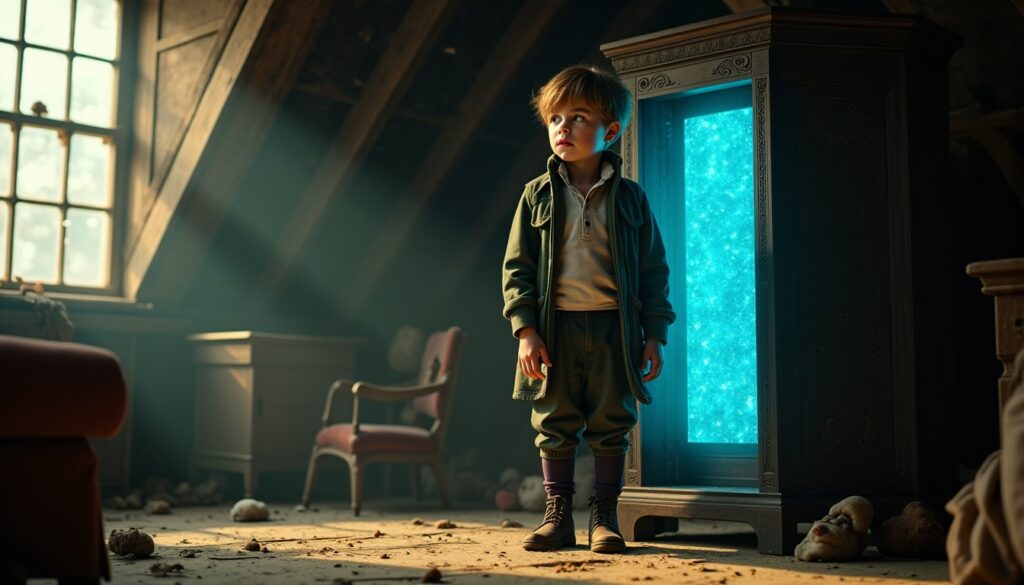
The new film diverges from the previous ones because it adapts another book and tells the birth of Narnia, long before the arrival of the Pevensie children. With The Magician’s Nephew, Greta Gerwig shifts the medieval fantasy narrative towards a parallel worlds adventure, driven by a new visual approach and a different timeline.
This cinematic adaptation therefore does not retell the story of the first Disney film released in 2005. It follows Digory Kirke and Polly Plummer, whose travels take them from London to the Wood Between the Worlds, then to Charn, a world ravaged by Jadis. To understand the differences with the previous films, we can note three reference points:
- The characters change: Digory and Polly replace Peter, Susan, Edmund, and Lucy.
- The kingdom is to be created: Aslan gives life to Narnia instead of welcoming heroes into an already organized country.
- The tone transforms: the passages between realities and the use of Led Zeppelin establish a stranger, more sensory atmosphere.
The project is announced with a budget of around 280 million dollars, IMAX screenings from February 10, 2027, a worldwide theatrical release on February 12, and then a Netflix arrival on April 2. These choices give this new version considerable scale, but its aesthetic difference primarily stems from its story: the film goes back to the origins of the fantastical world rather than retelling the journey through the wardrobe.
The Magician’s Nephew tells the origins of Narnia, not the return of the Pevensies
To gauge the gap with the earlier feature films, we must first look at the starting point of the story. The 2005 film, The Lion, the Witch and the Wardrobe, introduced four London children displaced during the Second World War. By passing through a wardrobe, Lucy discovered an already inhabited Narnia, ruled by Jadis and endowed with its own peoples, landscapes, and legends.
The Magician’s Nephew adapts the novel published by C. S. Lewis in 1955. The plot centers on Digory Kirke and Polly Plummer, two children who encounter Uncle Andrew’s magic rings. These objects allow them to cross boundaries between multiple worlds: the adventure does not just consist in entering a kingdom, but in understanding how still unknown realities function.
The Wood Between the Worlds gives a concrete form to this idea. Instead of a single, familiar passage, the characters discover a transitional space that opens onto different universes. They notably reach Charn, a ruined city associated with Jadis, before taking part in the events that lead to the birth of Narnia. The journey thus multiplies discoveries and changes of atmosphere.
The contrast is visible in the very role of the heroes. The Pevensies entered a story already underway and had to help free a country. Digory and Polly are closer to the beginning: their choices place them at the heart of a founding narrative. Aslan is therefore not just the guide of a resistance; he intervenes in the creation of the world that audiences know from the previous films.
Take the example of a viewer discovering the saga through this feature film. They would not immediately encounter battles for a throne or the armors that marked the 2005 adaptation. Instead, they would follow two children confronted with mysterious passages, a destroyed world, and a reality in the process of forming. This change of scale explains why the images don’t resemble a mere sequel.
Jadis’s role evolves as well. The audience knows the White Witch as the Pevensies’ adversary, but the prequel presents her before this confrontation. The story can therefore show her in a different context and reveal an earlier stage of her history, without replaying the same battle against the children and Narnia’s forces.
Netflix is thus developing an adaptation distinct from Disney and Walden Media productions, with a new creative team for the franchise. To follow the information devoted to the project, we can consult this update on the Narnia Netflix film. The change of characters is not a casting detail: it signals that the chosen story demands a different entry point into this universe.
A new visual approach to show the birth of a world
The previous films could rely on an already established kingdom. They showed castles, armies, inhabited forests, and territories associated with visible traditions. For The Magician’s Nephew, the staging must represent a world beginning to exist: the visual mission is less about illustrating a known geography than making its rules felt as they emerge gradually.
This narrative difference can guide every choice of setting. London, Uncle Andrew’s lab, the Wood Between the Worlds, and Charn do not evoke the same imagination. The British capital offers a daily, almost recognizable setting; the lab introduces experimentation and danger; the Wood opens onto a calm strangeness; the ruins of Charn suggest a vanished civilization. The alternating spaces give the film a richer palette than that of an adventure focused on a single kingdom.
The first images have been described as more psychedelic and more musical than those of earlier productions. This vocabulary does not necessarily mean the film abandons the wonder of C. S. Lewis. It can reflect the perspective of the two children: Digory and Polly do not yet know how to interpret the places they cross, and the viewer shares their progressive discovery.
The Wood Between the Worlds allows imagining a staging based on threshold and repetition. Each access can lead to a different reality, giving the space a crossroads function rather than a simple decor. A passage scene therefore does not have the same value as the wardrobe’s opening in the 2005 film: it raises the question of the number of worlds and the consequences of traveling between them.
Charn provides a necessary counterpoint to this feeling of wonder. The city is destroyed and its history is linked to Jadis; it introduces a darker tone than the green landscapes associated with the familiar Narnia. The film can thus move from curiosity to unease, then to the discovery of a new world. This emotional variation corresponds to the creation narrative, where not everything is immediately welcoming or understandable.
The announced budget, around 280 million dollars, gives an idea of the production’s scale, without alone explaining its style. The spending makes sense if it serves to differentiate the worlds, give spectacular presence to transitions, and build a birth of Narnia that does not look like a mere digital set. The planned use of IMAX theaters reinforces this ambition: a huge space can convey the vertigo of passing between multiple realities.
For us, the new visual approach is therefore linked to the subject before being a gesture of rupture. Kingdom landscapes and battle scenes do not necessarily disappear from Narnia’s imagination; they simply are not the primary language of this story. The film must first make the unknown visible, then show how this unknown becomes a habitable world.
Led Zeppelin and the directorial choices change the tone of Narnia
The difference is not only in the sets: it is also heard. The trailer uses Led Zeppelin’s Stairway to Heaven, a song that does not spontaneously evoke the heroic orchestrations of medieval fantasy. Its broad, progressive movement accompanies the idea of an ascent toward something greater, matching the story of a world being born.
Greta Gerwig met Robert Plant and Jimmy Page to get permission to use the track in the trailer. This choice thus has an artistic dimension, but also a campaign dimension: the song helps distinguish the project from its first images. Instead of reminding the audience of the sound codes of the previous films, it offers a new association between Narnia, discovery, and contemporary musical energy.
A trailer alone does not give the measure of the full film’s soundtrack. It nonetheless reveals a directorial choice: to present the film as an experience of passage rather than an announcement of war. Where majestic brass might have emphasized a kingdom and its knights, Led Zeppelin’s rise insists on movement, mystery, and transformation.
This direction can also help the audience understand the prequel’s status. A foundation story has a different progression than a conquest story. The characters move toward a reality whose contours they still ignore; the music can accompany this ascent without immediately announcing who rules, who fights, and which territory must be saved. The choice of the track thus highlights the difference between discovering a world and defending a known world.
The contrast does not mean that Netflix rejects the qualities of the older films. They established a sound imagination associated with kingdoms, confrontations, and major collective decisions. The new version rather seeks to give identity to another stage of the saga. A well-known song in an unexpected context can express this evolution in a few seconds, without having to explain the chronology to the audience.
We can compare the effect to that of a theme music at the credits: a few notes are enough to orient expectations, even if they do not tell the whole story. Here, the presence of a rock classic suggests a scale and strangeness differing from the traditional orchestral register. The song does not prove that the film will adopt this sound at every scene; it shows that the promotion does not want to reprise the 2005 film’s auditory markers.
This stance must nevertheless remain in service of the story. If the music creates a promise of discovery, the images and the narrative will have to give it meaning: London, the rings, the Wood, and Charn must form a coherent journey, not a succession of astonishing tableaux. The track marks an immediate rupture, while the plot must justify it over time.
To situate this identity in the available announcements, we can also explore the information on this Netflix adaptation of The Magician’s Nephew. The musical tone then opens another directorial question: how far does the film alter the timeline and temporal markers of the novels?
The chronology of Narnia and faithfulness to the novel are reinterpreted
C. S. Lewis’s novel sets its action in London in 1900, long before the Pevensies’ adventures. Information linked to the film mentions a transposition of some elements to the 1950s. If this period is retained in the feature, it will mark a clear gap from the book’s timeline and add another reason why this adaptation should not be confused with the 2005 version.
This modification affects the saga’s temporal coherence. In The Lion, the Witch and the Wardrobe, the war and London bombings explain the Pevensie children’s displacement from the capital. If the origin story shifts to the 1950s, a possible later adaptation of the Pevensie adventures might place their story several decades after this period, rather than within the 1940s timeframe used by the previous films.
We must distinguish here two notions: faithfulness to the plot and faithfulness to the novel’s exact timeline. An adaptation can preserve the essential narrative elements — Digory, Polly, the rings, Charn, Jadis, and Aslan’s creation of Narnia — while modifying historical markers. Such choices influence costumes, everyday objects, architecture, and the way London is depicted.
A simple example helps understand the issue. A telephone, a street, or a domestic interior do not evoke the same era in 1900 and in the 1950s. The chronological shift is thus not limited to a date displayed on screen: it changes the familiar environment from which the children enter the marvelous. It can also bring the universe closer to contemporary viewers’ cultural codes, while distancing it from the historical context described by Lewis.
Narnia’s chronology is not just a timeline because the novels link multiple generations and different worlds. The prequel allows exploring a past until now little represented in cinema, but the connections with already adapted stories remain to be articulated. Available information does not yet precisely establish how Netflix will connect all periods in possible future films.
This caution does not prevent recognizing the choice’s significance. By shifting the era, the creative team can seek continuity specific to its adaptation, rather than reproducing that of the Disney films. The project presents itself as an origin story and not as a direct sequel; it therefore has room to build its own references, even if this freedom must remain clear to viewers.
Faithfulness to the novel is also measured by the themes given importance. The book links children’s curiosity, the consequences of Uncle Andrew’s acts, Jadis’s power, and the creation of a world. If these cause-and-effect relationships remain central to the film, a different era does not necessarily transform the story into an entirely new narrative. The adaptation can shift the temporal setting while preserving the novel’s founding function.
The interesting question is therefore not only whether every detail will be identical to the book. It is about observing how the film will make its era changes compatible with the characters and events leading to other Narnia stories. This timeline choice already influences how Netflix might conceive the saga as a whole.
A new cast and theatrical release designed to revive the saga
The cast confirms that Netflix is starting anew with an incarnation independent from the previous films. David McKenna is announced for the role of Digory Kirke and Beatrice Campbell for Polly Plummer. Daniel Craig is associated with Uncle Andrew’s universe, while Emma Mackey, Meryl Streep, Carey Mulligan, and Ciarán Hinds also appear among the announced names.
The choice of main roles follows the logic of the novel: the focus returns to two children discovering unknown worlds, rather than the four Pevensies already familiar to audiences. The announced adult actors can contribute depth to the figures who trigger or accompany these journeys. This new cast avoids direct continuity with the faces linked to Disney and Walden Media productions.
The announced release gives the project an unusual trajectory for a Netflix production. IMAX screenings are planned from February 10, 2027, followed by a worldwide theatrical release on February 12, and then availability on the platform on April 2. The roughly seven-week gap between the theatrical release and online arrival gives the film a genuine theatrical run.
This schedule accompanies the announced budget of around 280 million dollars. Such a sum signals a production designed to deploy large sets, spectacular transitions, and visually distinct worlds. It does not guarantee artistic success alone, but it highlights the ambition to offer a collective cinema experience before joining the platform’s catalog.
The use of IMAX takes on particular significance for a story built around passages between multiple realities. A large screen can amplify the feeling of depth of the Wood Between the Worlds or the scale of the spaces created by Aslan. Conversely, the London and laboratory scenes can retain a more intimate dimension, allowing the spectacle to rely on the contrast between everyday life and immensity.
For the audience, the release order offers two ways to discover the film: the theater, where the scale of images and sound form a shared experience, then Netflix, which will make the work accessible at home a few weeks later. This strategy also reflects the title’s status: it is not a simple discreet addition to the catalog but an event presented as a major return of the franchise.
The new cast, launch schedule, and production scale converge toward the same goal: building an identifiable version of Narnia, without exactly reusing the codes of the 2000s films. For fans, the most useful reference remains the 1955 novel; for newcomers, the film promises a standalone story where the foundations of the world are discovered before the Pevensies’ adventures.
We can thus understand the differences with the previous films as a coherent consequence of narrative and directorial choices. The characters change because the story goes back to the origins, the sets transform because Narnia must be born onscreen, and the promotion adopts a different musical and cinematic language. This new film does not seek to redo the old journey: it tells what will make it possible.