
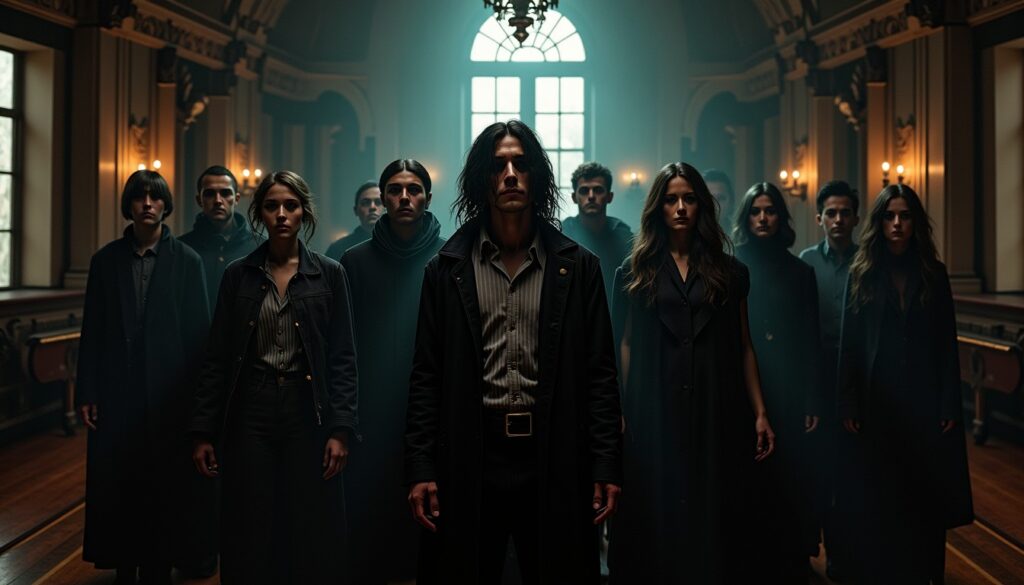
American Horror Story season 13 takes on the airs of an Avengers of horror because it brings together characters and performers associated with several seasons, while keeping its plot under lock and key. Scheduled in the United States for September 24, 2026, on FX and Hulu, this event season bets as much on the memory of fans as on the promise of a new narrative.
Jessica Lange, Sarah Paulson, Evan Peters, Angela Bassett, and Kathy Bates are among the announced names. With 13 episodes of about 30 minutes each, aired over a little more than five weeks, the series created by Ryan Murphy and Brad Falchuk organizes unusual reunions in the horror anthology landscape.
- A reunion of iconic characters associated with several periods of the franchise.
- A tight schedule, with three episodes right on the American launch night.
- A still mysterious plot, despite trailers filled with familiar faces.
To appreciate this reunion without confusing promotional clues and confirmed elements, we can examine the announced returns, the form of the crossover, and the broadcast modalities. It is in the balance between nostalgia and a new story that this season must find its uniqueness.
American Horror Story season 13: a crossover designed as an event
The comparison to the Avengers does not mean that the series adopts the codes of a superhero film. It rather describes the scale of the gathering: figures from different seasons could coexist in the same adventure, where the horror anthology had so far mainly offered distinct stories, renewed each chapter.
This shared universe idea relies on a ground already prepared by the franchise. Seasons like Murder House, Coven, and Apocalypse have established links between certain characters and certain places, giving viewers landmarks that a new crossover can reactivate.
The anthology principle allows each season to change setting, threat, and tone. A haunted house, a group of witches, or a community confronted with collective fear do not tell the same story, even when actors return under new faces.
Season 13 plays on this double expectation. The loyal can recognize a name or a silhouette, while less familiar viewers should still be able to follow a new plot. If the screenplay clearly explains the links between characters, the series’ past will enrich the experience without becoming a mandatory prerequisite.
To gauge the scope of these crossovers, think of a person discovering the season with a passionate close one. They can grasp the worry of a scene without knowing the full story of Constance Langdon, while their close one spots a reference to Murder House. This difference in reading can create a conversation rather than an obstacle.
Ryan Murphy bets on fans’ recognition
Ryan Murphy’s campaign highlights the returns and the meeting between several periods of the series. The Avengers of horror formula reflects the scale of the promotional promise, but the real challenge remains narrative: why do these figures reunite, and what threat makes their presence necessary?
A successful crossover is not limited to lining up appearances. It gives each character a precise function, creates tensions between opposing temperaments, and makes their previous stories a material useful to the plot. A witch, a killer, or a figure linked to a haunted house should not only be there to evoke a recognition effect.
Viewers wishing to review the announcements can consult this overview of the American Horror Story crossover. The promise sums up like this: the past provides the puzzle pieces, but the season must still prove that their assembly produces a coherent story.
Iconic characters and the return of historic actors
The announced cast gives the project its main draw. Jessica Lange, Sarah Paulson, Evan Peters, Angela Bassett, and Kathy Bates are among the performers most associated with the series, and their presence immediately evokes several chapters of its history.
The information communicated associates Jessica Lange with Constance Langdon, Sarah Paulson with several roles including Cordelia Foxx, Evan Peters with Kai Anderson, Angela Bassett with Marie Laveau, and Emma Roberts with Madison Montgomery. John Carroll Lynch is linked to Twisty the Clown, while Rubber Man also appears in promotional elements.
Faces associated with different universes
These returns summon very distant atmospheres. Constance refers to the domestic and unsettling universe of Murder House, Cordelia and Marie Laveau recall the stakes of Coven, while Kai Anderson belongs to the political and paranoiac register of Cult.
Twisty the clown evokes the memory of Freak Show and its marginalized characters. Madison Montgomery, herself, is linked to the world of witches. The variety of these references offers a palette of tones: the story can switch from gothic horror to psychological tension, provided that the transitions are well managed.
The announced list also includes Billie Lourd, Gabourey Sidibe, Frances Conroy, and Leslie Grossman. John Waters, Joey Pollari, Paul Anthony Kelly, Matt Fraser, Mena Suvari, and Berto Colón are also among the names shared, which suggests a group that goes beyond just the most publicized returns.
Recognizing a character does not reveal their role
The promotion does not yet specify the exact role of each in the plot. A return can correspond to a central role, a one-time appearance, or a narrative variation that the released images do not yet allow to explain.
This distinction is important so as not to turn announcements into excessive promises. When a trailer shows a known silhouette, it confirms presence on screen, not necessarily the duration of their role or importance in the story. We can therefore distinguish established facts from fan deductions.
To illustrate this caution, imagine a viewer who sees Rubber Man in a teaser. They might suppose a direct return of the first season’s story, while the scene could rely on visual memory or a new function of the costume. The clues feed expectation, but do not replace the narrative.
This cast also allows comparison of the ways performers act over the seasons. Sarah Paulson has already portrayed contrasting characters, and the possibility of seeing her in several roles gives the season a dimension of performance as much as continuity.
To position the announcements and characters, we can browse the page dedicated to American Horror Story season 13. The cast constitutes a strong promise, but its value will depend on how each presence serves the story rather than mere nostalgia.
A mysterious trailer that fuels theories
The first full trailer was revealed on September 10, 2026. It favors recognizable faces and the feeling of a large gathering, without delivering a detailed synopsis on the central threat nor on the mechanism that will bring the characters together.
The promotional formula “Welcome to the greatest show on Earth” accompanies this campaign, along with several teasers, including The Grand Unveiling. The choice is telling: show enough to awaken curiosity, while leaving the narrative links in the shadows.
Visual clues rather than a user manual
In a series that builds its seasons around places and strong atmospheres, an image can contain multiple layers of reading. A familiar setting recalls a past season; a hairstyle or a costume can identify a character; a quick cut in editing can suggest a meeting without specifying if it takes place in the same space or at the same time.
This restraint can make online discussions particularly lively. If a teaser shows several figures in a few seconds, fans can confront their memories and propose leads. But a promotional montage is not a complete chronology: it sometimes assembles shots to produce an impression, not to faithfully describe the unfolding of an episode.
The horror crossover format further increases this expectation. Every return raises a question: does the character keep their original story? Are the seasons connected by an event, a place, or a common threat? The campaign does not yet provide a definitive answer, and it is better to treat these questions as hypotheses.
Why keeping the plot under wraps can serve the series
Too early a revelation could reduce the pleasure of discovering alliances and conflicts. By keeping the general framework discreet, the promotion leaves the first episode the task of setting the rules and giving meaning to the reunions.
This strategy also carries a risk. If the teasers focus almost exclusively on the returns, some viewers might expect a succession of winks rather than a standalone plot. The season will therefore need to quickly offer an identifiable stake, with a sufficiently solid threat to justify the gathering.
We can compare this to an investigation where witnesses each know a fragment of the case. The audience recognizes the names but waits to know why their paths cross now. It is the answer to this question that will turn recognition into real suspense.
The best way to follow the campaign is to separate three levels: the explicitly announced names and characters, the images really visible in the teasers, then the viewers’ interpretations. This sorting avoids taking a popular theory for confirmed information.
The trailer therefore confirms a direction, not all the rules of the story. As episodes arrive, the audience will be able to verify whether the scattered clues form a common story or primarily serve to set the atmosphere.
Broadcast schedule: 13 episodes in a little over five weeks
In the United States, American Horror Story: 13 is set to start Thursday, September 24, 2026, at 9 p.m. on FX and Hulu. The season has 13 episodes of about 30 minutes, with a particularly dense premiere night: the first three chapters are announced on the same day.
This organization changes the pace of discovery. Instead of waiting a whole week between each episode from the start, viewers will be able to quickly judge the setup of the plot, its atmosphere, and the way it establishes the reunions.
The announced American schedule
| Date | Episodes | Broadcast pace |
|---|---|---|
| September 24, 2026 | 1 to 3 | Three episodes for the launch |
| October 1, 2026 | 4 to 6 | Second batch of three episodes |
| October 8, 2026 | 7 and 8 | Two episodes |
| October 15, 2026 | 9 and 10 | Two episodes |
| October 22, 2026 | 11 and 12 | Two episodes |
| October 29, 2026 | 13 | Final episode aired alone |
The first six episodes become available within a week, since the first two batches arrive seven days apart. Then the broadcast continues in blocks of two episodes before a finale scheduled on October 29, near Halloween.
A more concentrated viewing, but not entirely without waiting
This schedule may encourage different habits. A group of friends could watch three episodes at launch, then meet every Thursday to follow the new revelations. Another person might prefer to wait for the full release before starting: the format remains compact enough to allow close viewing.
Episodes lasting about 30 minutes make each batch accessible, but brevity does not mean the narrative pace will necessarily be fast. A scene can establish a character or an atmosphere with few dialogues, and the density of revelations will depend on the plot as much as the indicated duration.
This grouped broadcast also has a practical consequence for fans: discussions and theories are likely to evolve quickly from the first days. To avoid spoilers, it may be useful to cut notifications related to the series or to specify to close ones how far one has gotten.
The October 29 finale may strengthen the link between the season and the Halloween period, without that proximity alone guaranteeing a spectacular conclusion. The schedule is a broadcasting framework; it is the dramatic resolution that will determine if the thirteen episodes form a satisfying whole.
By concentrating the broadcast over a little more than five weeks, FX sets the season as a sustained autumn appointment. The format favors exchanges between episodes but leaves the essential task to the writing to maintain a clear progression.
Disney+, local availability, and viewers’ expectations
In the United States, the broadcast is announced on FX and Hulu from September 24, 2026. Internationally, the season is expected to join Disney+ depending on territories, with dates that may vary according to local schedules.
In the United Kingdom, the first three episodes are planned for September 25, then releases are expected to follow a one-day lag compared to the American schedule. The thirteenth episode is announced there for October 30. For France, it is necessary to wait for local Disney+ information rather than automatically deduce the British dates.
Check dates before planning your viewing
International releases do not always follow a single rule. A platform may offer several episodes at launch in one country but adopt a different date in another, depending on its programming and territorial agreements.
If you follow the series from France, the most reliable reflex is to consult the platform’s page and its local announcements as the release approaches. This avoids planning a night around an American date that would not correspond to French availability.
Schedule gaps can also expose viewers to spoilers before they have access to episodes. An online search about a character might display a title or image revealing a twist. During release periods, keyword filters and careful browsing of social networks can preserve the joy of discovery.
An event season, not an officially announced farewell
Available information presents this thirteenth season as a grand gathering, sometimes as a franchise anniversary event. They do not describe it as the official end of the series, and no season 14 is confirmed in the provided elements.
It is therefore preferable to distinguish the importance of the event from its status in the program’s future. An exceptional cast and a focus on historic characters can give this season a special character without constituting a farewell announcement.
For enthusiasts, the central question will be how the season balances three pleasures: finding familiar performers, understanding the links between their characters, and discovering a story that can stand on its own. If a new viewer can follow the action while a regular spots echoes of past seasons, the shared universe will have found its right measure.
The first block of three episodes should provide the necessary landmarks: tone, stakes, characters’ place, and degree of dependence on previous seasons. Viewers will then be able to judge if the reunions serve a real story or rest mainly on the pleasure of seeing beloved figures again.
The strongest promise of this season thus remains a meeting between memory and novelty. For the Avengers of horror to convince, each return must enrich the present narrative, and not just recall the nightmares that came before.