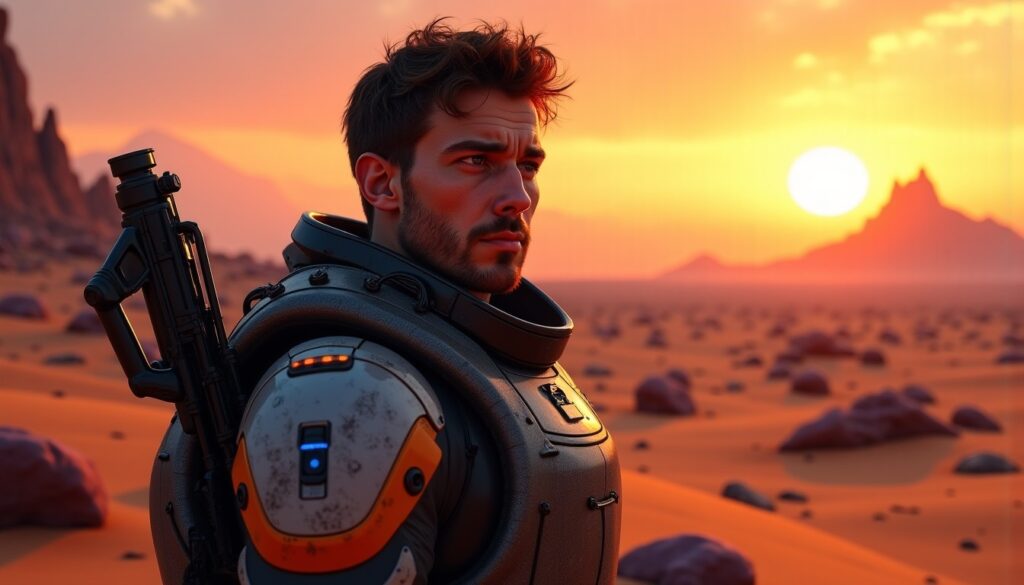
StarCraft Dominion is announced as a narrative open-world shooter game, where we will be able to create a character, explore the Koprulu sector, and follow a story designed to conclude. Blizzard presented it at BlizzCon on September 12, 2026, with a release planned for 2030, without yet unveiling any gameplay footage.
The project shifts perspective but retains the ambition to tell an adventure within the StarCraft science fiction universe. To understand what this announcement really allows us to expect, we can highlight three points:
- A standalone campaign, designed around a story with a beginning, development, and an end.
- Two gameplay rhythms, between structured missions and free exploration.
- Many unknowns, particularly regarding intense combat, the camera, platforms, and multiplayer.
The available information thus outlines a direction, not yet a full demonstration of the game. Here is what this orientation could mean for players and what must be awaited before judging the result.
StarCraft Dominion: an open-world shooter that changes the perspective
With StarCraft Dominion, Blizzard moves a franchise known for top-down military strategy towards an open-world shooter. The change is major: instead of commanding squads by observing a map, we would follow a character at the heart of the events. The confrontations and narrative choices could thus be lived at soldier-level rather than at the scale of an army.
This evolution does not mean that StarCraft abandons everything that built its identity. The Terrans, Zergs, and Protoss remain announced as components of the project, while the political and military conflicts of the Koprulu sector form a naturally suitable ground for an action adventure. The question is rather how the team will translate the rivalries between interstellar factions into situations we can directly experience.
Blizzard announced the game during the BlizzCon opening ceremony on September 12, 2026, and aims for a 2030 release. This timeline allows several years for development, but the concrete elements revealed remain limited: no specific platform, release date, gameplay demonstration, or progression mechanics have been communicated. The presentations mention a shooter, sometimes a FPS, without confirming that the first-person view will be the sole perspective.
This caution helps distinguish facts from expectations. The term “open world” alone does not imply a gigantic map, vehicles, outposts, or endless activities. Likewise, the mention of intense combat does not yet indicate if the game will favor tactical duels, large-scale battles, or more scripted confrontations.
One can imagine a Terran recruit tasked with crossing a disputed zone to reach a decisive mission. In a real-time strategy game, this situation might be solved by moving units and managing resources; in a shooter, it could be embodied through movement, equipment choice, and terrain reading. This is an illustration of the format’s potential, not a confirmed mechanic.
The genre shift thus draws attention, but the central promise also lies in the storytelling approach. Blizzard presents the project as a complete adventure, a choice that could give a unique identity to this new chapter rather than simply reproducing historical campaigns with a closer camera.
A complete story with a player-created character
The narrative is one of the most distinctive announced elements for StarCraft Dominion. Dan Hay, creative director and General Manager of the project, describes it as a “box product”: an experience that we buy, play through, and can finish. The expression highlights a game designed as a complete work, rather than a narrative service whose story would necessarily stretch across successive seasons.
The player will be able to create and name their character, who will occupy the center of the adventure. This customization could strengthen the connection to the storyline: we would not only follow decisions of already established heroes but also give an identity to the person plunged into the events. The creation possibilities remain unknown; nothing currently confirms detailed physical customization, distinct classes, or choices that would alter the plot.
The promise of a beginning, middle, and end provides a simple benchmark. A plot can progress towards a resolution without requiring the audience to wait for a next season to learn its outcome. For players who prefer spending a few dozen hours on a bounded adventure rather than returning every week, this structure has real value: it gives a clear objective and respects the time invested.
StarCraft campaigns have already given significant importance to characters, from Brood War to the three StarCraft 2 installments. The transition to shooting should therefore not force the team to reduce the universe to a succession of targets. A mission can advance a conflict while showing its human consequences: the fate of a colony, the loyalty of a crew, or a soldier’s dilemmas caught between conflicting orders.
This direction differs from productions that extend their narrative through regular updates. The game is not presented as seasonal in its current conception, according to Dan Hay. The formula describes an intention without guaranteeing that the title will never receive additional content after launch.
This distinction matters to avoid hasty conclusions. Blizzard has not detailed the possible presence of expansions, updates, in-app purchases, or a permanent connection. Nothing allows affirming that the game will be strictly solo either. We only know the main story is conceived as a standalone experience, not as a first step whose ending would depend on a content calendar.
Paul Lee, senior producer, cited Lies of P, Stellar Blade, and Crimson Desert as examples of standalone games able to reach an international audience. These references illustrate an editorial path, not confirmed mechanical inspirations. For StarCraft Dominion, the challenge will be to coexist player freedom with a plot strong enough to lead naturally to its conclusion.
Free exploration, dynamic missions, and adventure pacing
The open world should complement narrative missions, not replace them. Dan Hay mentions two game spaces with different functions: structured sequences that advance the story, then a freer zone where we can explore at our own pace. His comparison between a swimming pool and a hot tub highlights the idea of distinct spaces, accessible according to desire, rather than a single imposed path from start to finish.
In practice, this organization could alternate between a scripted operation and discovery time. After a mission that shifts a front, we might traverse a region, observe traces of conflict, or meet secondary characters before resuming the main thread. This example shows one possible way to link locations and story, without confirming the presence of side quests or random events.
The term free exploration arouses specific expectations: what can be done between two missions? An open map becomes interesting when its locations have a function, a story, or an effect on our progression. An empty valley crossed only to lengthen the journey would be less convincing than an outpost where a faction tries to maintain control, provided the game really gives us the means to intervene.
The communicated information does not specify map size, number of regions, or secondary activities. We also do not know if spaceships will be piloted, if terrestrial vehicles will allow crossing long distances, or if progression will rely on weapons, skills, or equipment upgrades. These elements will determine the pace as much as the size of the environment.
The term dynamic missions may describe an expectation but should not be treated as an announced feature. No precision confirms objectives that change according to our actions, procedural generation, or spontaneously triggered fights. At this stage, it is more accurate to speak of structured missions and an exploration space whose rules remain to be revealed.
To evaluate the coherence of this world, we will be able to observe several criteria when Blizzard shows gameplay. Transitions between exploration and scenario must be seamless; movements must serve discovery; and optional activities must enrich the adventure rather than turn into repetitive tasks. A vast map is not automatically a living map.
This separation between story and freedom could also avoid an obligatory daily cadence. If we can explore as we wish, then return to main objectives when we want, the open world becomes a pacing tool rather than a list of chores. The quality of this articulation will weigh as much as the quantity of accessible kilometers.
| Announced or expected element | What we know | What remains to be clarified |
|---|---|---|
| Campaign | A story designed with an end | Duration, branches, and replayability |
| Exploration | A free zone distinct from missions | Size, activities, and regions |
| Combat | A shooter set in the StarCraft universe | Camera, arsenal, and feel |
| Post-launch support | Design announced as non-seasonal | Expansions, updates, and business model |
The open world will be convincing if it serves both curiosity and story progression, without asking the player to confuse freedom with activity accumulation.
A new chapter in the Koprulu sector, 70 years after Legacy of the Void
StarCraft Dominion’s action would be set about 70 years after the events of StarCraft 2: Legacy of the Void. This distance gives Blizzard considerable narrative leeway: the team can introduce new characters and new political balances without having to immediately revisit every conflict left unresolved by previous episodes.
The Koprulu sector remains the general setting, and the Terrans, Zergs, and Protoss are announced as stakeholders in the project. Their precise importance is unknown. We do not know which factions will be playable, if one will dominate the story, or if the player-created character can join different groups over the course of the adventure.
A seven-decade gap can transform a familiar conflict into a historical legacy. A colony founded after a war, a shifted frontier, or technology once experimental becoming commonplace could tell the passage of time without imposing a long explanation. Veterans would recognize major saga milestones, while newcomers might discover a universe already structured but with a new entry point.
Interstellar factions are particularly suited to an adventure experienced on the ground, as their interests may intersect on the scale of the same region. A contested territory can illustrate the tension between strategic objectives of a command and the consequences for inhabitants. Such an approach would give depth to StarCraft’s military strategy, even if the player no longer directly commands an army via a tactical interface.
Dan Hay brings to the project his experience from the Far Cry series. This makes understandable the interest in an open environment alternating movement freedom and mission sequences, without allowing to assert that StarCraft Dominion will reuse specific systems from that franchise. A creator’s experience informs about the types of challenges he knows; it does not reveal alone the game’s final form.
The challenge will be to preserve StarCraft’s epic scale while giving importance to a single character. A campaign can show an interstellar confrontation through its local effects: a remote base lacking supplies, a bad evacuation, or civilians caught between rival forces. This scale change can make the universe more tangible without erasing military stakes.
Spaceships could offer natural links between regions and operations, but their presence as a means of transport has not been confirmed. The same goes for space combat or piloting sequences. Considering them as given would risk creating expectations not yet established by the announcement.
For long-time fans, the time jump is thus a promise of renewal rather than a guarantee of detailed continuity. The project retains the major species and the Koprulu setting, while opening a still little-explored period of its history.
Intense combat and player expectations facing the standalone model
The choice of a standalone adventure fits into a sector where sci-fi shooter games have followed very different trajectories. A futuristic world can provide planets, weapons, and varied enemies but these resources do not guarantee an audience will return for years. Loyalty also depends on the quality of fights, clarity of progression, and confidence in the economic model.
Anthem, released in February 2019, was to rely on extended progression. Its major overhaul, known as Anthem Next, was abandoned, then game support ended. Concord had a quicker trajectory: launched in August 2024, the game was removed from the market about two weeks later, prior to the announcement of Firewalk Studios’ closure by Sony.
These examples do not prove that long-term supported games are doomed. They show that a service model requires a sufficient audience, regular content, and systems that give a desire to return. In 2026, Marathon’s situation, the extraction shooter developed by Bungie, remains marked by difficulties and uncertainties whose final effects are not yet established.
StarCraft Dominion displays another priority: delivering a complete story. If this promise translates into the game, the audience will not necessarily depend on a rewards schedule to reach the story’s end. We will be able to judge the campaign on its progression, combat, and the way it uses the universe, rather than on the amount of content added month after month.
This direction does not automatically exclude multiplayer, expansions, or updates. Blizzard has provided no definitive answers on these points. The formula “non-seasonal in its current design” should therefore be understood as a stated orientation, not an exhaustive guarantee about the entire commercial life of the title.
Players’ expectations will likely focus on very concrete elements as soon as the first gameplay sequences become available: weapon accuracy, enemy variety, clarity of confrontations, and the role given to tactics. A fight against a Zerg opponent, for example, might require a different approach from a confrontation against a Terran squad equipped. This diversity is a possibility linked to the universe, not a confirmed feature.
Price, platforms, campaign length, presence of a cooperative mode, and monetization terms remain to be discovered. With a planned 2030 release, the team still has time to clarify its proposal, and the project can evolve. The current information mainly allows to discern an ambition: to make the open world the setting for an adventure rather than an obligation for permanent connection.
For now, we can therefore expect a narrative shooter focused on a customizable character, missions, and an exploration zone, within the familiar StarCraft framework. The decisive demonstration will be the one showing how these promises translate controller in hand: that is where the project will be able to convince beyond its genre shift.