
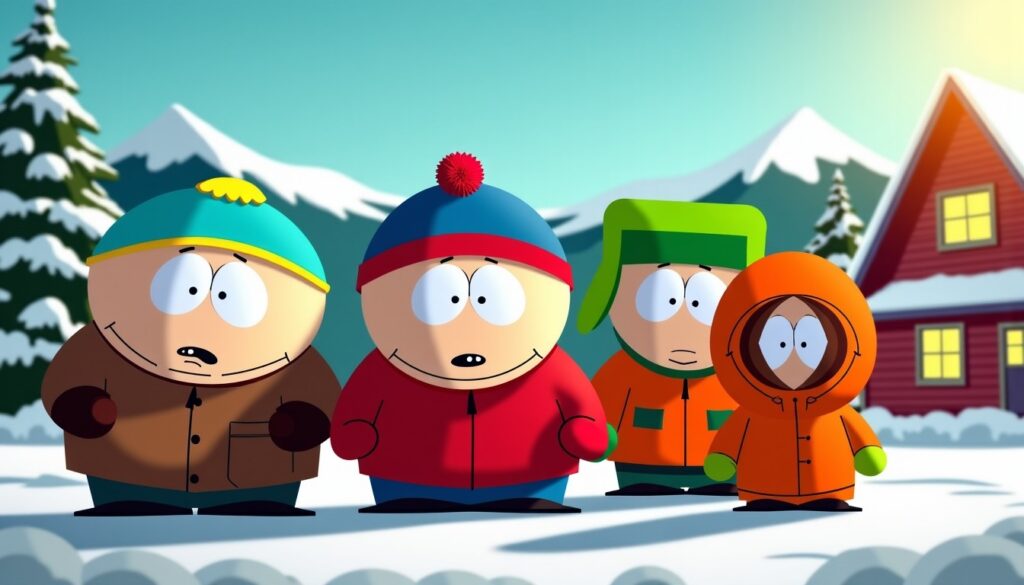
The famous TV series South Park is about to mark a major turning point by officially adopting a new name: South America. This change comes on the eve of the release of its new season, scheduled for September 16, 2026, on Comedy Central. This singular decision, announced in early September by creators Trey Parker and Matt Stone, fits into a satirical approach targeting the contemporary politics of geographic renaming and aligns with the corrosive and provocative humor that made the animated series famous.
Here is what we will cover in this article to fully grasp the stakes:
- The genesis and scope of the name change linked to recent political news, notably the initiatives of Donald Trump.
- The concrete aspects of this renaming for the series, from the logo to social media.
- The context of a 29th season that continues the satirical line of previous seasons.
- Public reactions and the major technology companies indirectly involved in this approach.
- The potential impact on the image and longevity of this iconic animated comedy.
Let’s discover together why and how South Park becomes South America, and what it means for fans and the audiovisual industry.
The political and satirical reasons behind the transition from South Park to South America
The name change from South Park to South America directly responds to a well-marked political news in 2025 and 2026, illustrating the series’ ability to transform current events into raw material for biting satire. To understand why this renaming was decided, one must revisit the controversial decisions taken by Donald Trump’s administration regarding geographic names.
Starting January 2025, an executive order required the name Gulf of Mexico to be replaced by Gulf of America in all usages by the U.S. federal government. Shortly after, in August 2026, another official decree turned Lake Ontario into Lake America, amid trade tensions between the United States and Canada. The term New America also circulated as a replacement for New Mexico, without this renaming being officially legally validated.
These changes, although administrative, quickly sparked controversy and also found a form of translation in digital mapping services. For example, Apple Maps and Google Maps integrated these new names for their American users, while other platforms remained loyal to the old naming.
In this context, Trey Parker and Matt Stone chose to rename their series drawing inspiration from this trend of patriotic and absurd escalation, twisting it with their particular humor. Their ironic message thus congratulates the “courage and patriotism” of tech giants like Apple and Google, but also their parent company Paramount, criticized in the same breath by the expression “Skydance Capitulation.”
This official announcement on September 8, 2026, can be viewed as a satirical reaction to these forced renaming practices. The parallel between geographic transformations and the series becomes clear: Gulf of Mexico becomes Gulf of America, Lake Ontario becomes Lake America, South Park becomes South America.
Beyond a simple joke, this shift illustrates the show’s ability to comment on American political current events incisively and intelligently, while laying the groundwork for a 29th season that promises to address these issues in a renewed and daring manner.
The practical implications of the new name South America for the TV series and its distribution
Adopting a new name such as South America is not limited to changing a simple label. The series, having become a classic of animated comedy for nearly 30 years, undergoes visible transformation across several platforms and points of interaction with the audience.
On the digital side, the official series accounts have already adopted the new identity. For example, the X (formerly Twitter) and Instagram pages now display “South America” in their logos and visual content. This shift therefore has a concrete and immediate effect that goes beyond the sphere of a simple humorous press release. However, the X handle remains @southpark, allowing symbolic and historical continuity.
Regarding broadcast, season 29 will begin under this new label. The first episode will air on September 16 at 10 p.m. (ET/PT) on Comedy Central and will also be available on Paramount+ the next day in several countries, demonstrating the global scope of this renaming operation. The episode schedule extends until late November, providing comfortable time for the name change to settle in viewers’ minds.
Remaining questions concern on-screen presentation: the opening credits, the official logo during episodes, and not forgetting the famous fictional town. It remains to be seen whether this universe will persist under the name South America or whether we will witness wink references to this renaming, which has so far been kept partially secret.
In a table, here are the notable transformations for the airing of the new season and the name change:
| Elements | Before September 16, 2026 | After September 16, 2026 |
|---|---|---|
| Official name | South Park | South America |
| Social media | Historic name and logo | Logo and visuals adapted to the new name |
| TV broadcast | Comedy Central – South Park | Comedy Central – South America |
| Streaming availability | Classic Paramount+ | Paramount+ with South America branding |
This strategic rollout is an example of the creators’ marketing and narrative ability, who remain faithful to their style while innovating in how they approach communication around their content.
How South Park’s satire integrates into American current events and politics
With its 29th season under the banner of South America, the series remains more than ever rooted in American political satire, a domain in which it has excelled since its creation. By addressing Donald Trump’s plans for renaming territories and government projects, Trey Parker and Matt Stone continue a often sharp but also very nuanced social critique.
Seasons 27 and 28 had already featured the character of Donald Trump in a particularly explicit way, oscillating between caricature and denunciation. The series’ new identity confirms this trend, accentuating the mocking and provocative aspect to challenge both viewers and decision-makers.
By directly citing Apple, Google, Paramount, and Skydance in their statement, the creators also highlight the influence of large technology and industrial companies in public debate, as well as their sometimes ambiguous relationships with political powers. This dynamic fits perfectly in contemporary satire which no longer limits itself to politicians alone but encompasses all system actors.
The tone of this change cannot be apprehended without understanding the corrosive humor that is South Park’s strength: a mix of irony, provocation, and often deliberate exaggeration. The creators know how to play with ambiguity, leaving the audience in suspense about the exact scope of the renaming—a classic element in their way of blurring lines between fiction and reality.
This paradox is also found in the digital handling of the name. While social platforms change their skin, the maintenance of the @southpark tag shows caution mixed with a form of homage to the past, but also a form of inside humor. This gives fans a double layer of interpretation and creates space for multiple readings, which will surely fuel upcoming discussions.
Public reactions and the impact of major tech groups on the name change
Reactions to this renaming were quick to be heard. For the most loyal fans, this event is a landmark moment that rekindles interest in the series and its ability to remain at the forefront of satire. Many recognize here the creators’ typical signature, mixing boldness and relevance.
On the corporate side, Apple and Google were highlighted in the statement for their role in the actual adoption of the modified geographic names. This raises questions about the share these tech companies hold in spreading government decisions and how they influence public perception. Several map service users noticed these changes, fueling online conversations and debates.
The rapprochement between Paramount and Skydance, mentioned by the authors in satirical form as “Skydance Capitulation,” also illustrates the tension in creative industries regarding the influence of large groups on cultural content. With a takeover deal estimated at $111 billion approved by the Trump administration, the series subtly denounces a form of compromise between creativity and business.
This renaming operation, accompanied by an intelligent communication campaign, shows how a comedy show can continue to influence cultural and political debate while riding the new digital platforms.
- Fans appreciate the continuity and the ability to renew humor.
- Social network debates on the role of companies in politics stimulate reflection on media power.
- The launch of season 29 in September will create a new moment of gathering and discussions around the series.
- Critics highlight the strength of the satirical message combined with innovative technological support.
- South America could become a modern symbol at the crossroads of humor, politics, and digital.
Perspectives for South America: identity, humor, and future of the animated series
We are entering a new era for this flagship animated comedy program. The adoption of South America opens several paths for how the series might evolve, both narratively and in marketing terms.
This name change is far from trivial as it occurs just before the thirtieth anniversary of the series, a strategic moment to make an impact. It testifies to the creators’ clear will not to settle for a mere repetition but to pursue a constant dynamic of questioning and critique of current events.
The maintenance of sharp humor, capable of crossing the boundaries of simple entertainment, should thus continue, as well as the commitment to address sensitive social themes boldly. Fans can expect a 29th season rich in biting parodies, notably around political and technological themes that inspired this renaming.
It is likely that the series will also explore on screen the symbol of renaming, relying on rumors, speculations, and controversies surrounding it, which will bring a renewal of the fictional and narrative setting.
For pop culture enthusiasts, the anticipation is high, supported by a communication campaign that already polarizes attention. This renaming episode is a clear demonstration that the series remains a major player in the world of satirical TV shows.
If you want to understand the impact of major franchises on different cultural universes, the Kenny quests in Fortnite provide an interesting example of this gaming-culture intertwining, similar to the link the series constantly maintains with its times. Furthermore, the recent crossover between Fortnite and Game of Thrones shows how differently popular universes merge to capture new audiences, a phenomenon that South America could also exploit in its future.