
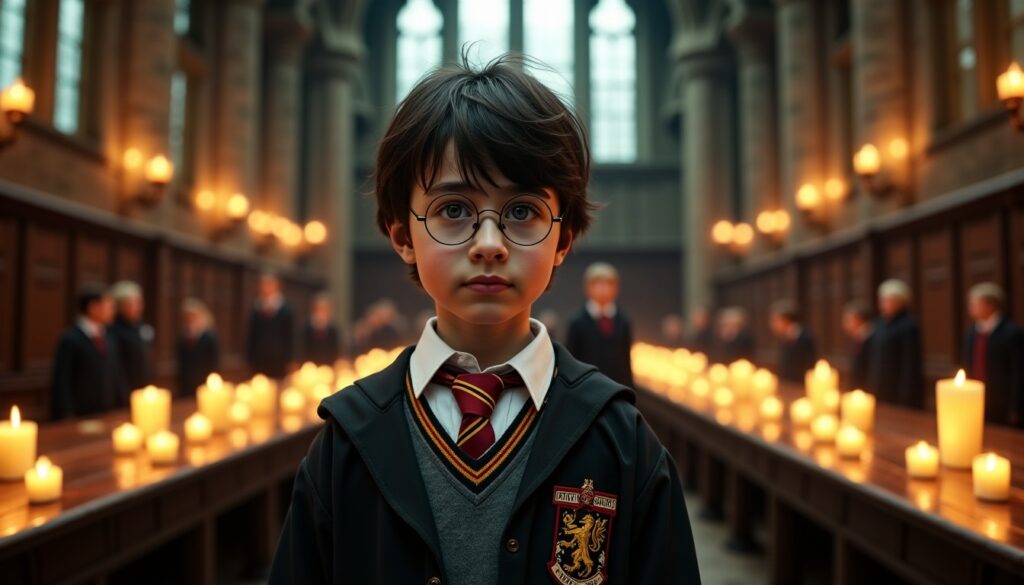
The upcoming Harry Potter television series Hogwarts School of Witchcraft and Wizardry produced by HBO promises to be a faithful and in-depth adaptation of J.K. Rowling’s novels, aiming to go far beyond the films we know. Three major pillars structure this new approach:
- A complete development of the plot and characters through a whole season dedicated to each book.
- The reintroduction and deepening of secondary elements, often absent from the films, to strengthen the magical universe and daily life at Hogwarts.
- A new aesthetic and an original cast aiming to bring the magic back to life while respecting the legacy of previous adaptations.
These key points carry the hope for a richer, more faithful, and above all longer immersion in the world of the young wizards. We will explore in the following sections how this series will manage to combine respect for the novels and narrative demands on the small screen, what changes compared to the feature films, the importance of lesser-known secondary characters, and how HBO is building a work that is both new and nostalgic.
A faithful and detailed adaptation: how HBO unfolds the full magic of the novels
Unlike the cinema format, limited to two to three hours per film, the Harry Potter series at Hogwarts School of Witchcraft and Wizardry that HBO is preparing promises an exhaustive immersion in the original text by J.K. Rowling. The choice of one season per book allows the story to extend over about eight episodes, each lasting about an hour. This substantial time offers a new breadth:
- Classes and daily life at Hogwarts will be fully explored, providing a more complete vision of the magical setting, from Quidditch to meals, including professors and their personalities.
- Secondary plots will be developed without being sacrificed in favor of the main action, such as the rivalry between students or details about the Weasley family.
- The psychological development of the heroes, notably Harry, Ron, and Hermione, will be able to rely on their inner thoughts and evolving relationships, often simplified in the films.
The series will not only aim to present a succession of iconic events but will seek to convey the breath and richness of the novel. Thus, each day of a school year will be felt, not rushed. For example, the appearance of unpredictable staircases, the routine of homework, festive meals in the Great Hall, or the arrangement of dormitories can be extended into meaningful scenes.
With a long format, the audience discovers a living Hogwarts, not frozen. It is a challenge for HBO to avoid artificially stretching the story while finding the right rhythm to balance major plots and moments of daily life. The challenge is crucial because the rush of the films had forced the cutting of entire passages, suddenly rendered useless or silent.
The promised fidelity is not a simple copy-paste but a respectful and committed rereading. In this regard, one can consult the anticipations on the site Gamers Land, which details the hopes and promises of this adaptation. The series, at the end of 2026, should breathe new life into the magical universe for both nostalgics and newcomers.
More than images: differentiating the book from the film in the new Harry Potter series on HBO
The transition from novel to cinema format imposes strong constraints in terms of narration and structure, which HBO counters with its series. Compared to this, the Harry Potter films at Hogwarts, while efficient, compressed the text into a direct and fluid story, without being able to fully deploy the richness of the context.
With one book per season, the series gives itself the means to:
- Reclaim minor but significant scenes, such as quiet moments between students or details about professors, absent or condensed in the film.
- Fully exploit dialogues and inner thoughts, which on paper work through mastering reading rhythm, but on screen must be translated into dynamic scenes.
- Give an increased face and role to characters like Charlie Weasley, whose presence in the novels enriches the family but was almost nonexistent in the films.
- Create a more immersive atmosphere with the reconstruction of corridors, moving staircases, and classes at Hogwarts, elements that contribute to the authenticity of the setting.
The challenge is great: a meticulous adaptation can quickly drown the plot in a surplus of superfluous details, while excessive simplification distorts the story. HBO has committed not to fall into the trap of a tedious word-for-word, nor into a too loose version that betrays the spirit of the saga.
Viewers expect a series where tensions and rivalries between students take the time to be exposed, where a Transfiguration class can unfold, and where each room in the castle lives to the rhythm of magic and human interactions. This patient work will be decisive to respect the balance between fantastic narration and the realism of emotions, different from the less deep dynamic of the films. Precise analyses of the episodes will show whether the production succeeded in better telling the magic in 2027.
Secondary characters and magical details: the regained richness thanks to HBO
One of the strong promises of this new series, according to available information, is to reintegrate elements forgotten by the films, such as the poltergeist Peeves or the dragonologist Charlie Weasley. These more modest figures in the story have a fundamental role in creating a living and coherent universe.
Peeves, for example, embodies the disorder and anarchic humor that characterize life at Hogwarts but was excluded from the film adaptations for reasons of pacing and narration. His presence could reveal:
- Student resistance to authority and rules, an essential facet of wizarding school life.
- Comical and original moments, avoiding an overly dramatic or institutional atmosphere.
- A figure reminding that the castle is a magical and unpredictable place, beyond complete control.
Charlie Weasley, for his part, broadens the family dynamic beyond Ron, enriching the family plot and adding subplots linked to dragons. This kind of approach is useful because it creates real depth in the world beyond the main trio.
The series will also be an opportunity to restore details that forge familiarity with Hogwarts: the moving staircases, ghosts, professors with their precise habits, not to mention small nuances like culinary customs in the Great Hall. All these details help recreate a universe where magic is part of everyday life, far from spectacular simplifications.
A television series has the necessary duration to unfold these little details that make a universe come alive and paint a more faithful portrait of what readers expected after the films. If you want to discover what magic truly means at Hogwarts beyond action scenes, this series is a must-watch. You can also check discussions around the possible return of Peeves to better gauge his impact.
The renewed cast and new visual identity: breathing life back into the magical universe
The choice of a new trio of actors to embody Harry, Hermione, and Ron reflects HBO’s desire not to reproduce the aesthetic already well established by the films, but rather to propose a reading closer to the descriptions in the novels. Dominic McLaughlin (Harry), Arabella Stanton (Hermione), and Alastair Stout (Ron) bring fresh energy and allow moving away from direct comparisons with Daniel Radcliffe, Emma Watson, and Rupert Grint.
This new team portrays characters with subtle nuances:
- A less caricatural Ron, with his flaws, fears, and complexity.
- A brilliant but imperfect Hermione, who also shows impatience and mistakes.
- A Harry who is both courageous and vulnerable, closer to the adolescent fragility described in the novels.
Visually, the series seems to take a path less saturated with excessive special effects, preferring atmosphere and set detail to underline the magic. This authentic reconstruction of Hogwarts aims to offer the viewer an immersion where magic is an integral part of everyday life, not a permanent spectacle.
Chris Columbus, director of the first films, had expressed his reservations by reminding that he had already given his cinematic vision – a vision that this series will have to surpass without limiting itself to a mere visual repetition. To follow production news and its schedule, it is useful to regularly consult the page dedicated to Harry Potter HBO Max.
An appointment in 2027 for a new breath in the Harry Potter universe
The series launch is now set for 2027 on HBO Max, giving fans and newcomers enough time to await a carefully crafted production. Beyond fidelity to the book, this time window will allow the production to apply lessons learned from previous adaptations and build a universe that offers a more natural pace over time.
The series must convey the progression of a full year at Hogwarts, with its evolutions, joys, conflicts, and mysteries. The challenge lies in the ability to make every modest moment live, from the arrival at the Dursleys to the final confrontation over the Philosopher’s Stone.
The audience also hopes that the spirit of the novel will be translated through richer narrative arcs, where secondary characters will have an enhanced role, thus bringing more density to the magical universe.
The development will not escape economic and artistic stakes: the series is announced as one of the most ambitious and expensive in HBO’s history. The decisions made to preserve the magic and atmosphere of the book while appealing to a broad audience will mark the success or failure of this enterprise.
To follow all evolutions and comparisons between literary and television adaptation, the site Gamers Land remains a valuable source of information and critical analyses on the series still in preparation.