
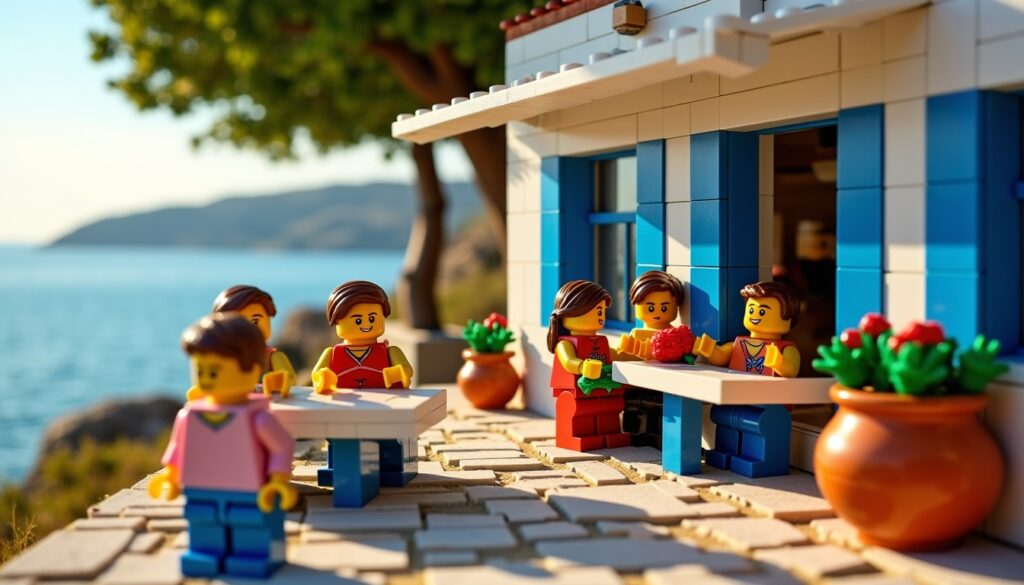
The LEGO collection “Restaurants Around the Globe” captivates with its imaginative exploration of international cuisines and cultures, embodied by miniature restaurant models. After a first visual journey to Japan with a sushi restaurant, then a colorful stopover in Mexico centered around a taqueria, the series might soon set its sights on Greece. Here’s what we know about this potential new Mediterranean stop:
- A promising mini-set evoking a traditional seaside Greek taverna.
- A summery atmosphere marked by iconic colors and Greek cultural symbols.
- A promotional operation following the line of previous offers reserved for LEGO Insiders members.
- An insight into the creative challenges linked to representing an international cuisine through LEGO bricks.
This article details the series’ history, analyzes the characteristics of the leaked Greek set, compares the models from each country, examines its commercial potential, and immerses you in the unique world of LEGO miniature restaurants. Let’s get ready, together, to discover how Greece could join this fascinating adventure.
The Success of LEGO Restaurants: From Asia to the New Continent
Since 2026, LEGO has expanded its universe by launching the promotional collection “Restaurants Around the Globe,” exploring the richness of world culinary cultures through detailed mini-models. The first installment, dedicated to Japan, stood out with a finely crafted setting reproducing a sushi restaurant, where a large nigiri proudly sat on the roof. This model, with its 289 pieces, managed to charm sushi lovers and LEGO fans alike, thanks to its realism and sleek aesthetic, blending tradition and modernity.
Soon after, the series headed to Mexico with a festive taqueria. With a total of 327 pieces, this model offered abundant details: a giant taco marked the facade, while the colorful touches recalled the vibrant and welcoming streets of Mexican towns. The success was there, attesting to a marked interest in local architecture and gastronomy, in miniature form.
In both cases, these models were offered as gifts with purchase, in strictly limited-time promotions. Members of the LEGO Insiders program could thus benefit from an exclusive gift tied to a minimum spending amount. This strategy encouraged strong engagement from collectors and enthusiasts, while highlighting the cultural and tourist aspect.
Each set tells a story, a specific ambiance that goes beyond the simple brick game: they reflect a country, its culinary postcard, and its own graphic identity. This gourmet and cultural journey is also a remarkable springboard to engage an international audience and renew interest around LEGO products, without requiring ranges that are too complex or costly.
The diversity of themes and the desire to explore new horizons could well continue to support the collection and justify the upcoming arrival of a Greek model. This Mediterranean destination, renowned for its landscapes, culture, and gastronomy, naturally imposes itself as a next step in this series.
A Detailed Look at the LEGO Greece Set: Mediterranean Charm and Strong Symbols
A box photo published in early August 2026 on the Chinese social network RedNote offered a glimpse of a new model potentially entitled 40908 Restaurants of the World: Greece. This visual leak reports a 254-piece set, aimed at builders aged 12 and up, presented as a limited edition to be offered during a promotional operation. The lack of official announcement does not prevent this image from generating enthusiasm and speculation.
The model represents a typical taverna of the Greek coasts, dominated by white and blue colors, immediately evocative of the Aegean islands. Notably visible are arches on the facade, a large fish hanging above the entrance, a bouzouki fixed to the wall, and a sign using the modern Greek alphabet, hinting at the mention “TABERNA”. These elements contribute to a warm atmosphere, embodying Mediterranean tourism and culture.
The charm is reinforced with realistic details: a small terrace upstairs, a bright yellow parasol, subtle vegetation, a minifigure holding a fish, and a small cat at the taverna’s feet. This scene invites escape, like an invitation to sit down, taste local specialties, and enjoy the sunny summer.
This concise representation, with no pretension of grandeur, continues the dynamic initiated by the Japanese and Mexican restaurants, while bringing a more intimate Mediterranean touch. The choice of a giant fish on the facade fits into a simple but effective graphic charter, making each model a testimony to local gastronomy.
This Greek model, with fewer pieces than its predecessors (35 pieces fewer than Japan and 73 pieces fewer than Mexico), illustrates the care put into balancing realism, practicality, and aesthetics. It underlines that success does not necessarily depend on size, but on a design that is thoughtful and faithful to regional identity.
| Characteristic | Detail |
|---|---|
| Reference | 40908 |
| Number of pieces | 254 |
| Recommended age | 12+ |
| Theme | Restaurants of the World |
| Edition | Limited, promotional |
| Key symbols | Giant fish, bouzouki, Greek sign |
So, a careful approach is noticeable to immerse the player in an experience that is both cultural and visual, enriched by precise references to tourism and Greek gastronomy.
The Challenges and Cultural Scope of an International Culinary LEGO Collection
The “Restaurants Around the Globe” collection plays an original role in the LEGO universe by combining culture, architecture, and cuisine, inviting a global journey through bricks. This concept goes beyond simple playful construction to showcase cultural diversity through the accessibility of play.
This project illustrates several dimensions:
- Promotion of international gastronomy: Each set celebrates a dish or type of emblematic cuisine, such as Japanese sushi, Mexican taco, or potentially Greek taverna specialties.
- Highlighting traditions and architectural heritage: The facades and decorative details faithfully reproduce characteristic elements of each country, thus creating a miniature postcard.
- An educational tool: For children and adults, these models can spark curiosity about the culture and cuisine of others, encouraging discovery and respect for diversity.
- A tourist stimulus: These miniatures can inspire real travel desires to these destinations, nurturing a close relationship between tourism, gastronomy, and cultural representation.
This collection responds to a current trend in the toy world, where the narrative and immersive experience takes a prominent place. Where a classic set may be limited to a construction, the restaurant model offers an invitation to travel, strengthened by symbolic details and visual authenticity.
To illustrate this point, note that the first Japanese set was even used in cultural events to introduce Asian cuisine and encourage dialogue between LEGO enthusiasts and culinary tourism lovers.
Mexico also served as an example for communication campaigns aimed at promoting Mexican culinary arts, showing that these models have uses far beyond simple pastime.
LEGO Marketing Strategies Around the Promotional Restaurants of the World Sets
Lately, LEGO has shown great mastery in using promotional campaigns to create engagement and reduce stock through exclusive gifts. The Greek model would fit this logic, as demonstrated by previous Japanese and Mexican experiences:
- The Japanese set was offered during a restricted 10-day period, accessible only with a minimum purchase of about 180 euros at LEGO, reserved for Insiders members.
- The Mexican model followed a similar pattern, with a limited buying window and precise conditions for obtaining the gift, encouraging rapid acquisition and exclusivity effect.
- This enthusiasm fuels strong demand on the secondary market, as models linked to promotional campaigns tend to become collector’s items.
The case of the supposed Greek taverna suggests a likely summer promotion launched from August 11, again directed towards well-informed enthusiasts and collectors. If confirmed, this scheme will strengthen the momentum around sets inspired by international cuisine and tourist destinations.
Beware of restricted availability, which requires increased vigilance not to miss this exclusivity. We can anticipate that LEGO will use this strategy to maintain a balance between supply and demand while offering its customers a tangible benefit and a strong emotional dimension in the purchase.
Perspectives and Expectations for the Next Steps in the LEGO Restaurants Collection
If Greece joins this adventure very soon, it will bring new cultural and aesthetic richness to an already colorful and varied series. This Mediterranean stop could encourage LEGO to further explore global culinary and tourist traditions.
Here are a few possible avenues for future developments:
- Integrate larger and more detailed sets, based on iconic restaurants or specific markets.
- Expand the range to other continents like Africa, India, or Central Europe, thus offering even richer diversity.
- Develop partnerships with tourist agencies or culinary events to strengthen the immersive and cultural aspect.
- Offer combined experiences including constructions but also inspired recipes or educational materials related to culinary culture.
Meanwhile, the Greek model, if confirmed, represents a wonderful opportunity to immerse oneself in the unique atmosphere of seaside tavernas, with their scents, bouzouki sounds, and radiant charm. This stop fits into an exciting journey that allows every LEGO lover to travel without moving, exploring varied and authentic worlds.