
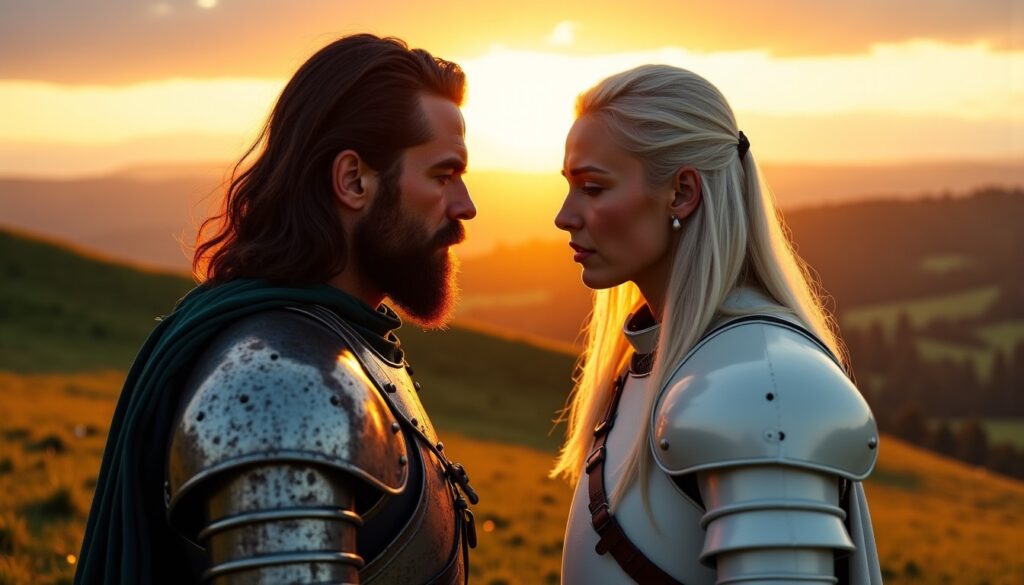
Berserk inaugurates a new significant phase for the rivalry between Guts and Griffith, which now unfolds with renewed depth. This evolution is based on several key elements revealed in recent chapters, notably:
- The revelation of Guts’ connection to the Interstice since his birth.
- The shift in Griffith’s relationship with the God Hand.
- A post-Miura narrative structuring orchestrated by Kouji Mori and his team.
These changes not only redefine the epic battle between the two iconic figures of the manga but also enrich the metaphysical and symbolic dimension of the story. This new era invites us to explore how Berserk’s dark fantasy renews itself by refocusing on a destiny that seems more cosmic than ever, while respecting the human tragedy at the heart of the saga.
A strengthened cosmic link: the Interstice and Guts’ nature
The publication of chapter 384 upended our understanding of Guts by stating that he has been connected to the Interstice, that astral universe playing a fundamental role in the world of Berserk, since his birth. This revelation radically changes the perception of his character, which goes beyond the simple figure of the warrior tormented by his rage and past.
Previously, Guts seemed to be a human with a tragic existence, facing supernatural enemies solely through the strength of his will. Today, he appears as a being intrinsically connected to a parallel dimension, which explains his ability to survive trials that few could endure. This cosmic link gives his fight an almost metaphysical scope, where it is no longer just a duel against Griffith or the dark forces, but a confrontation between two worlds or existential forces.
This perspective comes with a dual interpretation. Officially, the connection to the Interstice is now a confirmed narrative fact. For readers, it opens the way to re-reading past scenes in a new light, such as Guts’ ability to fend off death or rise after mortal wounds. The fact that he was “born” to fight in this liminal world accentuates the notion that his destiny is inevitable, but also extraordinarily powerful.
Take, for example, his fights against the apostles, where his endurance seems to defy natural laws. This endurance now takes on a new dimension: it is no longer simply due to a martial art or an extraordinary strength of character but to a rooting in an astral reality that interferes with the human one. This offers strong narrative leads for the future, where Guts could fully embody this duality between human and chosen of the Interstice.
Concretely, this change also prompts us to question his famous sword, now called the “Marked Warrior’s Sword.” This weapon, linked to his destiny, no longer becomes just an instrument of vengeance or anger, but a symbol on a cosmic scale, reinforcing his role as an emblematic figure of resistance in a universe where betrayal and fatality coexist.
Griffith and the God Hand: a questioning of divine power
Chapter 386 echoes this change by showing us a Griffith evolving in a context where the authority of the God Hand, these quasi-divine entities, is challenged. Since always, Griffith has been seen as the incarnation of perfect destiny, aiming his gaze toward a lofty ideal supported by the mystical backing of these supernatural forces.
The novelty lies in the palpable tension surrounding his position. The God Hand, long depicted as an immutable hierarchy, seem to experience internal friction, raising questions about the very stability of this power. Griffith, who has long presented himself as the almost infallible executive arm of this order, now appears faced with challenges where his role may shift.
This alteration of the dynamic between Griffith and the God Hand has a major impact on the rivalry with Guts. Not only does Griffith still embody betrayal and the rise toward an enigmatic destiny, but his power is now somewhat fragile, vulnerable to challenges. This fuels an unprecedented suspense: the battle between them would no longer be a predetermined confrontation but a struggle where the balance of power could tip one way or the other.
Griffith’s connection with Falconia, a fortified city and symbol of human power co-opted by the supernatural, illustrates this point. This city represents a kind of microcosm where politics, power, and the supernatural intertwine and where Griffith must maintain his authority in an unstable environment. This introduces debates on legitimacy and evolution of power in the world of Berserk, especially when confronted with Guts’ courage and fierce independence.
To measure the importance of this situation, we can compare the current rivalry to a more complex chess game, where each side must deal with shifting alliances and hidden forces, instead of a simple frontal duel. Griffith is now an actor situated in a multi-dimensional system, and this fragile balance nourishes new tension.
A post-Miura continuity that builds a solid narrative future
Since Kentaro Miura’s passing, the direction of Berserk has been managed by Kouji Mori and a team dedicated to preserving the spirit of the original work while opening new paths. This approach is expressed through a particular editorial rhythm, where each chapter becomes a true event, with spaced but content- and revelation-rich releases.
The switch to Mori’s supervision claims responsibility towards fans by maintaining narrative coherence while respecting the universe’s complexity. This context strongly influences the reading of recent chapters, all scrutinized in detail, giving rise to passionate discussions about the directions taken.
This new mode of publication opposes the Miura era’s more impulsive and irregular style, aiming instead for a more thoughtful tempo orchestrated in blocks. This structuring gives particular weight to each key moment, reinforcing the impression of witnessing essential turning points. Expectations are therefore high, showing how much the work remains a major reference in the manga and dark fantasy landscape.
To illustrate this transformation, we can mention the palpable difference in the story’s tension build-up, which now seems to head toward a clearly drawn climax, without scattering into superfluous digressions. The rivalry between Guts and Griffith is at the heart of this narrative focus, embodying both a legacy and a renewal, a guiding line where past and future merge.
This assumed continuity also guarantees that the series benefits from a more synthetic dimension where every element has its place. We witness a form of maturity in the narration, where the mythological character of Berserk’s universe is highlighted while remaining grounded in the characters’ psychology. This editorial choice gives new solidity to the work, reinforcing its status as a cult masterpiece capable of evolving without betraying its essence.
The Guts-Griffith rivalry under a renewed and metaphysical prism
Beyond the revelations, what strikes us in this new phase of Berserk is the way the fight between Guts and Griffith is enriched with a metaphysical dimension. The stake is no longer just a tragic face-off but a cosmic opposition between two structural forces of the universe.
Guts, the embodiment of a will forged in pain and resilience, now carries the duality of a man and an element tied to the depths of the Interstice. Griffith, for his part, has become the symbol of a divine power seeking balance, fragile despite his apparent supremacy. This new framework places their rivalry in a context where it carries the weight of a destiny that goes beyond the personal.
Fans can also see this evolution as the opening of a new trajectory, less predictable, where classical tragedy gives way to a struggle intertwining sacred symbols and human realities. Berserk’s dark fantasy is no longer simply a tale of confrontation between good and evil, but a universe where fatality and free will are intertwined in an even more complex way.
To illustrate this idea, we can refer to some recent passages where dialogues and scenes reveal tensions about control over destiny, individual responsibility, and choices facing cosmic fatality. This shakes up the usual representations of sword fighting and the lone hero, who now becomes a warrior marked by an interstitial destiny.
This direction will undoubtedly influence the manga’s finale, which seems to be taking shape. This perspective renews the very nature of the confrontation and questions the nature of antagonisms in a story where heroes are always marked by deep tragedy.
Key narrative and thematic stakes of Berserk’s new era
Finally, to understand how much the Guts-Griffith rivalry is part of a new era, it is useful to make a synthetic overview of the main elements structuring this narrative metamorphosis:
- Cosmic origin of Guts: the link with the Interstice opens a broader field of interpretation about his destiny and superhuman strength.
- Tensions within the God Hand hierarchy: Griffith is no longer the sole master; he must deal with other mysterious forces, which weakens his authority.
- Post-Miura editorial framework: Kouji Mori’s work sets a rhythm highlighting key moments, encouraging in-depth and thoughtful reading.
- Dramatic concentration: stakes no longer extend indefinitely; they focus around the rivalry, intensifying the story’s scope.
- Metaphysical dimension: the conflict rises to a cosmic level, mixing destiny, will, and human tragedy in an unstable balance.
| Aspect | Old Paradigm | New Era (After 2026) |
|---|---|---|
| Nature of Guts | Human warrior marked by tragedy | Being linked to the Interstice, quasi-cosmic |
| Position of Griffith | Invincible right hand of the God Hand | Faction among the God Hand, unstable hierarchy |
| Narrative pace | Intermittent publication, spontaneous rhythm | Spaced releases, progression in blocks |
| Central themes | Personal revenge and betrayal | Cosmic conflict and struggle for destiny |
| Resolution | Open, uncertain | Final phase underway, narrative convergence |
Thus, the series maintains its aura by masterfully combining its dark fantasy heritage with a deeper exploration of destiny and power notions. To fully enjoy this evolution, it may be useful to follow online analyses that constantly enrich the discussion, notably by tracking debates on dedicated platforms.
For those wishing to broaden their manga horizons, season 4 of Jujutsu Kaisen or season 2 of Off Campus offer diverse universes, just like more iconic series that continue to captivate audiences.