
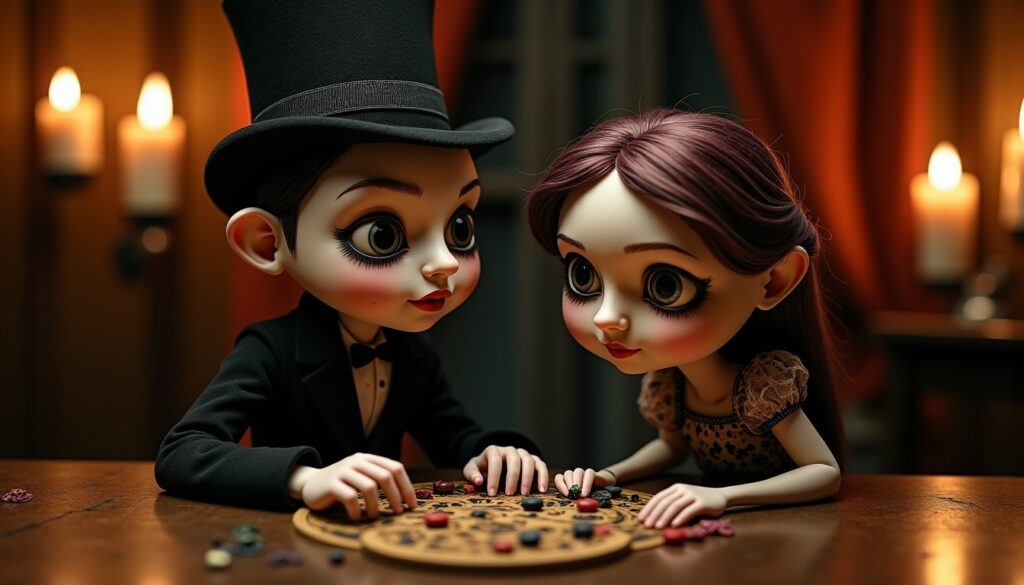
Out of Words is a cooperative game that captures our attention with its unique aesthetic and its singular universe shaped in stop-motion. This extraordinary creation, scheduled for 2026, plunges us into a captivating adventure where two players embody Kurt and Karla, searching for their lost voice in a gothic world full of mystery. Here is what we will explore:
- The intriguing setting and the dark atmosphere of the world of Vokabulantis.
- The artistic peculiarity of stop-motion, a source of visual charm and originality.
- The mechanics of local and online cooperative gameplay, designed to strengthen the connection between players.
- The striking parallel with the universe of Tim Burton and his poetic gothic style.
- The narrative and emotional journey offered by this immersive story.
Let us discover together why Out of Words positions itself as a must-play of the year and a cooperative experience that is at once playful, artistic, and touching.
The singular universe of Vokabulantis: a dive into a gothic world filled with poetry and mystery
Vokabulantis is not just a simple setting but a true character in its own right. This strange kingdom with a marked visual identity is the setting in which Kurt and Karla, our silent protagonists, evolve. Losing their voice becomes the central metaphor of the story, illustrating the fragility of human relationships and the necessity of genuine and sincere communication. The gothic atmosphere, melancholic while being rich in poetry, perfectly suits this emotional quest.
Varied environments, from ancient catacombs to clay skyscrapers, offer a visual and narrative texture uncommon in the video game universe. By crossing each stage, we are invited to an exploration both dreamlike and tactile, blending unease and beauty, often evoking the sense of wonder typical of films with a dark aesthetic.
This visual and thematic depth draws its roots from the collaboration with the poet Morten Søndergaard, who shaped the foundations of this story. His contribution underscores the desire to bring more than just a platformer game but a true artisanal work.
The richness of this world also gives it a mystical and mysterious dimension. Every corner of Vokabulantis seems to hold secrets to discover, enhancing the feeling of immersion and encouraging players to fully invest themselves in this adventure. The role of cooperative gameplay is essential in this approach, as it invites a continuous dialogue between the two players, an exchange that goes beyond simple game mechanics.
Let’s take a closer look at the qualities that define Vokabulantis:
- A gothic visual atmosphere: dark, dimly lit, paced by strong contrasts between shadow and light.
- A poetic narrative approach that embodies the characters’ emotions without using speech.
- An alternative setting that mixes natural elements and handcrafted architectural forms like clay shapes, reinforcing the handcrafted aspect.
- A tactile sensation enhanced by stop-motion, making us almost feel the textures.
As enthusiasts of games combining artistic depth and innovative gameplay, we find in Out of Words a universe that enriches the current scene, far from sanitized standards, where each image is crafted patiently for a complete sensory experience. This approach will surely attract lovers of adventures that are as much playful as contemplative, in search of strong emotions and a story full of nuances.
The unique charm of stop-motion: a visual craft at the heart of the experience
The major originality of Out of Words lies in its use of stop-motion, a rare technique in video games, which gives the title a unique visual signature. Each character, setting, and animation is handcrafted, photo by photo, to recreate a tangible, almost palpable universe. This artistic choice directly nurtures the gothic charm, reinforcing the distinctiveness of an adventure where the artisanal gesture is felt in every frame.
The difficulty of the process testifies to the passion of the Kong Orange and WiredFly teams. While traditional games exploit 3D engines in real time, here, each shot is the result of a long precise work blending patience and expertise. The imperfect surfaces, the slightly deformed volumes, help create a living universe, inhabited by a visual poetry both delicate and strange.
The stop-motion rendering is not limited to mere aesthetics: it becomes a vector of mystery and emotion. For example, in sequences where Kurt and Karla explore catacombs, frame-by-frame animation heightens tension and invites anxious wonder. The attention paid to materials like clay and other organic textures enhances the feeling of a world made of palpable memories and emotions frozen in time.
Some key elements illustrating the strength of stop-motion in Out of Words:
- A tangible rendering where every object seems sculpted by hand, giving real life to the settings.
- The depth of shadow and light games which accentuate the gothic side and the visual poetry.
- Sophisticated animation work to translate the characters’ emotions despite their silence.
- An harmony between gameplay and craftsmanship which gives a unique flavor to the gameplay and the story told.
We are far here from standardized and hyper-realistic productions. Moreover, this artisanal choice fits into a logic of quality over time, where uniqueness prevails over quantity. This approach is praised in the field of indie games and deserves attention, just like cooperative titles such as Monday Meltdown which innovate in style and duo experience.
Out of Words manages to combine technical rigor with visual magic, offering a visual spectacle like no other, whether for an informed audience or newcomers sensitive to the beauty of shapes and volumes. Far beyond simple animation, stop-motion becomes here a true artistic language that speaks to our emotions, carving a path for a game built to last in memory.
A cooperative game experience designed for the duo: from precise gameplay to sincere complicity
The central aspect of the Out of Words project is clearly its cooperative gameplay mode, exclusively designed for two players. The title offers no solo mode, putting collaboration, coordination, and listening at the heart of the experience. This strong direction relies on a demanding mechanic that poses physical puzzle challenges and platforming segments requiring perfect timing.
Players embody Kurt and Karla, friends tied by a common quest: to recover their voice in this mysterious world. This narrative framework translates into gameplay through sequences where each action by one has a direct impact on the other’s progress. Thus, gestural and tacit communication becomes a fundamental element, offering a strengthened proximity between partners.
The cooperative experience is available locally on a single screen as well as online with cross-platform support, allowing two players on PC, PlayStation 5, Xbox Series X/S, or Nintendo Switch 2 to share the same adventure, regardless of their machine. This technical flexibility fits into a desire for universality and accessibility while maintaining the game’s level of challenge.
We can identify several mechanics that make Out of Words a captivating cooperative experience:
- Coordination of complementary actions, for example simultaneously activating levers or combining abilities to overcome obstacles.
- Solving physical puzzles requiring joint thinking and manual precision.
- Perfect timing in platforming phases, where every jump counts to keep the rhythm.
- Constant exchange between players, translating narrative progression into a fine dance of understanding and sharing.
This precise sizing of the duo is a strength that avoids the dispersion found in other cooperative productions with more players. Here, the intensity of the relationship between players is highlighted, favoring immersion and deep complicity, an aspect rarely exploited so well. For ardent team play lovers, this positioning recalls the finesse of titles like Resident Evil 4 Remake in cooperation, honoring collaboration as a central pillar.
In short, Out of Words invites players to rediscover the pleasure of duo play in a setting where each player must listen and understand the other to progress together. This human and playful challenge is a strong promise of shared emotions and renewed cooperative pleasure.
The influences of Tim Burton on the game’s aesthetic and dark atmosphere
The graphic and sound universe of Out of Words finds clear resonances with the imagination of director Tim Burton, famous for his gothic and poetic approach tinged with black humor. Without fully adopting Burton’s heritage, the game strongly draws inspiration from it to create an atmosphere where the strange mixes with delicacy, where shadow and light converse to fabricate a setting both unsettling and fascinating.
The visual contrasts, the twisted silhouettes of the characters, and the settings evoking alternative worlds carry this very particular gothic charm. This parallel with Tim Burton becomes tangible in the very construction of Vokabulantis, a world inhabited as much by mystery as by poetry. The teams’ work on textures recalls films like The Nightmare Before Christmas or Dark Shadows, where animation and setting become an integral part of the story.
This dark atmosphere is amplified by the carefully orchestrated soundtrack and sound effects, heightening the sense of strangeness while remaining conducive to emotion. One feels the influence of this aesthetic in the way light plays on surfaces, creating variable atmospheres ranging from dreamy melancholy to deep unease.
Here are some characteristics that bring Out of Words closer to Tim Burton’s universe:
- Expressive silhouettes with original and slightly distorted shapes.
- A limited color palette favoring dark tones and shadow nuances.
- A balance between the sordid and the marvelous, creating a feeling of constant ambiguity.
- A visual narration privileging emotion through the unsaid and silence, reinforcing the mystery.
The charm of this gothic atmosphere also relies on attention to artisanal details, strengthening this feeling of fragile beauty where each element tells a story. This desire is essential to offer players a universe reflecting complex emotions, inscribed in a faceted and intense cooperative narrative. The alliance of video game, stop-motion, and Burtonian style thus forms an original experience capable of capturing attention durably and delighting both narrative lovers and visual arts enthusiasts.
This game fits into a current trend valuing atypical universes, as can be seen in some recent events dedicated to independent and original titles, including those presented at the Steam AAA Games Festival.
Narrative and emotional exploration: a cooperative adventure at the heart of a silent dialogue between two souls
The story of Out of Words is based on a seemingly simple but deeply profound quest: Kurt and Karla, two friends, must reclaim their voice in a world cut off from language. This loss symbolizes a lack of connection, and the narrative progression is built around both concrete and symbolic efforts to restore communication.
The game offers an immersive experience where every visual and sound element contributes to establishing an emotional tension conducive to reflection. Without words, it is the gestures, lights, and movements that tell a story, directly engaging our sensitivity. This narration through image and silence, at the border between video game and artisanal work, pushes the player to fully involve themselves in this intimate exchange.
The cooperative device amplifies this experience: playing as two, players are more invited to feel and then interpret together this story carried by mystery and ambient poetry. This mechanic revives the joy of playful sharing, immersed in an atmosphere both tender and disturbing.
Some keys to understanding this emotional journey:
- An experience based on silent dialogue between two players.
- A progression built around symbolic puzzles that reflect personal and relational reconciliation.
- A sound and visual universe that nurtures empathy, fostering total immersion.
- A renewed proposal of the game as a space for emotional expression, far from classical dialogues.
Thanks to these narrative choices and this staging, Out of Words already asserts itself as a distinctive experience, where collaborative gameplay makes sense, fitting into a lineage of ambitious video game works that combine emotion and cooperation to transcend the medium. Those wishing to immerse themselves in contrasting universes mixing immersive atmosphere and two-player challenges will find a rich proposition to savor on consoles and PC in 2026.