
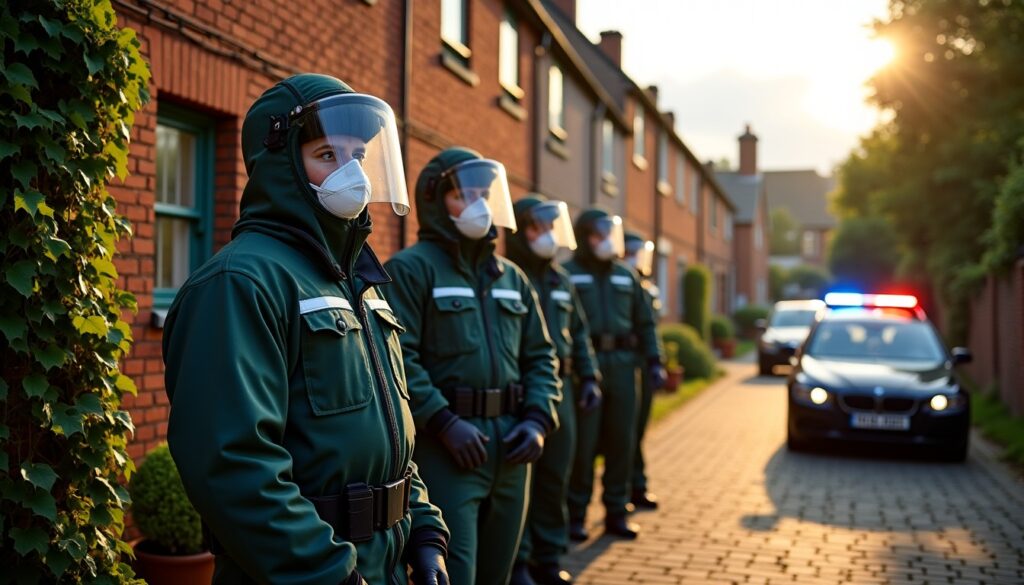
The series The Salisbury Poisonings establishes itself as a must-watch work for fans of intense dramas rooted in a disturbing reality. Inspired by a true event that took place in England in 2018, this captivating miniseries explores the Novichok poisoning, a fearsome neurotoxic agent, involving victims such as Sergei Skripal, his daughter Yulia, and several Salisbury residents. Available on Prime Video for several years, it deserves rediscovery in 2026, especially for its humane and measured treatment of a major health and diplomatic crisis. Here are the key aspects we will discuss in detail:
- The original and realistic approach of the series, far from the classic political thriller
- The intimate portrait of victims and local actors involved in crisis management
- The elements of investigation, toxicology, and suspense that fuel the narrative
- The parallel with the series Chernobyl that enhances the emotional depth
- The short and dense format, ideal for a binge-watching weekend that captivates without excess
We invite you to dive with us into these different dimensions to better understand why The Salisbury Poisonings is both a poignant and instructive series.
A realistic immersion into the Salisbury drama: between suspense and truth
The strength of The Salisbury Poisonings lies in its deeply reality-rooted approach, avoiding the clichés of the conventional political thriller. The plot opens with the Novichok poisoning of Sergei Skripal, former Russian double agent, and his daughter Yulia, on March 4, 2018 in Salisbury, England. This attack immediately triggers a worldwide diplomatic wave, with massive diplomat expulsions and palpable tension between nations. Yet, the series does not focus its narrative solely on this geopolitical context: it shifts attention to the local population itself, directly and dramatically affected.
We discover how the accidental contamination of police officer Nick Bailey during his intervention disrupts an entire town. Public exposure is not limited to the initially targeted victims. The tragic death of Dawn Sturgess, which occurred on July 8, 2018 after contact with a contaminated object, clearly illustrates the health and human scale of the incident. This narrative choice amplifies the tension, even though the viewer already knows the overall outcome: it is a disturbing suspense where the invisible — the poison — lurks and strikes at every moment.
We can summarize the key dates as follows:
| Date | Event |
|---|---|
| March 4, 2018 | Poisoning of the Skripals in Salisbury |
| Mid-March 2018 | Accidental exposure of police officer Nick Bailey |
| July 8, 2018 | Death of Dawn Sturgess, collateral victim |
| 2024 | Publication of a public inquiry on certain institutional failures |
From this perspective, the series brings a unique tension, based not on spectacular special effects but on a stripped-down realism, allowing the viewer to feel the anxiety of an invisible threat to the very end. The suspense does not come from a chase or political confrontation; it emanates from immediate human management, health doubts, and chain reactions that upset an entire community.
The everyday heroes: local actors and civilians at the heart of a toxic crisis
One of the most striking aspects of The Salisbury Poisonings is undoubtedly the choice to highlight ordinary protagonists rather than political figures or spies in suits. For example, the pivotal role of Tracy Daszkiewicz, local public health director portrayed by Anne-Marie Duff, reveals all the complexity and pressure faced by those who must manage such exceptional scenarios.
Through her perspective, we discover the multiple facets of managing a toxic disaster: coordinating decontamination operations, communicating to the public, handling media and diplomatic stress, not to mention the human and emotional impact. This approach, in its sobriety, recalls Chernobyl, which also chose a narrative close to the men and women directly involved rather than purely political spheres.
In parallel, the story closely follows the trajectory of Nick Bailey, a police officer exposed to the poison. Portrayed with intensity by Rafe Spall, his character undergoes severe symptoms, ranging from loss of consciousness to deep distress affecting his family and daily life. This very human portrayal reduces the usual distance between viewer and victim, immersing us in a powerful sensory and emotional experience.
Finally, the figure of Dawn Sturgess, played by MyAnna Buring, demonstrates the extent of collateral damage. Her death illustrates that the threat far exceeds the initial target and plunges the community into a collective ordeal that the series makes tangible.
Here are some salient features of this human focus:
- A narrative that favors closeness with victims and local responders
- A realistic and unexaggerated representation of daily stress and fears
- Attention to medical details and toxicology, for full immersion
- An illustration of the emotional weight of events on families and the community
The viewer is therefore not only informed but invited to feel the fragility of lives disrupted by an invisible and insidious contamination.
The investigative and toxicological stakes underpinning a breathless suspense
Beyond its human aspect, The Salisbury Poisonings unfolds a precise and layered plot around several joint investigations. From the first moments, the attention to toxicology is evident, with detailed scenes illustrating the detection, diagnosis, and treatment of Novichok poisoning. These elements reinforce the scientific credibility of the narrative and enable engagement in a particular suspense, especially since the poison used is both ultra-powerful and little known to the general public.
The police investigation adds to this tension. Nick Bailey’s intervention, contamination, and consequences open a new inquiry, initially less visible to central authorities, but which must take into account the dangers for ordinary citizens. For example, the late discovery of contaminated objects contributes to growing uncertainty within the population and local authorities. The delayed reaction of British institutions, highlighted by the 2024 public report, underlines the difficulties in reconciling health emergency, state secrecy, and political management.
The suspense is also fueled by a moral questioning posed by the series:
- How does a community react when a deadly poison spreads inadvertently?
- What are the compromises between public safety and transparency?
- How to protect the population without causing uncontrollable panic?
These questions are embodied in the character of Tracy Daszkiewicz, overwhelmed but determined, who offers a realistic view of the difficulty in acting quickly and effectively.
Thus, we find a story structured around three complementary axes that gradually build relentless tension:
- The police and toxicological investigation into the origin and consequences of the poison
- Local management of the health crisis
- The diplomatic stakes in the background, never overshadowing the human drama
A striking parallel with Chernobyl: the power of a sober and potent human drama
Critics have regularly compared The Salisbury Poisonings to the famous series Chernobyl for several deep reasons. On the one hand, for their ability to address a recent disaster with rigorous documentary concern, and on the other hand, for a narrative construction that favors the portrait of local actors rather than a purely political or technological vision.
Both expose contamination dramas — chemical or nuclear — where the invisible represents the main threat. The British series offers meticulous attention to toxicology details, decontamination measures, and the disrupted daily life of exposed people. The powerful realism of this approach creates an immersive atmosphere, where the viewer shares the diffuse anxiety and growing mistrust within a population confronted with a silent danger.
The parallel with Chernobyl does not end there: it continues in the implicit critique of institutions. The series shows without excessive emphasis how authorities sometimes delayed transmitting information, coordinating prevention effectively, and reassuring the public. This choice underscores that the real disaster is not only the poisoning itself but also the human consequences of sometimes hesitant management.
A key point illustrating this proximity:
| Aspect | The Salisbury Poisonings | Chernobyl |
|---|---|---|
| Nature of the threat | Novichok neurotoxic agent | Nuclear accident |
| Narrative focus | Local population and responders | Technicians and local authorities |
| Human dimension | Ordinary victims and families | Workers and exposed inhabitants |
| Institutional critique | Communication and delayed management | Lack of initial transparency |
This comparison reaffirms the quality of the drama in its sober treatment, avoiding any spectacular excess. The viewer is invited to observe singular stories in a heavy historical context, which gives the series its powerful authenticity.
A condensed and incisive format for an exciting binge-watching weekend
The Salisbury Poisonings is presented in the form of a miniseries of only three episodes, totaling about three hours. This short format is a real asset, offering a sustained and controlled pace without unnecessary digressions. Every scene is designed to serve the precise representation of events, maximizing immersion and tension.
This editorial choice favors perfect binge-watching for a weekend, allowing the viewer to fully enter the story and feel all its emotional impact without unnecessary interruption. Moreover, the absence of cumbersome subplots guarantees strong narrative linearity, focused on the core drama.
The key stages of this format:
- Quick introduction of the event and major characters
- Progressive development of the health and human crisis in Salisbury
- Final confrontation with the most tragic consequences and institutional assessment
In parallel, the series benefits from renewed relevance thanks to the 2024 public inquiry, which highlighted certain government management failures. This context gives the series additional weight, reinforcing its notable interest in the landscape of dramatized documentaries.
We could summarize the success of the format as follows:
| Criterion | Contribution |
|---|---|
| Total duration | ≈ 3 hours, conducive to binge watching |
| Number of episodes | 3, avoiding digressions |
| Focus | Human story and local management |
| Emotional impact | Strong, lasting, and authentic |
For fans of stories rooted in recent history and thrilling investigations, this series represents a meditative impulse on the vulnerability of societies facing chemical stakes, as well as a reminder of the power of human resilience.